


Tuition can make a real difference, but timing matters. Start too late and your child spends the year catching up. Start without a reason and you pay for lessons nobody needs. This guide walks through the five moments Singapore parents most often start tuition, from P1 to JC1, and what to do if you have already passed them.
Short answer
The best time to start tuition is when you spot a real signal, not when your child reaches a set age. Signals include a slipping subject, an upcoming PSLE, SEC or A-Level exam, a move into Sec 1 or JC1, or a long school holiday. In primary school, start while a gap is still small. In secondary school, start by Sec 3. In JC, start in JC1, not weeks before the A-Levels.
Not sure yet whether your child needs help at all? Start with our guide to the signs in primary school that a tutor would help, then come back here to choose the timing.
When should we start PSLE preparation?
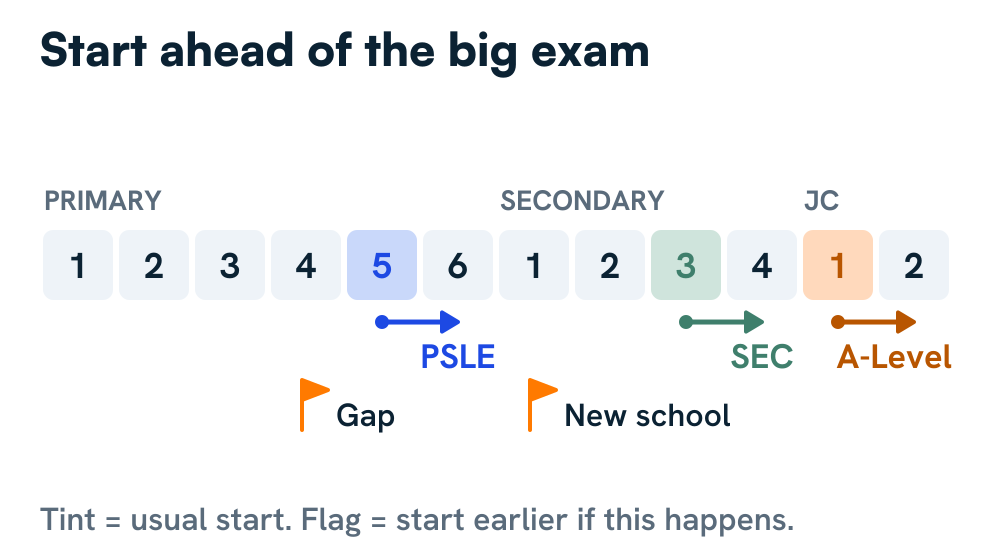
For most children, start focused PSLE preparation in P5, and no later than the start of P6. If a gap is already showing in maths or English, start in P4. The PSLE is sat at the end of P6, and each subject is graded from AL1 (best) to AL8. The four subject scores add up to a PSLE Score from 4 to 32, so one weak subject can pull the whole score down. Starting in P5 gives a tutor time to find the weak topics, teach them properly and then move on to timed practice in P6, without cramming.
Starting in the last few weeks before the exam rarely changes the result. Starting two terms out usually does. A good tutor also teaches the skills around the content: how to plan time in the paper, how to check working and how to stay calm on the day. If your child is already anxious, read our guide on how to help your child manage exam stress. To see how lessons are planned around the P6 papers, visit our PSLE tuition page.
How early should we start tuition before the SEC, O-Levels or A-Levels?
Start at the beginning of Sec 3 for the SEC or O-Levels, and at the beginning of JC1 for the A-Levels. Both are two-year courses, so the content your child is examined on starts on day one of Sec 3 or JC1. If your child is already partway through, aim for at least six months before the papers. That gives a tutor time to fix weak topics, build study habits and run timed practice before the pressure peaks.
From 2027, the O-Level and N-Level papers combine into a single exam, the Singapore-Cambridge Secondary Education Certificate (SEC), according to the Singapore Examinations and Assessment Board. 2026 is the last year of the separate O-Level and N-Level papers. Students in Sec 3 now will sit the SEC, so tuition should follow the SEC syllabus for each subject. Our SEC and O-Level tuition covers both.
For JC students, H2 subjects move quickly and the A-Levels come at the end of JC2. Students who start A-Level tuition in JC1 build each topic once, properly, instead of relearning it in a rush before the promotional exams or the A-Levels.
Should my child start tuition at P1, Sec 1 or JC1?
These three transitions are some of the best moments to start, because the work changes suddenly at each one. New subjects appear, the pace picks up and study habits that worked the year before stop working. Tuition during these years helps with the content and with the habits around it: organising notes, managing time and knowing when to ask for help.
P1: most children do not need tuition just because they have started school. If your child is struggling with reading or early number sense, a short weekly lesson closes the gap fast, before it carries into P2 and P3.
Sec 1: this is the biggest jump. Your child moves to a new school, has a different teacher for each subject and takes subjects at G1, G2 or G3 under Full Subject-Based Banding. Sec 1 tuition in the first term means your child settles in with a head start, not a gap.
JC1: the step from secondary school to H1 and H2 subjects is steep, and the A-Levels are less than two years away. Starting in the first term of JC1 matters more than any other time in JC.
Are the school holidays a good time to start tuition?
Yes. The year-end holidays and the June holidays are two of the best windows to start. According to the MOE school calendar, the 2026 June holidays run from 30 May to 28 June, and the year-end holidays run from 21 November to 31 December. Long breaks are when skills slip most, especially in maths and English, and they are also the calmest time to fix a gap.
A light schedule of one lesson a week keeps maths and English skills warm, so your child goes back to school in January ready, not rusty. There are no homework deadlines and no tests, which leaves space to fix the topic that caused trouble all year or to get ahead on next year's work. For a Sec 4 student, the June holidays are also the last long stretch to revise before the national exams.
Should my child have tuition all year round?
For most families, yes, even at one lesson a week. Students who have steady tuition through the year usually build more confidence and more consistent results than students who start and stop around whichever exam is closest. A good tutor builds a personalised plan, keeps track of what is working and adjusts as your child improves.
Consistent tuition also builds the habit of independent learning. Over time, a good tutor steps back and the student takes over. By upper secondary, many students need less tuition, not more, because the study habits and the confidence to ask questions are now their own. To see who teaches with Tutero, browse our Singapore-based tutors.
Related reading
So when is the right time to start tuition?
Whenever you spot a real signal, and the earlier you act on it, the bigger the difference. Whether your child needs help with a weak subject, preparation for the PSLE, SEC or A-Levels, support through Sec 1 or JC1, or a steady routine over the holidays, it is almost never too late to start. Pick the next transition point or holiday and begin there.
For more on choosing the right format, read our comparison of online vs home tuition.
Ready to find the right tutor for your child? Tutero matches Singapore families with Singapore-based tutors for 1-to-1 online tuition from P1 to JC, from S$65 an hour at every level. You pay after each lesson, with no contracts and no sign-up fee. See the full tuition rates.
Tuition can make a real difference, but timing matters. Start too late and your child spends the year catching up. Start without a reason and you pay for lessons nobody needs. This guide walks through the five moments Singapore parents most often start tuition, from P1 to JC1, and what to do if you have already passed them.
Short answer
The best time to start tuition is when you spot a real signal, not when your child reaches a set age. Signals include a slipping subject, an upcoming PSLE, SEC or A-Level exam, a move into Sec 1 or JC1, or a long school holiday. In primary school, start while a gap is still small. In secondary school, start by Sec 3. In JC, start in JC1, not weeks before the A-Levels.
Not sure yet whether your child needs help at all? Start with our guide to the signs in primary school that a tutor would help, then come back here to choose the timing.
When should we start PSLE preparation?
For most children, start focused PSLE preparation in P5, and no later than the start of P6. If a gap is already showing in maths or English, start in P4. The PSLE is sat at the end of P6, and each subject is graded from AL1 (best) to AL8. The four subject scores add up to a PSLE Score from 4 to 32, so one weak subject can pull the whole score down. Starting in P5 gives a tutor time to find the weak topics, teach them properly and then move on to timed practice in P6, without cramming.
Starting in the last few weeks before the exam rarely changes the result. Starting two terms out usually does. A good tutor also teaches the skills around the content: how to plan time in the paper, how to check working and how to stay calm on the day. If your child is already anxious, read our guide on how to help your child manage exam stress. To see how lessons are planned around the P6 papers, visit our PSLE tuition page.
How early should we start tuition before the SEC, O-Levels or A-Levels?
Start at the beginning of Sec 3 for the SEC or O-Levels, and at the beginning of JC1 for the A-Levels. Both are two-year courses, so the content your child is examined on starts on day one of Sec 3 or JC1. If your child is already partway through, aim for at least six months before the papers. That gives a tutor time to fix weak topics, build study habits and run timed practice before the pressure peaks.
From 2027, the O-Level and N-Level papers combine into a single exam, the Singapore-Cambridge Secondary Education Certificate (SEC), according to the Singapore Examinations and Assessment Board. 2026 is the last year of the separate O-Level and N-Level papers. Students in Sec 3 now will sit the SEC, so tuition should follow the SEC syllabus for each subject. Our SEC and O-Level tuition covers both.
For JC students, H2 subjects move quickly and the A-Levels come at the end of JC2. Students who start A-Level tuition in JC1 build each topic once, properly, instead of relearning it in a rush before the promotional exams or the A-Levels.
Should my child start tuition at P1, Sec 1 or JC1?
These three transitions are some of the best moments to start, because the work changes suddenly at each one. New subjects appear, the pace picks up and study habits that worked the year before stop working. Tuition during these years helps with the content and with the habits around it: organising notes, managing time and knowing when to ask for help.
P1: most children do not need tuition just because they have started school. If your child is struggling with reading or early number sense, a short weekly lesson closes the gap fast, before it carries into P2 and P3.
Sec 1: this is the biggest jump. Your child moves to a new school, has a different teacher for each subject and takes subjects at G1, G2 or G3 under Full Subject-Based Banding. Sec 1 tuition in the first term means your child settles in with a head start, not a gap.
JC1: the step from secondary school to H1 and H2 subjects is steep, and the A-Levels are less than two years away. Starting in the first term of JC1 matters more than any other time in JC.
Are the school holidays a good time to start tuition?
Yes. The year-end holidays and the June holidays are two of the best windows to start. According to the MOE school calendar, the 2026 June holidays run from 30 May to 28 June, and the year-end holidays run from 21 November to 31 December. Long breaks are when skills slip most, especially in maths and English, and they are also the calmest time to fix a gap.
A light schedule of one lesson a week keeps maths and English skills warm, so your child goes back to school in January ready, not rusty. There are no homework deadlines and no tests, which leaves space to fix the topic that caused trouble all year or to get ahead on next year's work. For a Sec 4 student, the June holidays are also the last long stretch to revise before the national exams.
Should my child have tuition all year round?
For most families, yes, even at one lesson a week. Students who have steady tuition through the year usually build more confidence and more consistent results than students who start and stop around whichever exam is closest. A good tutor builds a personalised plan, keeps track of what is working and adjusts as your child improves.
Consistent tuition also builds the habit of independent learning. Over time, a good tutor steps back and the student takes over. By upper secondary, many students need less tuition, not more, because the study habits and the confidence to ask questions are now their own. To see who teaches with Tutero, browse our Singapore-based tutors.
Related reading
So when is the right time to start tuition?
Whenever you spot a real signal, and the earlier you act on it, the bigger the difference. Whether your child needs help with a weak subject, preparation for the PSLE, SEC or A-Levels, support through Sec 1 or JC1, or a steady routine over the holidays, it is almost never too late to start. Pick the next transition point or holiday and begin there.
For more on choosing the right format, read our comparison of online vs home tuition.
Ready to find the right tutor for your child? Tutero matches Singapore families with Singapore-based tutors for 1-to-1 online tuition from P1 to JC, from S$65 an hour at every level. You pay after each lesson, with no contracts and no sign-up fee. See the full tuition rates.


For most children, P5 is the right time to start focused PSLE preparation, and no later than the start of P6. If a gap is already showing in maths or English, start in P4. That gives a tutor time to rebuild weak topics before moving on to timed practice in P6.
Not if there is a clear sign, such as trouble with reading or early number work. Most P1 children do not need tuition just because school has started. If your child is struggling, a short weekly lesson is usually enough to close the gap before it carries into P2 and P3.
It helps to start in the first term of Sec 1, or in the year-end holidays just before it. Sec 1 brings a new school, more subjects and a different teacher for each one. Starting early means your child settles in with a head start rather than a gap.
No. Starting in Sec 3 is ideal because the SEC and O-Level content runs over two years, but tuition in Sec 4 still helps when it focuses on the specific subjects and topics holding your child back. Aim for at least six months before the papers if you can.
Yes, the June holidays are one of the best windows to start or keep up tuition. In 2026 they run from 30 May to 28 June. One lesson a week keeps skills from slipping, and for Sec 4 and JC2 students it is the last long break to revise before the national exams.
Ideally, start at the beginning of JC1, which is almost two years before the A-Levels. If your child is already in JC2, start at least six months before the papers. That leaves time to fix weak H2 topics and run timed practice without cramming.
Hoping to improve confidence & grades?


