


Quick answer: Most primary school children do not need tuition, but a clear set of signs tells you when it would help. If your child takes over 45 minutes on homework that should take 20 in P2 to P4, avoids maths or reading at home, or comes home saying they are "stupid", those are early warnings. Two or more signs lasting longer than a school term is the point to act. A good primary school tutor finds exactly which basic skill is missing and rebuilds it before the gap widens.
How do I know if my primary school child needs tuition?
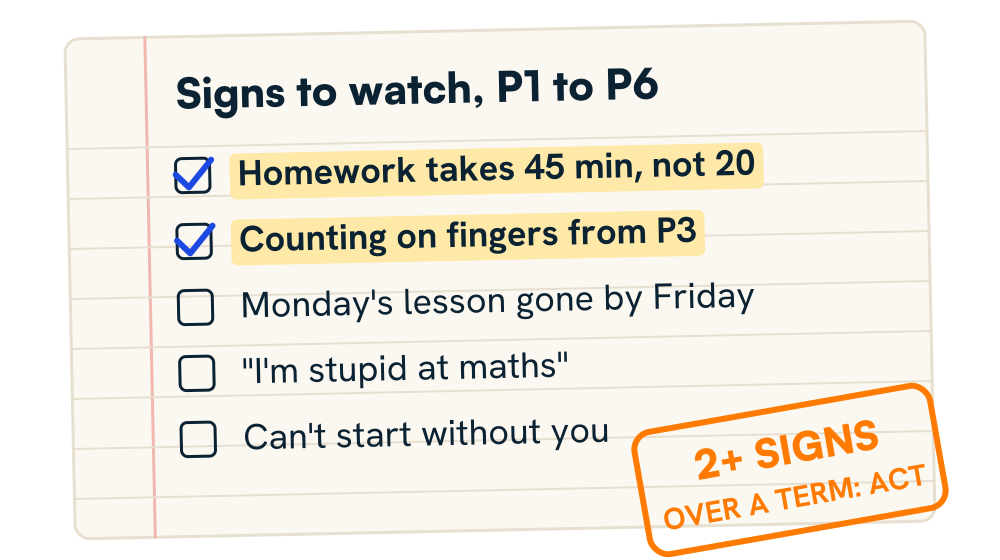
The clearest signs fall into three groups: academic patterns, emotional and behavioural changes, and what teachers tell you (and what they politely leave out). Most parents notice the emotional signs first and connect them to the academic ones later, by which point the gap has been growing for a term or two. One sign on its own is usually a normal rough patch. Two or more, lasting longer than a school term, is the signal to act.
Academic warning signs
The most reliable academic warning signs are concrete and easy to measure at home:
- Homework regularly takes more than 45 minutes in P2 to P4 when it should take 20. Your child is not being slow. They are relearning ideas they should already have, instead of using them.
- Counting on fingers for basic number facts in P3 and beyond. Multiplication tables and single-digit addition should come from memory by the middle of primary school. A child still counting on fingers tires out on the basics before they reach the problem sum, a clear sign they need primary maths tuition on the foundations.
- Reading fluency stalls for more than one school term. Slow reading drags down every subject, because the effort of working out each word leaves nothing for understanding. Watch for guessing words from the first letter or the picture instead of sounding them out. English tuition that rebuilds phonics and comprehension fixes this at the root.
- Skills learned on Monday are forgotten by Friday. The new idea has nothing solid to attach to, because an earlier step is missing. Marks that stay low across a whole term despite real effort are a stronger signal than any single bad week.
- Your child cannot get through homework without you. Younger children asking for help is normal. The flag is a P4, P5 or P6 child who cannot start, continue or finish without you sitting beside them. That usually means a missing concept, not missing motivation. Try stepping back: "Have a go at the first one yourself, then I'll come back." If that keeps failing, building that independence is exactly a tutor's job.
Emotional and behavioural warning signs
Most parents notice the behaviour first. The cause is usually a gap in the schoolwork.
- "I hate maths" or "I'm stupid at English." When a child labels themselves as bad at a subject, they are usually hiding a gap in the basics. They have decided that they are the problem, when the real problem is a missing concept no one has spotted. Confidence drops before marks drop.
- Avoiding homework or certain subjects. Tantrums, shutdowns, "I left it in school", a sudden interest in anything else. Refusing schoolwork is rarely defiance. It is almost always a child trying to escape feeling stupid.
- A sudden loss of interest in school. A child who used to chat about their day goes quiet when school comes up. This usually sits on top of something else: boredom (they are ahead and not stretched), frustration (they are behind and embarrassed) or overwhelm (the volume of work has tipped over). Ask which it is, then set small goals, like one page of practice tonight, and praise each one.
- Focus problems that vanish in front of a tablet. Many "focus issues" in class are avoidance of hard work, not attention difficulties. A child who can play a game for an hour but cannot sit through ten minutes of reading is often protecting themselves from overload. Real attention concerns are worth raising with a paediatrician. Avoidance of schoolwork is worth raising with a tutor.
- Sunday-night dread. If your child turns withdrawn or anxious on Sunday evenings, school is causing stress. Primary school children should not dread Monday mornings.
Teacher feedback warning signs
Your child's form teacher sees them alongside a full class of children the same age, so they often notice a gap before you do. But teachers tend to use gentle wording, so the most important signals arrive as polite suggestions:
- "Would benefit from more practice" in the report book usually means your child is clearly behind and the teacher has run out of options in class.
- The same concern in two report books in a row is a serious signal. One term can be a rough patch. Two terms is a pattern.
- A teacher raising tuition unprompted at a Parent-Teacher Meeting is rare and worth acting on. Teachers do not suggest it lightly.
Whatever the teacher says, ask one specific question: "Which two or three skills should we work on first?" That short list is the brief you would give a tutor.
Does my child need tuition in Primary 1?
Usually not. P1 is a big change, and most children need a term or two to settle into longer days, new routines and a bigger class. Small struggles in the first months often fade on their own. MOE has also removed all weighted assessments and examinations for P1 and P2 since 2019, and schools report learning at these levels with qualitative descriptors instead of marks, so there is no exam to prepare for.
Primary 1 tuition is worth considering when a sign lasts beyond the first two terms:
- Your child still cannot sound out simple words or recognise common sight words by the middle of the year.
- Counting and simple adding within 20 still need objects or fingers every time.
- The teacher raises the same concern at two meetings in a row.
- Your child is upset about going to school most mornings, not just in the first few weeks.
If you do start in P1, keep it light: 30-minute lessons, once a week, with a parent nearby for the first few. The goal is confidence with reading and numbers, not getting ahead. For more on timing, read when to start tuition.
Why do primary school students fall behind?
Primary school is the foundation for every subject your child will take. The MOE syllabus builds step by step, so a concept missed in P2 affects related concepts in P3 and beyond. Maths is the clearest example. Without secure place value, fractions, decimals and the model method all become shaky. Reading works the same way. Without secure phonics, comprehension stalls.
This is not about a child being unable to learn. Children learn at different speeds, and a specific gap needs specific help. Gaps that persist and widen in the early years are a real warning sign. They rarely close on their own, and they get harder to close the longer they are left.
Timing matters more in P4. At the end of P4, the school recommends a subject combination for P5 and P6 based on your child's school exam results, and children can take a mix of standard and foundation subjects in English, Mother Tongue, Maths and Science. In P6, each PSLE subject is scored from AL1 to AL8, and the PSLE Score ranges from 4 to 32. Closing a gap in P3 or P4 is far easier than in the PSLE year.
How much does primary school tuition cost in Singapore?
Rates vary widely in Singapore depending on the tutor's experience and how lessons are arranged. At Tutero, 1-to-1 tuition is from S$65 an hour, or from S$75 an hour for a qualified teacher. The rate is the same from P1 to P6, and the same again at Secondary and JC. What changes by level is the lesson, not the price.
For a typical routine of one 1-hour lesson a week, ten weekly lessons cost from S$650, or from S$750 with a qualified teacher. You pay after each lesson. There are no contracts, no sign-up fee, and you can cancel any time. See Tutero's tuition rates for the full details, or read our guide to how much maths tuition costs in Singapore for the wider market range.
Is one hour of tuition a week enough for primary school?
Yes, for most primary school children. One focused hour of 1-to-1 tuition a week is usually enough to close a typical gap, as long as the tutor targets the right skill and your child does a little practice between lessons.
When to consider two lessons a week:
- Deeper gaps, more than two terms behind
- PSLE preparation under time pressure in P6
- A child who is falling behind in more than one subject
The first four lessons matter most. That is when most parents see a change in confidence, and it is a good early sign that the tuition will work. Trying to "make up time" with three lessons a week often leads to burnout at primary age. One focused lesson a week, short practice in between, then the next lesson, works better than cramming.
Can a primary school tutor help with dyslexia or learning differences?
Yes, often very well, but it has to be the right tutor. The Dyslexia Association of Singapore estimates that about 30% of learners will find learning challenging and need additional support. Many children with dyslexia also have related difficulties, such as with numbers, attention or processing speed. A tutor without relevant experience can make these children feel worse, not better.
What to look for:
- A tutor experienced with the specific learning difference your child has
- A structured, step-by-step approach to reading and spelling, not just "I'll go through the homework"
- Patience with the slower pace many children with dyslexia need
Tutero can match your child with a tutor experienced with dyslexia and other learning differences. See our page on dyslexia tuition, or read our guide to common learning differences.
Important: a tutor is not a substitute for a formal assessment if you suspect a learning difference. If your child shows persistent signs, an assessment by an educational psychologist will tell you what you are working with, and a good tutor builds on those findings.
How do you choose the right primary school tutor?
Choosing a tutor is choosing a relationship. Get it right and your child often re-engages with school within a term. Get it wrong and you reinforce the message that learning is hard.
Qualifications and MOE syllabus alignment
At minimum, look for solid experience teaching the MOE syllabus at primary level, including the model method in maths and PSLE-style English and Science questions, plus experience teaching one child at a time. Classroom experience does not transfer cleanly. Teaching one child at their level is a different skill from running a whole class.
Ask directly: how will you find out where my child is struggling? A good tutor has a clear answer, such as a short set of questions at the start, not "I'll see how the first lesson goes".
One-to-one vs group; home vs online
For closing a specific gap, 1-to-1 is clearly more effective than group tuition. Group classes at a tuition centre suit enrichment or exam practice where every student is at about the same level. They do not suit a child with a particular gap, because the tutor has to teach to the middle of the room.
For primary school children, online 1-to-1 tuition works as well as home tuition when the lesson is built for live interaction: a shared whiteboard, screen sharing and the tutor seeing your child's working in real time. For younger children, keep lessons shorter and stay nearby for the first few.
How to judge the first lesson
The first lesson is your real signal, more than the credentials or the price. Watch for:
- Did the tutor ask questions to find the gap before teaching?
- Did your child engage, or shut down?
- When your child was stuck, did the tutor explain it a different way, or repeat the same explanation two or three times?
If your child says "I don't want to do that again", trust it. If they ask "Can I do that again?", you have found the tutor.
What happens in a primary school tuition lesson?
A good primary school tuition lesson follows a predictable shape:
| Phase | Time | What the tutor does |
|---|---|---|
| Check-in | 5 to 10 min | Checks where your child is on the specific skill being targeted, with quick questions or a short task. |
| Targeted teaching | About 30 min | Teaches the missing concept directly, works through examples, then guides practice. |
| Independent practice | 10 to 15 min | Your child applies what they have just learned without prompting. This is the only way to know whether the idea has landed. |
Between lessons: short independent practice on the specific skill, 10 to 15 minutes a day and no more at primary age, plus a clear note for you on what was covered and what to watch for at home.
Related reading
How does Tutero approach primary school tuition?
We do not believe in generic tuition. Early help only works when it is precise.
Tutero offers PSLE tuition from P1 to P6, following the MOE syllabus, with Singapore-based tutors who are ID-verified and have signed a declaration. Your child is matched with a tutor whose experience fits the gap, whether that is P3 fractions, P5 Science or PSLE English composition.
1-to-1 tuition with the right tutor lets them correct a misunderstanding the moment it shows up, which is the fastest way to make real progress in the primary years. Lessons are from S$65 an hour, the same at every level. You pay after each lesson, with no contracts and no sign-up fee.
The pattern to look for: your child starts to enjoy learning again within the first few lessons, and report book comments begin to change over the following term or two. Confidence comes back first. Better marks follow.
Ready to find a primary school tutor for your child?
If you recognised your child in two or more of the signs above, now is a good time to act. Gaps are much easier to close in primary school than in secondary. Tell us about your child and we will match them with a Singapore-based tutor for 1-to-1 tuition that fits their level.
Quick answer: Most primary school children do not need tuition, but a clear set of signs tells you when it would help. If your child takes over 45 minutes on homework that should take 20 in P2 to P4, avoids maths or reading at home, or comes home saying they are "stupid", those are early warnings. Two or more signs lasting longer than a school term is the point to act. A good primary school tutor finds exactly which basic skill is missing and rebuilds it before the gap widens.
How do I know if my primary school child needs tuition?
The clearest signs fall into three groups: academic patterns, emotional and behavioural changes, and what teachers tell you (and what they politely leave out). Most parents notice the emotional signs first and connect them to the academic ones later, by which point the gap has been growing for a term or two. One sign on its own is usually a normal rough patch. Two or more, lasting longer than a school term, is the signal to act.
Academic warning signs
The most reliable academic warning signs are concrete and easy to measure at home:
- Homework regularly takes more than 45 minutes in P2 to P4 when it should take 20. Your child is not being slow. They are relearning ideas they should already have, instead of using them.
- Counting on fingers for basic number facts in P3 and beyond. Multiplication tables and single-digit addition should come from memory by the middle of primary school. A child still counting on fingers tires out on the basics before they reach the problem sum, a clear sign they need primary maths tuition on the foundations.
- Reading fluency stalls for more than one school term. Slow reading drags down every subject, because the effort of working out each word leaves nothing for understanding. Watch for guessing words from the first letter or the picture instead of sounding them out. English tuition that rebuilds phonics and comprehension fixes this at the root.
- Skills learned on Monday are forgotten by Friday. The new idea has nothing solid to attach to, because an earlier step is missing. Marks that stay low across a whole term despite real effort are a stronger signal than any single bad week.
- Your child cannot get through homework without you. Younger children asking for help is normal. The flag is a P4, P5 or P6 child who cannot start, continue or finish without you sitting beside them. That usually means a missing concept, not missing motivation. Try stepping back: "Have a go at the first one yourself, then I'll come back." If that keeps failing, building that independence is exactly a tutor's job.
Emotional and behavioural warning signs
Most parents notice the behaviour first. The cause is usually a gap in the schoolwork.
- "I hate maths" or "I'm stupid at English." When a child labels themselves as bad at a subject, they are usually hiding a gap in the basics. They have decided that they are the problem, when the real problem is a missing concept no one has spotted. Confidence drops before marks drop.
- Avoiding homework or certain subjects. Tantrums, shutdowns, "I left it in school", a sudden interest in anything else. Refusing schoolwork is rarely defiance. It is almost always a child trying to escape feeling stupid.
- A sudden loss of interest in school. A child who used to chat about their day goes quiet when school comes up. This usually sits on top of something else: boredom (they are ahead and not stretched), frustration (they are behind and embarrassed) or overwhelm (the volume of work has tipped over). Ask which it is, then set small goals, like one page of practice tonight, and praise each one.
- Focus problems that vanish in front of a tablet. Many "focus issues" in class are avoidance of hard work, not attention difficulties. A child who can play a game for an hour but cannot sit through ten minutes of reading is often protecting themselves from overload. Real attention concerns are worth raising with a paediatrician. Avoidance of schoolwork is worth raising with a tutor.
- Sunday-night dread. If your child turns withdrawn or anxious on Sunday evenings, school is causing stress. Primary school children should not dread Monday mornings.
Teacher feedback warning signs
Your child's form teacher sees them alongside a full class of children the same age, so they often notice a gap before you do. But teachers tend to use gentle wording, so the most important signals arrive as polite suggestions:
- "Would benefit from more practice" in the report book usually means your child is clearly behind and the teacher has run out of options in class.
- The same concern in two report books in a row is a serious signal. One term can be a rough patch. Two terms is a pattern.
- A teacher raising tuition unprompted at a Parent-Teacher Meeting is rare and worth acting on. Teachers do not suggest it lightly.
Whatever the teacher says, ask one specific question: "Which two or three skills should we work on first?" That short list is the brief you would give a tutor.
Does my child need tuition in Primary 1?
Usually not. P1 is a big change, and most children need a term or two to settle into longer days, new routines and a bigger class. Small struggles in the first months often fade on their own. MOE has also removed all weighted assessments and examinations for P1 and P2 since 2019, and schools report learning at these levels with qualitative descriptors instead of marks, so there is no exam to prepare for.
Primary 1 tuition is worth considering when a sign lasts beyond the first two terms:
- Your child still cannot sound out simple words or recognise common sight words by the middle of the year.
- Counting and simple adding within 20 still need objects or fingers every time.
- The teacher raises the same concern at two meetings in a row.
- Your child is upset about going to school most mornings, not just in the first few weeks.
If you do start in P1, keep it light: 30-minute lessons, once a week, with a parent nearby for the first few. The goal is confidence with reading and numbers, not getting ahead. For more on timing, read when to start tuition.
Why do primary school students fall behind?
Primary school is the foundation for every subject your child will take. The MOE syllabus builds step by step, so a concept missed in P2 affects related concepts in P3 and beyond. Maths is the clearest example. Without secure place value, fractions, decimals and the model method all become shaky. Reading works the same way. Without secure phonics, comprehension stalls.
This is not about a child being unable to learn. Children learn at different speeds, and a specific gap needs specific help. Gaps that persist and widen in the early years are a real warning sign. They rarely close on their own, and they get harder to close the longer they are left.
Timing matters more in P4. At the end of P4, the school recommends a subject combination for P5 and P6 based on your child's school exam results, and children can take a mix of standard and foundation subjects in English, Mother Tongue, Maths and Science. In P6, each PSLE subject is scored from AL1 to AL8, and the PSLE Score ranges from 4 to 32. Closing a gap in P3 or P4 is far easier than in the PSLE year.
How much does primary school tuition cost in Singapore?
Rates vary widely in Singapore depending on the tutor's experience and how lessons are arranged. At Tutero, 1-to-1 tuition is from S$65 an hour, or from S$75 an hour for a qualified teacher. The rate is the same from P1 to P6, and the same again at Secondary and JC. What changes by level is the lesson, not the price.
For a typical routine of one 1-hour lesson a week, ten weekly lessons cost from S$650, or from S$750 with a qualified teacher. You pay after each lesson. There are no contracts, no sign-up fee, and you can cancel any time. See Tutero's tuition rates for the full details, or read our guide to how much maths tuition costs in Singapore for the wider market range.
Is one hour of tuition a week enough for primary school?
Yes, for most primary school children. One focused hour of 1-to-1 tuition a week is usually enough to close a typical gap, as long as the tutor targets the right skill and your child does a little practice between lessons.
When to consider two lessons a week:
- Deeper gaps, more than two terms behind
- PSLE preparation under time pressure in P6
- A child who is falling behind in more than one subject
The first four lessons matter most. That is when most parents see a change in confidence, and it is a good early sign that the tuition will work. Trying to "make up time" with three lessons a week often leads to burnout at primary age. One focused lesson a week, short practice in between, then the next lesson, works better than cramming.
Can a primary school tutor help with dyslexia or learning differences?
Yes, often very well, but it has to be the right tutor. The Dyslexia Association of Singapore estimates that about 30% of learners will find learning challenging and need additional support. Many children with dyslexia also have related difficulties, such as with numbers, attention or processing speed. A tutor without relevant experience can make these children feel worse, not better.
What to look for:
- A tutor experienced with the specific learning difference your child has
- A structured, step-by-step approach to reading and spelling, not just "I'll go through the homework"
- Patience with the slower pace many children with dyslexia need
Tutero can match your child with a tutor experienced with dyslexia and other learning differences. See our page on dyslexia tuition, or read our guide to common learning differences.
Important: a tutor is not a substitute for a formal assessment if you suspect a learning difference. If your child shows persistent signs, an assessment by an educational psychologist will tell you what you are working with, and a good tutor builds on those findings.
How do you choose the right primary school tutor?
Choosing a tutor is choosing a relationship. Get it right and your child often re-engages with school within a term. Get it wrong and you reinforce the message that learning is hard.
Qualifications and MOE syllabus alignment
At minimum, look for solid experience teaching the MOE syllabus at primary level, including the model method in maths and PSLE-style English and Science questions, plus experience teaching one child at a time. Classroom experience does not transfer cleanly. Teaching one child at their level is a different skill from running a whole class.
Ask directly: how will you find out where my child is struggling? A good tutor has a clear answer, such as a short set of questions at the start, not "I'll see how the first lesson goes".
One-to-one vs group; home vs online
For closing a specific gap, 1-to-1 is clearly more effective than group tuition. Group classes at a tuition centre suit enrichment or exam practice where every student is at about the same level. They do not suit a child with a particular gap, because the tutor has to teach to the middle of the room.
For primary school children, online 1-to-1 tuition works as well as home tuition when the lesson is built for live interaction: a shared whiteboard, screen sharing and the tutor seeing your child's working in real time. For younger children, keep lessons shorter and stay nearby for the first few.
How to judge the first lesson
The first lesson is your real signal, more than the credentials or the price. Watch for:
- Did the tutor ask questions to find the gap before teaching?
- Did your child engage, or shut down?
- When your child was stuck, did the tutor explain it a different way, or repeat the same explanation two or three times?
If your child says "I don't want to do that again", trust it. If they ask "Can I do that again?", you have found the tutor.
What happens in a primary school tuition lesson?
A good primary school tuition lesson follows a predictable shape:
| Phase | Time | What the tutor does |
|---|---|---|
| Check-in | 5 to 10 min | Checks where your child is on the specific skill being targeted, with quick questions or a short task. |
| Targeted teaching | About 30 min | Teaches the missing concept directly, works through examples, then guides practice. |
| Independent practice | 10 to 15 min | Your child applies what they have just learned without prompting. This is the only way to know whether the idea has landed. |
Between lessons: short independent practice on the specific skill, 10 to 15 minutes a day and no more at primary age, plus a clear note for you on what was covered and what to watch for at home.
Related reading
How does Tutero approach primary school tuition?
We do not believe in generic tuition. Early help only works when it is precise.
Tutero offers PSLE tuition from P1 to P6, following the MOE syllabus, with Singapore-based tutors who are ID-verified and have signed a declaration. Your child is matched with a tutor whose experience fits the gap, whether that is P3 fractions, P5 Science or PSLE English composition.
1-to-1 tuition with the right tutor lets them correct a misunderstanding the moment it shows up, which is the fastest way to make real progress in the primary years. Lessons are from S$65 an hour, the same at every level. You pay after each lesson, with no contracts and no sign-up fee.
The pattern to look for: your child starts to enjoy learning again within the first few lessons, and report book comments begin to change over the following term or two. Confidence comes back first. Better marks follow.
Ready to find a primary school tutor for your child?
If you recognised your child in two or more of the signs above, now is a good time to act. Gaps are much easier to close in primary school than in secondary. Tell us about your child and we will match them with a Singapore-based tutor for 1-to-1 tuition that fits their level.


Usually not. Most P1 children need a term or two to settle in, and there are no weighted assessments or exams in P1 and P2. Consider tuition if your child still struggles to sound out simple words or count within 20 after the first two terms, or if the teacher raises the same concern twice. If you start, keep lessons to 30 minutes a week and focus on confidence.
There is no fixed start date. Most focused PSLE preparation happens in P5 and P6, once the subject combination is set after P4. If your child has a gap in maths or English in P3 or P4, closing it then is far easier than catching up in the PSLE year.
Rates vary widely depending on the tutor's experience and how lessons are arranged. At Tutero, 1-to-1 primary school tuition is from S$65 an hour, or from S$75 an hour for a qualified teacher, the same from P1 to P6. You pay after each lesson, with no contracts and no sign-up fee.
Yes, with a few adjustments. Shorter lessons of about 30 minutes work best at this age, and a parent nearby for the first few lessons helps your child settle. The tutor should use a shared whiteboard and watch your child's working in real time, so they can spot and fix mistakes straight away.
Only if there is a real gap. At the end of P4, the school recommends a mix of standard and foundation subjects for P5 and P6 based on your child's school exam results. If your child has been struggling in maths, English, Science or Mother Tongue for a term or more, P4 is a good time to close that gap. If they are coping well, there is no need to add tuition just because banding is coming.
For most children, one focused hour a week is usually enough for a typical gap, with 10 to 15 minutes of practice on the other days. Consider two lessons a week only for deeper gaps, more than one weak subject or PSLE preparation under time pressure. More than that often leads to burnout at primary age.
Hoping to improve confidence & grades?


