


Helping your child take better notes is one of the most useful things a parent can do for school. Strong notes feed every other skill: revision, exam prep, essay planning and problem-solving. The methods are not hard to teach. The six approaches below cover Primary, Secondary and JC, with a clear sense of which method fits which stage and subject.
Quick answer
Six note-taking methods cover almost every classroom situation: Cornell (best for Sec 3 humanities, JC and any text-heavy subject), outline (best for structured lessons), mind maps (best for Primary and lower Secondary, and for seeing connections), charting (best for compare-and-contrast topics), boxing (best for big topics with sub-themes) and sentence notes (the default until a student is ready for one of the others). Match the method to the subject, not the student. Most students use two or three methods across their week.
How do I help my child take notes from material they understand?
Before any method, the rule is the same: notes your child does not understand are notes they cannot revise from. If your child is copying without understanding, the system has already broken. At home, build a five-minute end-of-day habit: "Show me one thing you wrote down today, and tell me what it means." If they cannot explain it, that is the topic to revisit. For Primary and lower Secondary students, this conversation matters more than the format of the page. For upper Secondary and JC students, it is the moment to flag what to ask the tutor or teacher about next. Gaps caught early stop becoming the topic that derails the exam. If staying on top of notes is the bigger struggle, study skills tuition works on exactly that.
When does the Cornell method work best?
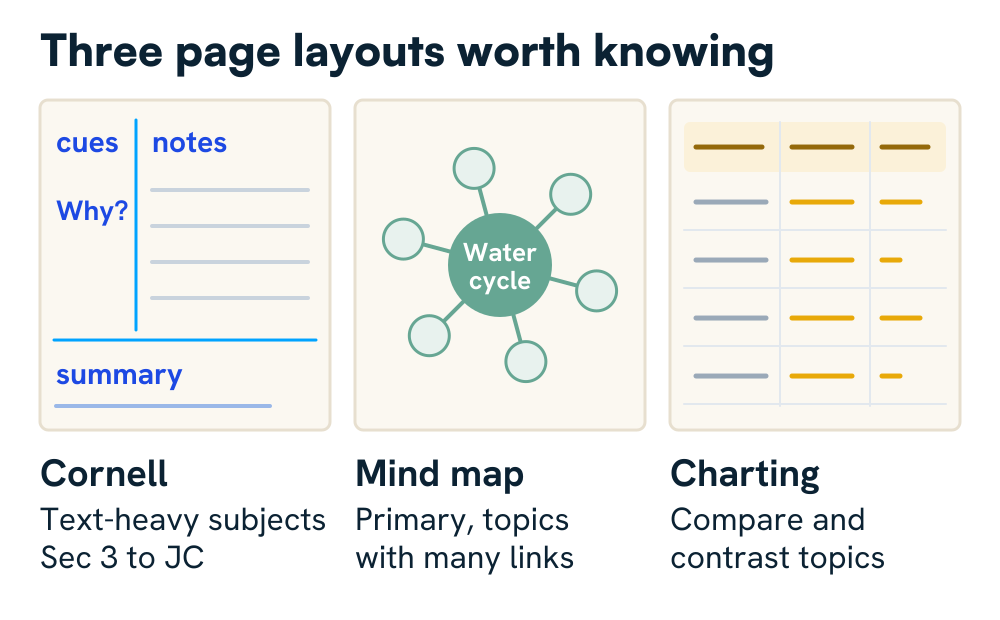
Cornell suits text-heavy subjects in upper Secondary and JC, such as English, History, Geography, Biology and Economics, and any subject where the test asks "what does the source say and what does it mean?" Set up the page with a vertical line about a third in from the left. Right column: the actual notes during class. Left column: cue questions or keywords, written after class while the lesson is fresh. Bottom: a two to three sentence summary written that night. The summary is what makes Cornell powerful, because it forces your child to pull the ideas together. For JC students working towards the A-Level, Cornell on every reading and every lecture pays off in revision, especially for H2 subjects like Economics where case studies and essays need clear links between ideas.
When does the outline method work best?
Outline notes work for structured lessons with clear sub-points. Most science and humanities subjects from Sec 1 to Sec 4 fall here. Headings go on the left margin (I, II, III), sub-points are indented underneath (A, B, C), then smaller points (1, 2, 3) under those. The format mirrors how a textbook is organised, so revision later feels like reading a well-laid-out summary. That matters in the run-up to the national exam: from 2027, the O-Level and N-Level are combined into the Singapore-Cambridge Secondary Education Certificate (SEC), and tidy outlines make the Sec 4 revision load lighter. The catch: outlines fail in classes that jump around or move fast. If your child is missing more than they are catching, switch them to sentence notes for that subject and keep outlines for the structured ones.
When do mind maps work best for younger kids?
Mind maps suit Primary and lower Secondary students, and any topic with lots of connections: characters in a novel, parts of an ecosystem, causes of a war. Put the central idea in the middle of the page, branch out to sub-topics, then branch off those for details. Encourage colour and small drawings. For Primary kids, this is the difference between notes that get done and notes that get abandoned. Mind maps are a natural fit for topics like cycles, systems and interactions in Primary Science, and science tuition often uses them to link concepts before the PSLE. They are weak for step-by-step or numerical material, so for maths working, switch to sentence notes or boxing. Many students use mind maps for revision summaries rather than live class notes, which is a perfectly valid use too.
When should students use charting or boxing?
Two specialist methods are worth knowing. Charting is a table: columns for the categories being compared, rows for the items. It is perfect for compare-and-contrast topics: three poems in Literature, two Cold War leaders, four cell types. Filling in the chart forces a student to find the differences. Boxing divides the page into rectangles, one per sub-topic, with all related notes inside that box. It is strong for big topics where the lesson jumps around, such as Sec 3 History or JC1 Economics. Both methods work well as revision summaries even if the student took notes another way during class.
How do I help my child ask the right questions in class?
Notes get stronger when students fill the gaps they spotted. Coach your child to write a small "?" in the margin every time something did not quite land: a definition they are unsure about, a step in a worked example they could not follow, a name they did not catch. Then they either ask the teacher at the end of class or look it up that night. For shy students, writing the question down on paper after class makes asking less daunting. If a particular subject collects more "?" than answers week after week, that is a flag. Bring in a tutor who can spend an hour going through the questions calmly, without a full class in the room. For comprehension and composition, English tuition can turn those question marks into a clear plan. For maths, our guide on how to study maths covers the same habit for worked problems.
When and how should my child review their notes?
Notes reviewed the same day are far easier to remember than notes filed away until exam week. Build a 10-minute end-of-day habit: re-read today's notes, fill in the cue column (if Cornell), fix any short forms your child will not remember in a month, and write a one-line summary at the bottom of each page. Once a week, and Sunday afternoon works for most families, spend 20 minutes reviewing the week's notes for each major subject. This is also when gaps surface. If the same topic keeps coming up confused, that is the topic to flag with a tutor, the teacher or a study group before the next class. Fitting these reviews into the week is easier with a study plan that works, and it builds the habits behind self-directed learning.
What should you do next?
The best note-taking method is the one your child will actually use, and the one that fits the subject. Start by helping them pick one method per subject this term. Build the daily 10-minute review habit. Watch for the topic where the question marks pile up, because that is the one to bring help into. If you would like a steady weekly anchor, a tutor who can sit beside your child, look at their actual notebooks and unblock whatever is stuck, PSLE tuition in P6 or support further up the school can help. Lessons are from S$65 an hour, or from S$75 an hour with a qualified teacher, and the rate is the same at every level, P1 to JC.
Want notes that actually work? Tutero families book week by week with Singapore-based tutors: pay after each lesson, no contracts, cancel any time. Find 1-to-1 tuition with Tutero and start with the subject where the notes are hardest.
Helping your child take better notes is one of the most useful things a parent can do for school. Strong notes feed every other skill: revision, exam prep, essay planning and problem-solving. The methods are not hard to teach. The six approaches below cover Primary, Secondary and JC, with a clear sense of which method fits which stage and subject.
Quick answer
Six note-taking methods cover almost every classroom situation: Cornell (best for Sec 3 humanities, JC and any text-heavy subject), outline (best for structured lessons), mind maps (best for Primary and lower Secondary, and for seeing connections), charting (best for compare-and-contrast topics), boxing (best for big topics with sub-themes) and sentence notes (the default until a student is ready for one of the others). Match the method to the subject, not the student. Most students use two or three methods across their week.
How do I help my child take notes from material they understand?
Before any method, the rule is the same: notes your child does not understand are notes they cannot revise from. If your child is copying without understanding, the system has already broken. At home, build a five-minute end-of-day habit: "Show me one thing you wrote down today, and tell me what it means." If they cannot explain it, that is the topic to revisit. For Primary and lower Secondary students, this conversation matters more than the format of the page. For upper Secondary and JC students, it is the moment to flag what to ask the tutor or teacher about next. Gaps caught early stop becoming the topic that derails the exam. If staying on top of notes is the bigger struggle, study skills tuition works on exactly that.
When does the Cornell method work best?
Cornell suits text-heavy subjects in upper Secondary and JC, such as English, History, Geography, Biology and Economics, and any subject where the test asks "what does the source say and what does it mean?" Set up the page with a vertical line about a third in from the left. Right column: the actual notes during class. Left column: cue questions or keywords, written after class while the lesson is fresh. Bottom: a two to three sentence summary written that night. The summary is what makes Cornell powerful, because it forces your child to pull the ideas together. For JC students working towards the A-Level, Cornell on every reading and every lecture pays off in revision, especially for H2 subjects like Economics where case studies and essays need clear links between ideas.
When does the outline method work best?
Outline notes work for structured lessons with clear sub-points. Most science and humanities subjects from Sec 1 to Sec 4 fall here. Headings go on the left margin (I, II, III), sub-points are indented underneath (A, B, C), then smaller points (1, 2, 3) under those. The format mirrors how a textbook is organised, so revision later feels like reading a well-laid-out summary. That matters in the run-up to the national exam: from 2027, the O-Level and N-Level are combined into the Singapore-Cambridge Secondary Education Certificate (SEC), and tidy outlines make the Sec 4 revision load lighter. The catch: outlines fail in classes that jump around or move fast. If your child is missing more than they are catching, switch them to sentence notes for that subject and keep outlines for the structured ones.
When do mind maps work best for younger kids?
Mind maps suit Primary and lower Secondary students, and any topic with lots of connections: characters in a novel, parts of an ecosystem, causes of a war. Put the central idea in the middle of the page, branch out to sub-topics, then branch off those for details. Encourage colour and small drawings. For Primary kids, this is the difference between notes that get done and notes that get abandoned. Mind maps are a natural fit for topics like cycles, systems and interactions in Primary Science, and science tuition often uses them to link concepts before the PSLE. They are weak for step-by-step or numerical material, so for maths working, switch to sentence notes or boxing. Many students use mind maps for revision summaries rather than live class notes, which is a perfectly valid use too.
When should students use charting or boxing?
Two specialist methods are worth knowing. Charting is a table: columns for the categories being compared, rows for the items. It is perfect for compare-and-contrast topics: three poems in Literature, two Cold War leaders, four cell types. Filling in the chart forces a student to find the differences. Boxing divides the page into rectangles, one per sub-topic, with all related notes inside that box. It is strong for big topics where the lesson jumps around, such as Sec 3 History or JC1 Economics. Both methods work well as revision summaries even if the student took notes another way during class.
How do I help my child ask the right questions in class?
Notes get stronger when students fill the gaps they spotted. Coach your child to write a small "?" in the margin every time something did not quite land: a definition they are unsure about, a step in a worked example they could not follow, a name they did not catch. Then they either ask the teacher at the end of class or look it up that night. For shy students, writing the question down on paper after class makes asking less daunting. If a particular subject collects more "?" than answers week after week, that is a flag. Bring in a tutor who can spend an hour going through the questions calmly, without a full class in the room. For comprehension and composition, English tuition can turn those question marks into a clear plan. For maths, our guide on how to study maths covers the same habit for worked problems.
When and how should my child review their notes?
Notes reviewed the same day are far easier to remember than notes filed away until exam week. Build a 10-minute end-of-day habit: re-read today's notes, fill in the cue column (if Cornell), fix any short forms your child will not remember in a month, and write a one-line summary at the bottom of each page. Once a week, and Sunday afternoon works for most families, spend 20 minutes reviewing the week's notes for each major subject. This is also when gaps surface. If the same topic keeps coming up confused, that is the topic to flag with a tutor, the teacher or a study group before the next class. Fitting these reviews into the week is easier with a study plan that works, and it builds the habits behind self-directed learning.
What should you do next?
The best note-taking method is the one your child will actually use, and the one that fits the subject. Start by helping them pick one method per subject this term. Build the daily 10-minute review habit. Watch for the topic where the question marks pile up, because that is the one to bring help into. If you would like a steady weekly anchor, a tutor who can sit beside your child, look at their actual notebooks and unblock whatever is stuck, PSLE tuition in P6 or support further up the school can help. Lessons are from S$65 an hour, or from S$75 an hour with a qualified teacher, and the rate is the same at every level, P1 to JC.
Want notes that actually work? Tutero families book week by week with Singapore-based tutors: pay after each lesson, no contracts, cancel any time. Find 1-to-1 tuition with Tutero and start with the subject where the notes are hardest.


The Cornell method splits the page into three parts: notes on the right, cue questions or keywords on the left, and a short summary at the bottom. Students take notes in class, add the cue questions after class and write the summary that night. It works best for text-heavy subjects in upper Secondary and JC.
Cornell is a strong default for JC Economics because the cue column turns lecture notes into exam-style questions and the summary forces students to link ideas. Charting helps for comparing market structures or policies side by side. Many JC students use Cornell in lectures and charts for revision.
Paper is usually the better starting point, because writing by hand pushes students to summarise rather than copy word for word. A laptop can help for long readings or when a school uses digital worksheets. Whatever the tool, the review habit matters more than the format.
Start small with one subject and one method, usually mind maps for Science or sentence notes for English. Ask your child each evening to show you one thing they wrote down and explain it. Colour, drawings and a short daily routine keep a P5 child interested.
A short review on the same day, about 10 minutes, plus a weekly review of about 20 minutes per major subject works for most students. In the weeks before the PSLE, SEC or A-Level, those weekly reviews become revision summaries. Topics that keep coming up confused are the ones to raise with a teacher or tutor.
Yes, mind maps suit PSLE Science well because so many topics are about connections, such as cycles, systems and interactions. A mind map per topic gives a P6 student a one-page summary to revise from. For questions that need step-by-step explanations, pair the mind map with short sentence notes.
Hoping to improve confidence & grades?


