


Quick answer
Self-directed learning is when a child takes ownership of what they study, how long they study, and how they know if they’ve actually learnt it, with you in the background instead of the driver’s seat. It is the skill that decides how a child copes once school stops chasing them every week, and it has to be built, not waited for. In Singapore it now has a fixed place in the school calendar too: secondary schools and JCs run regular Home-Based Learning days designed to make students self-directed learners. The five strategies below build the skill step by step, from P1 to JC, using the autonomy-supportive approach that researchers like Wendy Grolnick and the team behind Self-Determination Theory (Edward Deci and Richard Ryan) have studied for decades.
Quick answer. Build self-directed learning by handing your child small, age-appropriate choices about what and how they study, by replacing instructions with questions, by teaching them to plan and self-check before asking for help, by stepping back from the homework table on purpose, and by praising effort and strategy rather than the mark on the page. Start where your child is. A P2 child managing their own three-step morning routine is doing self-directed learning. So is a JC1 student preparing for A-Levels who runs their own weekly revision schedule. Same skill, different scale.
What is self-directed learning, and how do I encourage it at home?
Self-directed learning is the practice of a child setting their own goal for a task, choosing a strategy to reach it, monitoring their own progress, and judging the result themselves before checking with anyone else. It is the everyday version of what researchers call self-regulated learning: planning, monitoring and evaluating your own work. To encourage it at home, narrow your role from “the person who tells them what to do next” to “the person who asks the question that helps them decide what to do next”. That single shift, repeated daily, is most of the work.
How do I teach my child to learn on their own?
You teach a child to learn on their own by walking them through the same loop adults use, then handing it over piece by piece. The loop is plan, do, check, decide what next. Sit with them once and narrate it out loud: “What are you trying to finish? How will you know it’s right? What will you do if you get stuck?” Next time, ask the same questions instead of answering them. After a fortnight of that, write the four prompts on a sticky note above their desk and let them run the loop themselves. The goal is not that they never need you again. The goal is that they try the loop before they call you, and you only step in when they’ve genuinely exhausted it.
What strategies build autonomy at home?
| Strategy | What you do | Best fit by level |
|---|---|---|
| Hand over choice, not control | Offer a choice between two real options for what or how they study (“spelling first or maths first?”). | P1 onwards. |
| Replace instructions with questions | When you would normally say “do this”, ask “what do you think you should try first?” instead. | All ages. |
| Teach the plan-do-check loop | Before they start, ask them to write or say what done looks like. After they finish, ask how they’d check it. | P3 onwards. |
| Step back on purpose | Leave the room for fifteen minutes during homework. Resist the urge to check in. Let them notice they coped. | P4 onwards. |
| Praise the strategy, not the score | When they show you a finished piece of work, comment on the approach (“you went back and checked”) before the result. | All ages, and more important from Secondary onwards. |
How do I make my child more independent in their schoolwork?
The most reliable lever is to narrow the help you give until they reach for it themselves. Educators call this scaffolded autonomy: start with a lot of support, fade it deliberately, and don’t put it back on by default. In practice that looks like sitting next to them in Term 1, sitting in the same room but on the sofa in Term 2, and being one room over with the door open by Term 3. Each step teaches the child something they could not learn while you were there: that they can recover from a stuck moment without rescue. Independence is built in the moments after a child gets stuck and before a parent steps in.
What can my child do on their own at each level?
- P1 to P4 (lower and middle primary). A 30-minute work block, parent in the house but not at the desk. Two-choice menus (“spelling or reading first?”). The plan-do-check loop run aloud with you, then handed over.
- P5 to Sec 1 (upper primary into secondary). A weekly checklist the child writes themselves on Sunday night, planned around CCAs and school events. Phones out of the workspace. Parent available for one quick question per session, no more. The child decides when the session ends, based on the checklist.
- Sec 2 to Sec 4 (towards the SEC or O-Level). Self-set goals for each subject by term, and a study plan that works around CCAs. Self-quizzing as the default revision method (flashcards, past questions, blank-page recall). Parent involvement narrows to a weekly check-in conversation. If the jump into Secondary is where the habits slipped, Sec 1 and 2 tuition can rebuild them early.
- JC1 and JC2 (A-Level). A self-managed weekly study plan they show you, not one you set. They run their own past-paper cycles across their H1 and H2 subjects. Your job becomes logistics, food and listening, not study management.
Why are schools in Singapore building self-directed learning?
Because MOE has made it part of the school week. Under Blended Learning, secondary schools, JCs and Millennia Institute schedule regular Home-Based Learning (HBL) days, which MOE says are meant to develop students’ “ability to be self-directed, passionate and life-long learners”. MOE’s announcement said all secondary schools and JCs would run Blended Learning at all levels by Term 4, 2022. In a 2021 parliamentary reply, MOE put HBL days at about twice a month for secondary and pre-university students, around 10% of curriculum time in a year.
On HBL days students work from home, using tools such as the Singapore Student Learning Space, with an emphasis on student-initiated learning. Regular HBL days run only in secondary schools and pre-university institutions, where MOE says students “are more independent and can conduct HBL without adult supervision”, and schools tell parents the dates in advance. For parents, the takeaway is simple. By Sec 1 your child will be expected to run a school day on their own, so P5 and P6 are the years to practise the loop at home.
How can I stop hovering over my child’s homework?
Hovering is usually anxiety on the parent’s side dressed up as helpfulness on the child’s side, and the research is unkind to it. Wendy Grolnick’s studies of parenting style found that children of overly controlling parents show lower intrinsic motivation, weaker persistence on hard tasks and poorer self-regulation, the exact opposite of what hovering is meant to produce. The fix is to give yourself a job that isn’t their work. Set a fifteen-minute timer, sit in the next room, and read a book or fold the laundry. When the timer goes, don’t go in. Wait until they come to you with a specific question. Most of the time they won’t. That is the win.
Leave the room, trust the plan-do-check loop, and wait for your child to come to you with a specific question.
What is the difference between autonomy-supportive and controlling parenting?
Autonomy-supportive parenting takes the child’s perspective seriously, offers genuine choices, explains the reason behind any non-negotiable, and treats mistakes as information rather than a failure to comply. Controlling parenting uses pressure, deadlines, rewards and punishments, comparisons with siblings or classmates, and the parent’s own anxiety as a motivator. Both kinds of parents care equally. The second style tends to produce worse results because it crowds out the child’s sense of ownership over the work. The phrase to listen for in your own voice is “you have to”. Replace it with “what do you want to try?” and you’re most of the way there.
What should I say instead to build independence?
| Instead of | Try |
|---|---|
| “You have to do your maths now.” | “Maths or reading first today?” |
| “That’s wrong, do it again.” | “Walk me through how you got that.” |
| “Why didn’t you finish it?” | “What stopped you, and what would help next time?” |
| “Your sister was already doing multiplication at your age.” | “What feels harder this week than last week?” |
| “If you finish, you can have screen time.” | “What do you want to do once this feels properly done?” |
When should my child start studying without parental help?
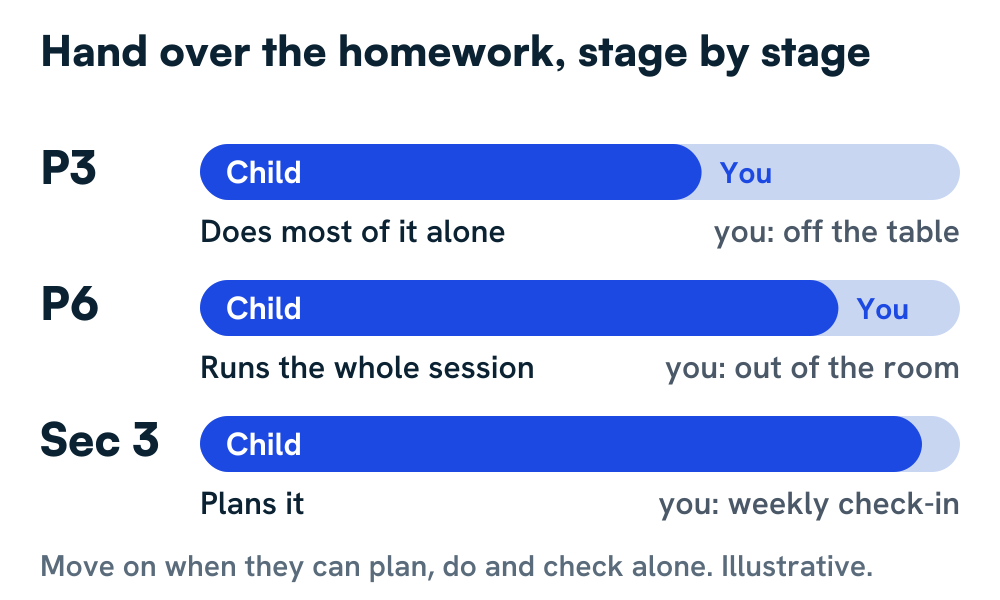
Earlier than most parents think. By P3 a child should be doing the bulk of a homework session without a parent at the table. By P6, the PSLE year, they should be running the whole session themselves, with you available but not in the room. By Sec 3 the parent role narrows almost entirely to logistics and a weekly check-in. The trigger is not age, though. It is whether the child has been taught the plan-do-check loop and given enough unsupported practice to know they can run it. A P4 child who has practised this since P1 is more independent than a Sec 3 student who has had a parent next to them every night since school started. Build the habit early and the timeline takes care of itself.
How do I build self-discipline in a teenager?
Self-discipline in a teenager is built by giving them real ownership of a real outcome they care about. That is the same idea behind the student-initiated learning on HBL days: the student plans, monitors and judges their own work on something that matters to them. Ask your teenager what mark, subject or skill matters to them this term. Then ask what they think a sensible weekly schedule would look like to get there. Their plan will be imperfect. Let it be. The first time they discover their own plan didn’t work and have to redesign it is when self-discipline starts to grow. Your job is to ask the question that prompts the redesign, not to redesign it for them.
How do I help my teenager build self-discipline?
- One concrete weekly goal, written down by the teenager on Sunday night.
- A self-quizzing routine (flashcards, past questions or blank-page recall) done at least twice per subject per week, without a parent present, built from better note-taking in class.
- A phone-out-of-the-room rule for study blocks, set by the teenager so it is theirs, not yours.
- A Friday review of what worked and what didn’t. Five minutes, not a lecture.
- An escalation rule the teenager owns: if they’ve genuinely tried and are still stuck after thirty minutes, they ask a parent, a teacher or a tutor, but only after thirty minutes.
How does self-directed learning improve academic outcomes?
Self-directed learners tend to do better on the things that matter most over time: remembering what they learnt, using a skill in a new subject, sticking with hard problems, and staying steadier under exam load. Carol Dweck’s growth-mindset work helps explain why. Children who own their learning treat a setback as information about what to try next. Children who don’t treat the same setback as proof they are “not smart”. The mark on a test follows from which of those views a child holds, and that view follows from how much ownership they’ve been given. Give ownership first and the results follow.
What if my child is genuinely stuck and self-directed learning isn’t working?
The honest test is whether the loop is failing because the skill hasn’t been built yet, or because the work is genuinely beyond what the child can reach with the tools they have. If your child has tried the plan-do-check loop, given it a real go for thirty minutes, and is still spinning, the answer isn’t to push harder on independence. It’s to bring in someone who knows the subject better than you do. A good tutor models the loop, lets the child run it, and steps back the moment the child catches the rhythm. That is what study skills tuition and subject lessons with Tutero are built around.
With 1-to-1 tuition from Tutero, a Singapore-based tutor sits with your child for an hour a week, asks the questions you’d ask if you knew the subject inside out, and then hands the loop back. Lessons are from S$65 an hour, or from S$75 an hour with a qualified teacher, and the rate is the same at every level from P1 to JC. You pay after each lesson, with no contracts. The ownership stays with your child.
Related reading from Tutero
- How to make an effective study plan: the planning layer. A self-directed learner who can’t plan a week loses most of the benefit.
- The easiest way to take effective notes in class: notes that turn into flashcards and self-quizzing at home.
- The ideal time to begin tuition: when outside help makes sense, and why earlier often works better.
- 6 questions to ask at a Parent-Teacher Meeting
What should you do next?
Self-directed learning at home is built by handing over real choice, replacing instructions with questions, teaching the plan-do-check loop, stepping back on purpose, and praising strategy ahead of the result. The P2 child managing a three-step morning routine and the JC2 student running their own revision week are using the same skill, and it starts the same way: with a parent in the next room, willing to wait. Want a tutor who builds independence instead of replacing it? See Tutero’s tuition rates: from S$65 an hour, the same from P1 to JC, with no contracts.
Quick answer
Self-directed learning is when a child takes ownership of what they study, how long they study, and how they know if they’ve actually learnt it, with you in the background instead of the driver’s seat. It is the skill that decides how a child copes once school stops chasing them every week, and it has to be built, not waited for. In Singapore it now has a fixed place in the school calendar too: secondary schools and JCs run regular Home-Based Learning days designed to make students self-directed learners. The five strategies below build the skill step by step, from P1 to JC, using the autonomy-supportive approach that researchers like Wendy Grolnick and the team behind Self-Determination Theory (Edward Deci and Richard Ryan) have studied for decades.
Quick answer. Build self-directed learning by handing your child small, age-appropriate choices about what and how they study, by replacing instructions with questions, by teaching them to plan and self-check before asking for help, by stepping back from the homework table on purpose, and by praising effort and strategy rather than the mark on the page. Start where your child is. A P2 child managing their own three-step morning routine is doing self-directed learning. So is a JC1 student preparing for A-Levels who runs their own weekly revision schedule. Same skill, different scale.
What is self-directed learning, and how do I encourage it at home?
Self-directed learning is the practice of a child setting their own goal for a task, choosing a strategy to reach it, monitoring their own progress, and judging the result themselves before checking with anyone else. It is the everyday version of what researchers call self-regulated learning: planning, monitoring and evaluating your own work. To encourage it at home, narrow your role from “the person who tells them what to do next” to “the person who asks the question that helps them decide what to do next”. That single shift, repeated daily, is most of the work.
How do I teach my child to learn on their own?
You teach a child to learn on their own by walking them through the same loop adults use, then handing it over piece by piece. The loop is plan, do, check, decide what next. Sit with them once and narrate it out loud: “What are you trying to finish? How will you know it’s right? What will you do if you get stuck?” Next time, ask the same questions instead of answering them. After a fortnight of that, write the four prompts on a sticky note above their desk and let them run the loop themselves. The goal is not that they never need you again. The goal is that they try the loop before they call you, and you only step in when they’ve genuinely exhausted it.
What strategies build autonomy at home?
| Strategy | What you do | Best fit by level |
|---|---|---|
| Hand over choice, not control | Offer a choice between two real options for what or how they study (“spelling first or maths first?”). | P1 onwards. |
| Replace instructions with questions | When you would normally say “do this”, ask “what do you think you should try first?” instead. | All ages. |
| Teach the plan-do-check loop | Before they start, ask them to write or say what done looks like. After they finish, ask how they’d check it. | P3 onwards. |
| Step back on purpose | Leave the room for fifteen minutes during homework. Resist the urge to check in. Let them notice they coped. | P4 onwards. |
| Praise the strategy, not the score | When they show you a finished piece of work, comment on the approach (“you went back and checked”) before the result. | All ages, and more important from Secondary onwards. |
How do I make my child more independent in their schoolwork?
The most reliable lever is to narrow the help you give until they reach for it themselves. Educators call this scaffolded autonomy: start with a lot of support, fade it deliberately, and don’t put it back on by default. In practice that looks like sitting next to them in Term 1, sitting in the same room but on the sofa in Term 2, and being one room over with the door open by Term 3. Each step teaches the child something they could not learn while you were there: that they can recover from a stuck moment without rescue. Independence is built in the moments after a child gets stuck and before a parent steps in.
What can my child do on their own at each level?
- P1 to P4 (lower and middle primary). A 30-minute work block, parent in the house but not at the desk. Two-choice menus (“spelling or reading first?”). The plan-do-check loop run aloud with you, then handed over.
- P5 to Sec 1 (upper primary into secondary). A weekly checklist the child writes themselves on Sunday night, planned around CCAs and school events. Phones out of the workspace. Parent available for one quick question per session, no more. The child decides when the session ends, based on the checklist.
- Sec 2 to Sec 4 (towards the SEC or O-Level). Self-set goals for each subject by term, and a study plan that works around CCAs. Self-quizzing as the default revision method (flashcards, past questions, blank-page recall). Parent involvement narrows to a weekly check-in conversation. If the jump into Secondary is where the habits slipped, Sec 1 and 2 tuition can rebuild them early.
- JC1 and JC2 (A-Level). A self-managed weekly study plan they show you, not one you set. They run their own past-paper cycles across their H1 and H2 subjects. Your job becomes logistics, food and listening, not study management.
Why are schools in Singapore building self-directed learning?
Because MOE has made it part of the school week. Under Blended Learning, secondary schools, JCs and Millennia Institute schedule regular Home-Based Learning (HBL) days, which MOE says are meant to develop students’ “ability to be self-directed, passionate and life-long learners”. MOE’s announcement said all secondary schools and JCs would run Blended Learning at all levels by Term 4, 2022. In a 2021 parliamentary reply, MOE put HBL days at about twice a month for secondary and pre-university students, around 10% of curriculum time in a year.
On HBL days students work from home, using tools such as the Singapore Student Learning Space, with an emphasis on student-initiated learning. Regular HBL days run only in secondary schools and pre-university institutions, where MOE says students “are more independent and can conduct HBL without adult supervision”, and schools tell parents the dates in advance. For parents, the takeaway is simple. By Sec 1 your child will be expected to run a school day on their own, so P5 and P6 are the years to practise the loop at home.
How can I stop hovering over my child’s homework?
Hovering is usually anxiety on the parent’s side dressed up as helpfulness on the child’s side, and the research is unkind to it. Wendy Grolnick’s studies of parenting style found that children of overly controlling parents show lower intrinsic motivation, weaker persistence on hard tasks and poorer self-regulation, the exact opposite of what hovering is meant to produce. The fix is to give yourself a job that isn’t their work. Set a fifteen-minute timer, sit in the next room, and read a book or fold the laundry. When the timer goes, don’t go in. Wait until they come to you with a specific question. Most of the time they won’t. That is the win.
Leave the room, trust the plan-do-check loop, and wait for your child to come to you with a specific question.
What is the difference between autonomy-supportive and controlling parenting?
Autonomy-supportive parenting takes the child’s perspective seriously, offers genuine choices, explains the reason behind any non-negotiable, and treats mistakes as information rather than a failure to comply. Controlling parenting uses pressure, deadlines, rewards and punishments, comparisons with siblings or classmates, and the parent’s own anxiety as a motivator. Both kinds of parents care equally. The second style tends to produce worse results because it crowds out the child’s sense of ownership over the work. The phrase to listen for in your own voice is “you have to”. Replace it with “what do you want to try?” and you’re most of the way there.
What should I say instead to build independence?
| Instead of | Try |
|---|---|
| “You have to do your maths now.” | “Maths or reading first today?” |
| “That’s wrong, do it again.” | “Walk me through how you got that.” |
| “Why didn’t you finish it?” | “What stopped you, and what would help next time?” |
| “Your sister was already doing multiplication at your age.” | “What feels harder this week than last week?” |
| “If you finish, you can have screen time.” | “What do you want to do once this feels properly done?” |
When should my child start studying without parental help?
Earlier than most parents think. By P3 a child should be doing the bulk of a homework session without a parent at the table. By P6, the PSLE year, they should be running the whole session themselves, with you available but not in the room. By Sec 3 the parent role narrows almost entirely to logistics and a weekly check-in. The trigger is not age, though. It is whether the child has been taught the plan-do-check loop and given enough unsupported practice to know they can run it. A P4 child who has practised this since P1 is more independent than a Sec 3 student who has had a parent next to them every night since school started. Build the habit early and the timeline takes care of itself.
How do I build self-discipline in a teenager?
Self-discipline in a teenager is built by giving them real ownership of a real outcome they care about. That is the same idea behind the student-initiated learning on HBL days: the student plans, monitors and judges their own work on something that matters to them. Ask your teenager what mark, subject or skill matters to them this term. Then ask what they think a sensible weekly schedule would look like to get there. Their plan will be imperfect. Let it be. The first time they discover their own plan didn’t work and have to redesign it is when self-discipline starts to grow. Your job is to ask the question that prompts the redesign, not to redesign it for them.
How do I help my teenager build self-discipline?
- One concrete weekly goal, written down by the teenager on Sunday night.
- A self-quizzing routine (flashcards, past questions or blank-page recall) done at least twice per subject per week, without a parent present, built from better note-taking in class.
- A phone-out-of-the-room rule for study blocks, set by the teenager so it is theirs, not yours.
- A Friday review of what worked and what didn’t. Five minutes, not a lecture.
- An escalation rule the teenager owns: if they’ve genuinely tried and are still stuck after thirty minutes, they ask a parent, a teacher or a tutor, but only after thirty minutes.
How does self-directed learning improve academic outcomes?
Self-directed learners tend to do better on the things that matter most over time: remembering what they learnt, using a skill in a new subject, sticking with hard problems, and staying steadier under exam load. Carol Dweck’s growth-mindset work helps explain why. Children who own their learning treat a setback as information about what to try next. Children who don’t treat the same setback as proof they are “not smart”. The mark on a test follows from which of those views a child holds, and that view follows from how much ownership they’ve been given. Give ownership first and the results follow.
What if my child is genuinely stuck and self-directed learning isn’t working?
The honest test is whether the loop is failing because the skill hasn’t been built yet, or because the work is genuinely beyond what the child can reach with the tools they have. If your child has tried the plan-do-check loop, given it a real go for thirty minutes, and is still spinning, the answer isn’t to push harder on independence. It’s to bring in someone who knows the subject better than you do. A good tutor models the loop, lets the child run it, and steps back the moment the child catches the rhythm. That is what study skills tuition and subject lessons with Tutero are built around.
With 1-to-1 tuition from Tutero, a Singapore-based tutor sits with your child for an hour a week, asks the questions you’d ask if you knew the subject inside out, and then hands the loop back. Lessons are from S$65 an hour, or from S$75 an hour with a qualified teacher, and the rate is the same at every level from P1 to JC. You pay after each lesson, with no contracts. The ownership stays with your child.
Related reading from Tutero
- How to make an effective study plan: the planning layer. A self-directed learner who can’t plan a week loses most of the benefit.
- The easiest way to take effective notes in class: notes that turn into flashcards and self-quizzing at home.
- The ideal time to begin tuition: when outside help makes sense, and why earlier often works better.
- 6 questions to ask at a Parent-Teacher Meeting
What should you do next?
Self-directed learning at home is built by handing over real choice, replacing instructions with questions, teaching the plan-do-check loop, stepping back on purpose, and praising strategy ahead of the result. The P2 child managing a three-step morning routine and the JC2 student running their own revision week are using the same skill, and it starts the same way: with a parent in the next room, willing to wait. Want a tutor who builds independence instead of replacing it? See Tutero’s tuition rates: from S$65 an hour, the same from P1 to JC, with no contracts.


Home-Based Learning (HBL) days are regular school days that secondary school, JC and Millennia Institute students spend learning from home, about twice a month according to MOE. They use tools such as the Singapore Student Learning Space and include time for student-initiated learning. MOE says the aim is to help students become self-directed learners. Schools tell parents the dates in advance, and students who need to can return to school on those days in consultation with their teachers.
Most children can do the bulk of a homework session without a parent at the table by P3, and run the whole session themselves by P6. By Sec 3 a parent’s role is mostly logistics and a weekly check-in. The real trigger is practice, not age: a child who has been taught the plan-do-check loop early becomes independent sooner.
Give yourself a different job during homework time. Set a fifteen-minute timer, sit in the next room, and only respond when your child comes to you with a specific question. When they do, answer with a question such as “what have you tried so far?” rather than the answer.
Hand over ownership of a goal they actually care about, then ask what weekly plan would get them there. Let them set their own phone rule and run a five-minute review on Fridays. Your role is to ask the question that prompts them to fix their own plan, not to fix it for them.
Yes. A P6 student who can plan a revision week, self-quiz and check their own answers gets far more out of each practice paper than one who waits to be told what to do. Self-directed habits built for the PSLE also make the move to Secondary easier, where regular HBL days expect students to work on their own.
It depends on the tutor. A good tutor models how to plan and check work, then steps back so your child runs the process themselves, which builds independence. Tutero’s 1-to-1 tuition is from S$65 an hour, the same rate from P1 to JC, with no contracts.
Hoping to improve confidence & grades?


