


Most students do not struggle with maths because they are "bad at maths". They struggle because they study it the wrong way. Reading the textbook, highlighting worked examples and watching your teacher solve a problem on the board all feel productive, but they barely change what you can do on your own in an exam. The four techniques in this guide are different. They take more effort at first and give you much better understanding and recall, whether you are in Primary preparing for the PSLE, in Secondary heading for the SEC (which replaces the O-Level and N-Level from 2027), or at JC taking H1 or H2 Maths.
Quick answer
The most effective way to study maths is to combine four techniques: break hard problems into small written steps, draw the maths (a bar model, a sketch or a diagram), test yourself from memory at spaced intervals, and do past-year papers under timed conditions. Re-reading worked examples and copying out notes feels like studying but does little for exam performance. Testing yourself from a blank page, then coming back to the same problem a few days later, works better at every level, from P3 fractions to Sec 3 A Maths to JC2 H2 Maths.
How do I break down complex maths problems without getting overwhelmed?
When a question looks scary, stop trying to solve the whole thing in your head and write one small step at a time. Work out what the question is asking, write down the formula or rule that applies, put in only the values you are given, then do one operation. After each line, pause and check that the next step is clear before you carry on. This is called chunking. It works because your working memory can only hold a few things at once. When you try to juggle the whole problem, you drop information and make small errors. Writing each step down takes that load off your head.
A worked example: a Sec 2 student looking at "find the area of a triangle with base 12 cm and height 9 cm" chunks it as: (1) write the formula A = ½ × b × h, (2) substitute A = ½ × 12 × 9, (3) simplify = ½ × 108, (4) solve = 54 cm². Four lines, four pauses. The same habit works for a Sec 4 differentiation question or a P6 problem sum. The size of the chunks changes; the discipline does not. Apps like Photomath are fine for checking an answer at the end, but do not let them do the chunking for you. The goal is for your brain to do the work.
How do visual aids help me understand maths better?
Visual aids work because maths is about relationships, and most relationships are easier to see than to describe. If you went to Primary school in Singapore, you already know the best example: the bar model. A model drawing turns a wordy problem sum about fractions, ratios or "before and after" into a picture you can read at a glance, and it often shows you the next step. The same idea carries on in Secondary and JC. A sketch on a coordinate plane makes "the gradient is negative" obvious. A Venn diagram makes a probability question with overlapping events manageable. The point is not pretty notes. It is turning symbols into a picture so your working memory is free for the actual problem.
Three visual habits that pay off from Primary to JC:
- Draw the model first. For any P3 to P6 problem sum with fractions, ratio or percentage, draw the bar model before you write a single number sentence.
- Redraw every figure. For geometry and trigonometry in E Maths or A Maths, redraw the figure on your own page and label the angles, sides and given values before solving.
- Sketch the graph. For algebra and functions, sketch the curve even if the question does not ask for it. It lets you check your answer (if you get x = -3, the curve should cross the x-axis there).
For formulas, make flashcards with the trigger on the front ("area of a sector") and the formula plus a tiny worked example on the back. Free flashcard apps such as Anki can schedule these for spaced review, which is the next technique.
What is active recall in maths and why does it work better than re-reading?
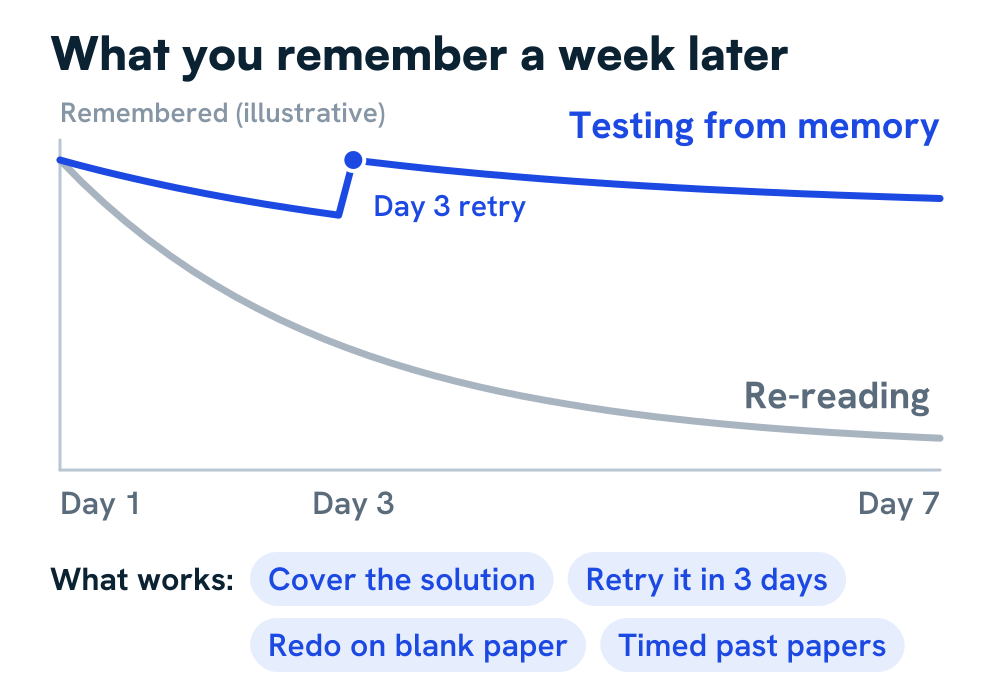
Active recall means forcing yourself to bring a solution back from memory without looking at your notes, then checking your answer afterwards. Re-reading only makes the page feel familiar. Familiar is not the same as knowing how to do it, and an exam paper does not show you the worked solution first. Every time you pull a method out of memory, you make it easier to pull out again, which is exactly what you need in an exam hall. Testing yourself is the habit that changes your marks. Re-reading is not.
In maths, active recall looks like this: cover the worked solution to a problem you have already studied, try it again on blank paper, then compare. Or write out the steps for completing the square from memory before checking your notes. The struggle you feel when you cannot quite remember is the useful part, and re-reading skips it. Pair active recall with spaced practice: redo each problem 1 day later, then 3 days later, then a week later. Flashcard apps handle the spacing for you, so you only review the cards you are about to forget. If you want help keeping class notes in a form you can test yourself on, see our guide to better notes in class.
Test yourself from a blank page. Re-reading your notes will not stick.
How do I work through past papers effectively?
Past-year papers, from the Ten-Year Series to your school's prelim papers, are the most useful resource you have, and most students underuse them. The mistake is treating a paper like homework: working slowly, looking up formulas, checking each answer as you go. That is not what an exam is, so it is not what you should rehearse. Instead, simulate the exam: print the paper, set a timer for the real length, no notes, calculator only where allowed, no breaks. When time is up, mark it against the answers and write every question you got wrong or guessed into an "error journal": the question, what you did, what you should have done, and the concept behind the mistake.
How this looks at each level:
- PSLE maths: in P6, work through full papers from the Ten-Year Series and your school's prelim papers, and time each paper strictly. Problem sums are where marks slip, so log every one you miss.
- SEC and O-Level maths: 2026 was the last O-Level year. From 2027, Sec 4 and Sec 5 students sit the SEC. Older O-Level papers and your school's prelims are still the closest practice for E Maths and A Maths, but check each question against your current syllabus.
- A-Level H2 Maths: the SEAB syllabus for H2 Mathematics (9758) sets two 3-hour papers, each marked out of 100, and you must answer all questions. Practise full 3-hour papers in JC2, not just single questions, so your timing holds up.
Reviewed every week, the error journal is the most useful habit in the last 6 to 8 weeks before any maths exam. It points you at the exact topics where you lose marks, and stops you re-practising what you already know.
How long should I study maths each day?
The quality of your practice matters far more than total hours. Here is a realistic daily guide by level:
| Level | Each weekday | What to fill it with |
|---|---|---|
| P3 to P6 | 15 to 25 minutes | A few problem sums with bar models, plus a handful of flashcards |
| Sec 1 to Sec 2 | 30 to 45 minutes | 20 minutes of new work, then 10 to 15 minutes of recall on older topics |
| Sec 3 to Sec 5 (E Maths, A Maths) | 45 to 60 minutes | Topical practice and recall, with a timed paper at the weekend from Sec 4 |
| JC1 to JC2 (H1, H2 Maths) | 45 to 75 minutes | Recall on weekdays, a longer past-paper block at the weekend, more in the final term |
None of these numbers means sitting at a desk without testing yourself. Five minutes of genuine recall does more than thirty minutes of re-reading. If you find it hard to fit maths around CCAs and other subjects, build a study plan that works for your week first, then slot these blocks in.
Can a maths tutor help me build these study habits?
A maths tutor can save you months of trial and error. The four techniques above are simple to describe and surprisingly hard to keep up on your own. Most students slide back to re-reading because it feels easier than testing themselves. A good tutor watches how you study, notices the slide, and rebuilds the habit one lesson at a time. They also bring two things a textbook cannot: (1) a clear sense of which topic is actually costing you marks (often not the one you think), and (2) a set of practice questions and past-paper questions ordered by difficulty for your level and syllabus.
Picture a typical case. A Sec 2 student keeps losing marks on algebra and decides "I just don't get algebra". A tutor looks at the working and finds the real gap is expanding brackets. The fix is small and specific: chunk each expansion line by line, sketch the area model for (a + b)(c + d), and review ten flashcards on expanding brackets each day. That is the kind of focused help that maths tuition with Tutero is built around, whether the goal is PSLE, the SEC or H2 Maths in JC1 and JC2. Our Singapore-based tutors are ID-verified and have signed a declaration, and they follow the MOE syllabus. Lessons are from S$65 an hour, or from S$75 an hour with a qualified teacher, the same rate from P1 to JC. You pay after each lesson, with no contracts.
Related reading
What should you do next?
Studying maths well is not about studying more. It is about studying in a way that changes what you can do on your own under exam pressure. Break hard problems into small written steps. Draw the maths, starting with the bar model. Test yourself from memory, then space that testing over days. Simulate exams with the Ten-Year Series and prelim papers, and keep an error journal of what you got wrong. Use all four, add a tutor if you want the habits to stick faster, and the result is the same from P1 to JC2: clearer understanding, better recall and better exam marks.
Related reading on the Tutero blog: how to handle maths anxiety, how to build an effective study planner and how to take effective notes in class.
Most students do not struggle with maths because they are "bad at maths". They struggle because they study it the wrong way. Reading the textbook, highlighting worked examples and watching your teacher solve a problem on the board all feel productive, but they barely change what you can do on your own in an exam. The four techniques in this guide are different. They take more effort at first and give you much better understanding and recall, whether you are in Primary preparing for the PSLE, in Secondary heading for the SEC (which replaces the O-Level and N-Level from 2027), or at JC taking H1 or H2 Maths.
Quick answer
The most effective way to study maths is to combine four techniques: break hard problems into small written steps, draw the maths (a bar model, a sketch or a diagram), test yourself from memory at spaced intervals, and do past-year papers under timed conditions. Re-reading worked examples and copying out notes feels like studying but does little for exam performance. Testing yourself from a blank page, then coming back to the same problem a few days later, works better at every level, from P3 fractions to Sec 3 A Maths to JC2 H2 Maths.
How do I break down complex maths problems without getting overwhelmed?
When a question looks scary, stop trying to solve the whole thing in your head and write one small step at a time. Work out what the question is asking, write down the formula or rule that applies, put in only the values you are given, then do one operation. After each line, pause and check that the next step is clear before you carry on. This is called chunking. It works because your working memory can only hold a few things at once. When you try to juggle the whole problem, you drop information and make small errors. Writing each step down takes that load off your head.
A worked example: a Sec 2 student looking at "find the area of a triangle with base 12 cm and height 9 cm" chunks it as: (1) write the formula A = ½ × b × h, (2) substitute A = ½ × 12 × 9, (3) simplify = ½ × 108, (4) solve = 54 cm². Four lines, four pauses. The same habit works for a Sec 4 differentiation question or a P6 problem sum. The size of the chunks changes; the discipline does not. Apps like Photomath are fine for checking an answer at the end, but do not let them do the chunking for you. The goal is for your brain to do the work.
How do visual aids help me understand maths better?
Visual aids work because maths is about relationships, and most relationships are easier to see than to describe. If you went to Primary school in Singapore, you already know the best example: the bar model. A model drawing turns a wordy problem sum about fractions, ratios or "before and after" into a picture you can read at a glance, and it often shows you the next step. The same idea carries on in Secondary and JC. A sketch on a coordinate plane makes "the gradient is negative" obvious. A Venn diagram makes a probability question with overlapping events manageable. The point is not pretty notes. It is turning symbols into a picture so your working memory is free for the actual problem.
Three visual habits that pay off from Primary to JC:
- Draw the model first. For any P3 to P6 problem sum with fractions, ratio or percentage, draw the bar model before you write a single number sentence.
- Redraw every figure. For geometry and trigonometry in E Maths or A Maths, redraw the figure on your own page and label the angles, sides and given values before solving.
- Sketch the graph. For algebra and functions, sketch the curve even if the question does not ask for it. It lets you check your answer (if you get x = -3, the curve should cross the x-axis there).
For formulas, make flashcards with the trigger on the front ("area of a sector") and the formula plus a tiny worked example on the back. Free flashcard apps such as Anki can schedule these for spaced review, which is the next technique.
What is active recall in maths and why does it work better than re-reading?
Active recall means forcing yourself to bring a solution back from memory without looking at your notes, then checking your answer afterwards. Re-reading only makes the page feel familiar. Familiar is not the same as knowing how to do it, and an exam paper does not show you the worked solution first. Every time you pull a method out of memory, you make it easier to pull out again, which is exactly what you need in an exam hall. Testing yourself is the habit that changes your marks. Re-reading is not.
In maths, active recall looks like this: cover the worked solution to a problem you have already studied, try it again on blank paper, then compare. Or write out the steps for completing the square from memory before checking your notes. The struggle you feel when you cannot quite remember is the useful part, and re-reading skips it. Pair active recall with spaced practice: redo each problem 1 day later, then 3 days later, then a week later. Flashcard apps handle the spacing for you, so you only review the cards you are about to forget. If you want help keeping class notes in a form you can test yourself on, see our guide to better notes in class.
Test yourself from a blank page. Re-reading your notes will not stick.
How do I work through past papers effectively?
Past-year papers, from the Ten-Year Series to your school's prelim papers, are the most useful resource you have, and most students underuse them. The mistake is treating a paper like homework: working slowly, looking up formulas, checking each answer as you go. That is not what an exam is, so it is not what you should rehearse. Instead, simulate the exam: print the paper, set a timer for the real length, no notes, calculator only where allowed, no breaks. When time is up, mark it against the answers and write every question you got wrong or guessed into an "error journal": the question, what you did, what you should have done, and the concept behind the mistake.
How this looks at each level:
- PSLE maths: in P6, work through full papers from the Ten-Year Series and your school's prelim papers, and time each paper strictly. Problem sums are where marks slip, so log every one you miss.
- SEC and O-Level maths: 2026 was the last O-Level year. From 2027, Sec 4 and Sec 5 students sit the SEC. Older O-Level papers and your school's prelims are still the closest practice for E Maths and A Maths, but check each question against your current syllabus.
- A-Level H2 Maths: the SEAB syllabus for H2 Mathematics (9758) sets two 3-hour papers, each marked out of 100, and you must answer all questions. Practise full 3-hour papers in JC2, not just single questions, so your timing holds up.
Reviewed every week, the error journal is the most useful habit in the last 6 to 8 weeks before any maths exam. It points you at the exact topics where you lose marks, and stops you re-practising what you already know.
How long should I study maths each day?
The quality of your practice matters far more than total hours. Here is a realistic daily guide by level:
| Level | Each weekday | What to fill it with |
|---|---|---|
| P3 to P6 | 15 to 25 minutes | A few problem sums with bar models, plus a handful of flashcards |
| Sec 1 to Sec 2 | 30 to 45 minutes | 20 minutes of new work, then 10 to 15 minutes of recall on older topics |
| Sec 3 to Sec 5 (E Maths, A Maths) | 45 to 60 minutes | Topical practice and recall, with a timed paper at the weekend from Sec 4 |
| JC1 to JC2 (H1, H2 Maths) | 45 to 75 minutes | Recall on weekdays, a longer past-paper block at the weekend, more in the final term |
None of these numbers means sitting at a desk without testing yourself. Five minutes of genuine recall does more than thirty minutes of re-reading. If you find it hard to fit maths around CCAs and other subjects, build a study plan that works for your week first, then slot these blocks in.
Can a maths tutor help me build these study habits?
A maths tutor can save you months of trial and error. The four techniques above are simple to describe and surprisingly hard to keep up on your own. Most students slide back to re-reading because it feels easier than testing themselves. A good tutor watches how you study, notices the slide, and rebuilds the habit one lesson at a time. They also bring two things a textbook cannot: (1) a clear sense of which topic is actually costing you marks (often not the one you think), and (2) a set of practice questions and past-paper questions ordered by difficulty for your level and syllabus.
Picture a typical case. A Sec 2 student keeps losing marks on algebra and decides "I just don't get algebra". A tutor looks at the working and finds the real gap is expanding brackets. The fix is small and specific: chunk each expansion line by line, sketch the area model for (a + b)(c + d), and review ten flashcards on expanding brackets each day. That is the kind of focused help that maths tuition with Tutero is built around, whether the goal is PSLE, the SEC or H2 Maths in JC1 and JC2. Our Singapore-based tutors are ID-verified and have signed a declaration, and they follow the MOE syllabus. Lessons are from S$65 an hour, or from S$75 an hour with a qualified teacher, the same rate from P1 to JC. You pay after each lesson, with no contracts.
Related reading
What should you do next?
Studying maths well is not about studying more. It is about studying in a way that changes what you can do on your own under exam pressure. Break hard problems into small written steps. Draw the maths, starting with the bar model. Test yourself from memory, then space that testing over days. Simulate exams with the Ten-Year Series and prelim papers, and keep an error journal of what you got wrong. Use all four, add a tutor if you want the habits to stick faster, and the result is the same from P1 to JC2: clearer understanding, better recall and better exam marks.
Related reading on the Tutero blog: how to handle maths anxiety, how to build an effective study planner and how to take effective notes in class.


Aim for at least 5 to 8 full papers done under timed conditions in the final term, after you have covered the topics with topical practice. Mark each one and log every mistake in an error journal, then review it weekly. 2026 was the last O-Level year, so from 2027 you sit the SEC, and older O-Level papers plus your school's prelims are still the closest practice. Check each question against your current syllabus.
Draw a bar model for every problem sum involving fractions, ratio or percentage before you write any working. Practise 15 to 25 minutes a day in P5 and P6, mixing a few problem sums with quick recall of formulas and methods. In P6, do full papers from the Ten-Year Series and your school's prelims under strict timing, and log every problem sum you miss so you can redo it a few days later.
Around 45 to 60 minutes on a weekday is realistic for a Sec 3 student taking both E Maths and A Maths, with roughly half of that on A Maths. Spend part of each session redoing older problems from memory, not just new homework. From Sec 4, add one timed paper at the weekend and keep an error journal of what you get wrong.
Do both, in that order. Practise by topic while you are still learning the content, because it lets you focus on one method at a time. In the final term before the PSLE, SEC or A-Levels, switch to full timed papers, since the exam mixes topics and tests your timing as well as your maths.
Write every step on its own line instead of doing several steps in your head, and pause after each line to check it. Keep an error journal and label each mistake by type, such as a copying error, a sign error or a misread question, so you can see your own pattern. Leave a few minutes at the end of every timed paper to check the questions where you usually slip.
Consider maths tuition when the same topic keeps costing you marks even after you have practised it, or when you cannot tell where the marks are going. A tutor can find the specific gap and set practice for it, which is hard to do on your own. Tutero offers 1-to-1 maths tuition from S$65 an hour, the same rate from P1 to JC, with no contracts.
Hoping to improve confidence & grades?


