


Kumon has over 80 centres in Singapore, so when a child starts to slip in maths or English, "should we just do Kumon?" is a common question. This guide answers it with Kumon Singapore's own published fees and description of its method, and a plain comparison with 1-to-1 tuition, so you can decide what suits your child.
Tutero is an online tuition provider. This guide reflects information on Kumon Singapore's website as at November 2026. Fees and programmes can change, so check the details with your local Kumon centre.
Quick answer: is Kumon worth it?
In our view, Kumon can be worth it for a child who needs regular practice of the basics and will sit down to worksheets every day. Kumon Singapore lists S$170 a month per subject, plus a one-time S$50 registration fee, both including 9% GST (November 2026). It may be a less suitable fit for a child who needs help with what their class is covering this term, or who needs a concept explained step by step. Kumon says its method supplements the Singapore education system, and its maths programme follows its own sequence. For those children, a 1-to-1 online tuition lesson built around their school topics may be the better fit.
Key takeaways
- Kumon fees: S$170 a month for each subject, per student, at every level, plus a one-time S$50 registration fee. Two subjects are S$340 a month.
- What you pay for: an individualised worksheet programme in maths, English or Chinese, with an Instructor who sets the plan and daily worksheets at home.
- Who it is for: Kumon has students from age 3 up to secondary school.
- Best fit, in our view: children who need regular practice in calculation or reading, and families who can support daily study at home.
How much are Kumon fees in Singapore?
Kumon Singapore publishes one fee for all levels. These are the figures from its Monthly Fee and Enrolment FAQ pages as at November 2026:
| Kumon fee | Amount | What to know |
|---|---|---|
| Registration fee | S$50 | One-time fee, paid when your child enrols. Includes 9% GST |
| Monthly fee, one subject | S$170 a month | Charged per subject, per student, regardless of school level. Includes 9% GST |
| Parent orientation and assessment | No charge | Kumon calls this a free assessment, where you meet the Instructor |
Kumon's website is clear on the fee itself, but it does not publish its terms for stopping, holiday closures or sibling discounts. Ask your centre about each one before you enrol, and get the answers in writing.
For comparison, a weekly one-hour lesson with Tutero starts from S$65, so four lessons cost from S$260 a month. With a qualified teacher, it is from S$75 an hour. That is more than one Kumon subject. The difference is the format: an hour each week with one tutor working on your child's own school work, compared with Kumon's worksheet programme of centre visits and daily study at home. Tutero's pricing is the same from P1 to JC, and you pay after each lesson. For the wider market, see what maths tuition costs in Singapore.
How much is Kumon for two subjects, two children or a full year?
Because Kumon charges per subject and per student, the total climbs quickly. These figures use Kumon Singapore's published S$170 monthly fee and S$50 registration fee, before any discount your centre may offer:
| Scenario | Monthly fee | First-year total |
|---|---|---|
| One child, one subject | S$170 | S$2,090 (S$2,040 in fees plus S$50 registration) |
| One child, maths and English | S$340 | S$4,130 (S$4,080 in fees plus S$50 registration) |
| Two children, one subject each | S$340 | S$4,180 (S$4,080 in fees plus S$50 registration for each child) |
| Two children, two subjects each | S$680 | S$8,260 (S$8,160 in fees plus S$100 registration) |
If you have more than one child, ask the centre whether a sibling discount applies. Kumon Singapore's website does not mention one.
What does Kumon actually do in a session?
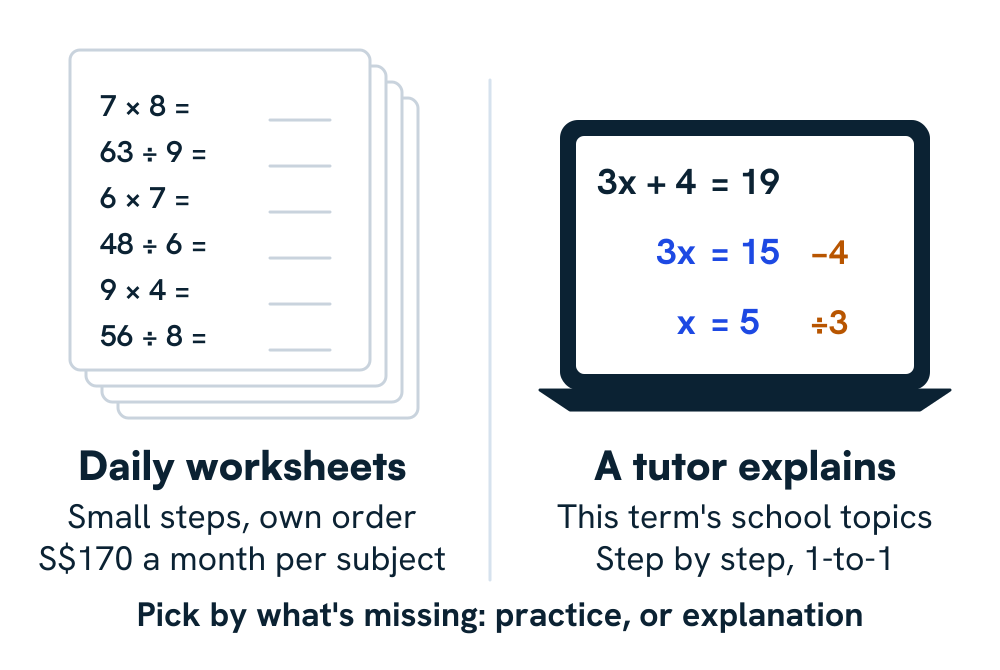
Kumon describes its method in four parts: learning at the "just-right" level, self-learning, the Kumon worksheets, and the Instructor. Children start with problems they can finish with a perfect score, then move up in small steps. When they reach something new, they study the worked example, draw on what they already know and try it. If they are stuck, Kumon says the Instructor checks what they understand and gives hints, or points them to a similar example. Children also correct their own mistakes. The Instructor sets each child's study plan, assigns the next worksheets and gives parents regular progress updates.
- Subjects: Kumon Singapore offers maths, English and Chinese programmes, for ages 3 and above.
- Maths: 20 levels, from Level 6A to Level O, plus 4 elective courses. Kumon says its maths programme has 4,420 worksheets, from preschool material up to high school calculus.
- Home study: Kumon says students work on their worksheets every day, and should be able to do their daily homework on their own.
- Delivery: printed worksheets, or Kumon Connect, a tablet version. Kumon lists supported tablets such as the Apple iPad (10th generation) with a stylus. It does not say whether every centre offers it.
- Scale: over 80 centres in Singapore, and more than 4.2 million students in over 60 countries.
The key point for parents is one Kumon makes itself. Its maths programme focuses on calculation and, in Kumon's words, leaves out "all unrelated concepts which may be covered in school" so children can move ahead as fast as possible. In our view, that is a fair summary of the trade-off.

What are the pros and cons of Kumon?
Based on Kumon Singapore's own description of its programme, this is how we see the trade-offs. In our view, whether it fits depends mostly on the child.
| Pros of Kumon | Cons of Kumon |
|---|---|
| One published fee: S$170 a month per subject, the same at every level | Daily worksheet study may not suit children who prefer more varied activities |
| Builds calculation speed and reading comprehension | Follows its own sequence, so it may not cover what your child's class is doing this term |
| A daily routine that builds study habits early | New topics are mostly learned from worked examples, with hints from the Instructor when stuck |
| Children can move beyond their school level | Worksheets at home every day, which some families find hard to fit around school and CCAs |
| Open from age 3, with over 80 centres | Terms for stopping and for holiday months are not published on the website |
The Instructor sets each child's plan, so experiences can differ between centres. It is worth visiting your local centre and asking how sessions run there.
When might Kumon not suit your child?
In our view, it comes down to how your child learns best. Kumon's maths programme follows its own path and leaves out concepts outside its focus on calculation, and new ideas are learned mainly by studying worked examples. That suits many children. A child who is stuck on a current class topic, such as fractions in P4 or algebra in Sec 1, may need someone to explain the idea directly and work from their school worksheets. The same goes for a P6 child preparing for PSLE, where PSLE tuition can work through the paper's topics and question types. The other thing to plan for is time at home: Kumon says students study their worksheets every day.
Kumon vs tuition: which is better for your child?
Neither is better for every child. The table compares three formats parents commonly weigh up: Kumon, a tuition centre, and 1-to-1 online tuition.
| Kumon | Tuition centre | 1-to-1 online tuition | |
|---|---|---|---|
| Published price | S$170 a month per subject, plus a one-time S$50 registration fee (GST included) | Varies by centre, level and class size | Tutero: from S$65 an hour, or from S$75 with a qualified teacher, paid after each lesson |
| What a session is | Worksheets at the child's level at the centre, plus daily worksheets at home | Usually a small group class | One tutor and one student, live, for the whole lesson |
| Follows the school syllabus? | Kumon says it supplements the Singapore education system and follows its own sequence | Many centres teach to the MOE syllabus; check with the centre | Works from your child's own school topics and worksheets |
| Personalisation | An individualised study plan set by the Instructor | Set by the class level and the centre's programme | Lessons built around your child's own topics and gaps |
| Commitment | Billed monthly; ask your centre about notice to stop | Usually weekly classes by term; check the notice terms | No contracts; pay after each lesson |
Our rule of thumb: if the goal is regular practice of the basics and your child enjoys routine, Kumon can be good value. If the goal is catching up on school work, preparing for PSLE or a school exam, or rebuilding confidence, a tutor who teaches one child at a time from their own class topics is often the better fit. Tutero's online tuition covers P1 to JC at the same rate, with no contracts, and every tutor is ID-verified and has signed a declaration. If you are weighing up a tuition centre or 1-to-1 tuition, that guide covers the trade-offs in more detail.
What should I ask a Kumon centre before enrolling?
Kumon's website covers the fee but not the terms around it. These five questions fill the gaps, and a good centre will answer them in writing:
- Is S$170 charged for each subject? Kumon's FAQ says yes, per subject and per student. Confirm the total for your family before you sign up.
- Is there a sibling discount? The website does not mention one, so ask.
- How much notice do I need to give to stop? Ask whether the next month's fee is still due if you stop part-way through a month.
- What happens in holiday months? Ask whether fees are charged when the centre is closed, and whether worksheets are still sent home.
- Is Kumon Connect available here, and is there an extra cost? Ask which tablet your child would need.
Are there good alternatives to Kumon?
Yes, and the right one depends on what your child needs:
- If your child needs things explained: 1-to-1 tuition, at home or online, where the tutor teaches rather than supervises. Tutero's maths tuition and English tuition work from your child's school topics, from P1 to JC.
- If you want a centre routine with more teaching: a tuition centre that teaches to the MOE syllabus in small classes.
- If cost is the main constraint: free school resources, such as MOE's Student Learning Space, and books from your nearest NLB public library, with a short block of tuition before a key exam.
- If your child is in secondary school: Lower Secondary tuition can help with the jump in maths and English from P6 to Sec 1 and Sec 2.
Related tuition guides
- The signs your child needs a tutor in Primary school
- Should you choose a tuition centre or 1-to-1 tuition?
- How much maths tuition costs in Singapore
Sources
- "Monthly Fee", Kumon Singapore, accessed 16 November 2026.
- "Enrolment Procedure & FAQs", Kumon Singapore, accessed 16 November 2026.
- "The Kumon Method", "Self-Learning", "Kumon Worksheets" and "The Role of Kumon Instructors", Kumon Singapore, accessed 16 November 2026.
- "Maths" and "Kumon Connect", Kumon Singapore, accessed 16 November 2026.
- "Student Learning Space", Ministry of Education Singapore, accessed 16 November 2026.
What else do parents ask about Kumon?
Short answers to what parents ask most are below. To compare costs side by side, see Tutero's pricing. Questions about Tutero itself are answered on our FAQ page.
Kumon has over 80 centres in Singapore, so when a child starts to slip in maths or English, "should we just do Kumon?" is a common question. This guide answers it with Kumon Singapore's own published fees and description of its method, and a plain comparison with 1-to-1 tuition, so you can decide what suits your child.
Tutero is an online tuition provider. This guide reflects information on Kumon Singapore's website as at November 2026. Fees and programmes can change, so check the details with your local Kumon centre.
Quick answer: is Kumon worth it?
In our view, Kumon can be worth it for a child who needs regular practice of the basics and will sit down to worksheets every day. Kumon Singapore lists S$170 a month per subject, plus a one-time S$50 registration fee, both including 9% GST (November 2026). It may be a less suitable fit for a child who needs help with what their class is covering this term, or who needs a concept explained step by step. Kumon says its method supplements the Singapore education system, and its maths programme follows its own sequence. For those children, a 1-to-1 online tuition lesson built around their school topics may be the better fit.
Key takeaways
- Kumon fees: S$170 a month for each subject, per student, at every level, plus a one-time S$50 registration fee. Two subjects are S$340 a month.
- What you pay for: an individualised worksheet programme in maths, English or Chinese, with an Instructor who sets the plan and daily worksheets at home.
- Who it is for: Kumon has students from age 3 up to secondary school.
- Best fit, in our view: children who need regular practice in calculation or reading, and families who can support daily study at home.
How much are Kumon fees in Singapore?
Kumon Singapore publishes one fee for all levels. These are the figures from its Monthly Fee and Enrolment FAQ pages as at November 2026:
| Kumon fee | Amount | What to know |
|---|---|---|
| Registration fee | S$50 | One-time fee, paid when your child enrols. Includes 9% GST |
| Monthly fee, one subject | S$170 a month | Charged per subject, per student, regardless of school level. Includes 9% GST |
| Parent orientation and assessment | No charge | Kumon calls this a free assessment, where you meet the Instructor |
Kumon's website is clear on the fee itself, but it does not publish its terms for stopping, holiday closures or sibling discounts. Ask your centre about each one before you enrol, and get the answers in writing.
For comparison, a weekly one-hour lesson with Tutero starts from S$65, so four lessons cost from S$260 a month. With a qualified teacher, it is from S$75 an hour. That is more than one Kumon subject. The difference is the format: an hour each week with one tutor working on your child's own school work, compared with Kumon's worksheet programme of centre visits and daily study at home. Tutero's pricing is the same from P1 to JC, and you pay after each lesson. For the wider market, see what maths tuition costs in Singapore.
How much is Kumon for two subjects, two children or a full year?
Because Kumon charges per subject and per student, the total climbs quickly. These figures use Kumon Singapore's published S$170 monthly fee and S$50 registration fee, before any discount your centre may offer:
| Scenario | Monthly fee | First-year total |
|---|---|---|
| One child, one subject | S$170 | S$2,090 (S$2,040 in fees plus S$50 registration) |
| One child, maths and English | S$340 | S$4,130 (S$4,080 in fees plus S$50 registration) |
| Two children, one subject each | S$340 | S$4,180 (S$4,080 in fees plus S$50 registration for each child) |
| Two children, two subjects each | S$680 | S$8,260 (S$8,160 in fees plus S$100 registration) |
If you have more than one child, ask the centre whether a sibling discount applies. Kumon Singapore's website does not mention one.
What does Kumon actually do in a session?
Kumon describes its method in four parts: learning at the "just-right" level, self-learning, the Kumon worksheets, and the Instructor. Children start with problems they can finish with a perfect score, then move up in small steps. When they reach something new, they study the worked example, draw on what they already know and try it. If they are stuck, Kumon says the Instructor checks what they understand and gives hints, or points them to a similar example. Children also correct their own mistakes. The Instructor sets each child's study plan, assigns the next worksheets and gives parents regular progress updates.
- Subjects: Kumon Singapore offers maths, English and Chinese programmes, for ages 3 and above.
- Maths: 20 levels, from Level 6A to Level O, plus 4 elective courses. Kumon says its maths programme has 4,420 worksheets, from preschool material up to high school calculus.
- Home study: Kumon says students work on their worksheets every day, and should be able to do their daily homework on their own.
- Delivery: printed worksheets, or Kumon Connect, a tablet version. Kumon lists supported tablets such as the Apple iPad (10th generation) with a stylus. It does not say whether every centre offers it.
- Scale: over 80 centres in Singapore, and more than 4.2 million students in over 60 countries.
The key point for parents is one Kumon makes itself. Its maths programme focuses on calculation and, in Kumon's words, leaves out "all unrelated concepts which may be covered in school" so children can move ahead as fast as possible. In our view, that is a fair summary of the trade-off.
What are the pros and cons of Kumon?
Based on Kumon Singapore's own description of its programme, this is how we see the trade-offs. In our view, whether it fits depends mostly on the child.
| Pros of Kumon | Cons of Kumon |
|---|---|
| One published fee: S$170 a month per subject, the same at every level | Daily worksheet study may not suit children who prefer more varied activities |
| Builds calculation speed and reading comprehension | Follows its own sequence, so it may not cover what your child's class is doing this term |
| A daily routine that builds study habits early | New topics are mostly learned from worked examples, with hints from the Instructor when stuck |
| Children can move beyond their school level | Worksheets at home every day, which some families find hard to fit around school and CCAs |
| Open from age 3, with over 80 centres | Terms for stopping and for holiday months are not published on the website |
The Instructor sets each child's plan, so experiences can differ between centres. It is worth visiting your local centre and asking how sessions run there.
When might Kumon not suit your child?
In our view, it comes down to how your child learns best. Kumon's maths programme follows its own path and leaves out concepts outside its focus on calculation, and new ideas are learned mainly by studying worked examples. That suits many children. A child who is stuck on a current class topic, such as fractions in P4 or algebra in Sec 1, may need someone to explain the idea directly and work from their school worksheets. The same goes for a P6 child preparing for PSLE, where PSLE tuition can work through the paper's topics and question types. The other thing to plan for is time at home: Kumon says students study their worksheets every day.
Kumon vs tuition: which is better for your child?
Neither is better for every child. The table compares three formats parents commonly weigh up: Kumon, a tuition centre, and 1-to-1 online tuition.
| Kumon | Tuition centre | 1-to-1 online tuition | |
|---|---|---|---|
| Published price | S$170 a month per subject, plus a one-time S$50 registration fee (GST included) | Varies by centre, level and class size | Tutero: from S$65 an hour, or from S$75 with a qualified teacher, paid after each lesson |
| What a session is | Worksheets at the child's level at the centre, plus daily worksheets at home | Usually a small group class | One tutor and one student, live, for the whole lesson |
| Follows the school syllabus? | Kumon says it supplements the Singapore education system and follows its own sequence | Many centres teach to the MOE syllabus; check with the centre | Works from your child's own school topics and worksheets |
| Personalisation | An individualised study plan set by the Instructor | Set by the class level and the centre's programme | Lessons built around your child's own topics and gaps |
| Commitment | Billed monthly; ask your centre about notice to stop | Usually weekly classes by term; check the notice terms | No contracts; pay after each lesson |
Our rule of thumb: if the goal is regular practice of the basics and your child enjoys routine, Kumon can be good value. If the goal is catching up on school work, preparing for PSLE or a school exam, or rebuilding confidence, a tutor who teaches one child at a time from their own class topics is often the better fit. Tutero's online tuition covers P1 to JC at the same rate, with no contracts, and every tutor is ID-verified and has signed a declaration. If you are weighing up a tuition centre or 1-to-1 tuition, that guide covers the trade-offs in more detail.
What should I ask a Kumon centre before enrolling?
Kumon's website covers the fee but not the terms around it. These five questions fill the gaps, and a good centre will answer them in writing:
- Is S$170 charged for each subject? Kumon's FAQ says yes, per subject and per student. Confirm the total for your family before you sign up.
- Is there a sibling discount? The website does not mention one, so ask.
- How much notice do I need to give to stop? Ask whether the next month's fee is still due if you stop part-way through a month.
- What happens in holiday months? Ask whether fees are charged when the centre is closed, and whether worksheets are still sent home.
- Is Kumon Connect available here, and is there an extra cost? Ask which tablet your child would need.
Are there good alternatives to Kumon?
Yes, and the right one depends on what your child needs:
- If your child needs things explained: 1-to-1 tuition, at home or online, where the tutor teaches rather than supervises. Tutero's maths tuition and English tuition work from your child's school topics, from P1 to JC.
- If you want a centre routine with more teaching: a tuition centre that teaches to the MOE syllabus in small classes.
- If cost is the main constraint: free school resources, such as MOE's Student Learning Space, and books from your nearest NLB public library, with a short block of tuition before a key exam.
- If your child is in secondary school: Lower Secondary tuition can help with the jump in maths and English from P6 to Sec 1 and Sec 2.
Related tuition guides
- The signs your child needs a tutor in Primary school
- Should you choose a tuition centre or 1-to-1 tuition?
- How much maths tuition costs in Singapore
Sources
- "Monthly Fee", Kumon Singapore, accessed 16 November 2026.
- "Enrolment Procedure & FAQs", Kumon Singapore, accessed 16 November 2026.
- "The Kumon Method", "Self-Learning", "Kumon Worksheets" and "The Role of Kumon Instructors", Kumon Singapore, accessed 16 November 2026.
- "Maths" and "Kumon Connect", Kumon Singapore, accessed 16 November 2026.
- "Student Learning Space", Ministry of Education Singapore, accessed 16 November 2026.
What else do parents ask about Kumon?
Short answers to what parents ask most are below. To compare costs side by side, see Tutero's pricing. Questions about Tutero itself are answered on our FAQ page.


Kumon Singapore lists S$170 a month per subject, per student, at every level, including 9% GST (November 2026). Maths and English together are S$340 a month. There is also a one-time S$50 registration fee when your child enrols.
Yes. Kumon Singapore charges a one-time registration fee of S$50 when a student enrols, including 9% GST. The parent orientation and assessment before enrolment are free. Ask your centre whether the fee applies again if your child stops and later restarts.
Yes. Kumon Singapore's FAQ says fees are S$170 per month, per subject, per student, regardless of school level. So two subjects for one child are S$340 a month, and one subject each for two children is also S$340 a month. The website does not mention a sibling discount, so ask your centre.
No. Kumon says its method supplements the Singapore education system and follows its own sequence of worksheets. Its maths programme focuses on calculation and leaves out concepts outside that focus which may be covered in school. If your child needs help with this term's MOE syllabus topics, a tutor who works from their school work may suit better.
In our view, it can help with speed and accuracy in calculation, which PSLE maths relies on. Kumon says it builds calculation, reading comprehension and analytical ability, which it calls essential for problem sums. It is not built around the PSLE syllabus or paper format, so a P5 or P6 child preparing for PSLE may need tuition that works through those topics directly.
Kumon Singapore's website does not publish a notice period or withdrawal process as at November 2026. Ask the Instructor at your centre how much notice they need, and whether the next month's fee is still due if you stop part-way. Get the answer in writing before you enrol. With Tutero, there are no contracts and you pay after each lesson.
Hoping to improve confidence & grades?


