.svg)

You don't need a homeschool curriculum, a teaching certification, or a Pinterest-perfect study room to teach your child at home. You need 20 minutes a day, six everyday activities you already do, and a small shift in how you frame them. Reading the bedtime story is teaching. Cooking dinner together is teaching. Walking around the backyard noticing things is teaching. The trick is knowing which everyday moments are the highest-leverage ones — and how to do them deliberately enough that they actually move your child forward.
This guide is for parents supplementing what school already does — not for full-time homeschoolers replacing the curriculum. The six methods below cover reading, math, science, history, art, and life skills. Each takes 15–30 minutes, fits around a working parent's schedule, and works for elementary, middle school, and high school students with small adjustments.
Quick answer: What are the best ways to teach your kids at home?
The six everyday activities with the strongest evidence behind them are: reading aloud together, kitchen-table math (fractions, ratios, money via cooking), backyard or kitchen-window science, conversation-time history and current events, art with a thinking purpose, and sport as strategy practice. None require special materials. All require only that you join your child for 15–30 minutes and ask follow-up questions instead of lecturing. The Education Endowment Foundation's Working with Parents to Support Children's Learning review found low-effort, high-frequency parent involvement (small daily moments) consistently outperforms high-effort, low-frequency involvement (occasional big "teaching sessions").
Twenty deliberate minutes a day, six days a week, beats two hours on a Sunday. The frequency is the lever, not the duration.
How do I teach my child at home without homeschooling them?
Supplementing school is different from replacing it. School handles curriculum coverage, peer learning, structured assessment, and the social side. Your job at home is the application layer — taking what school introduced and giving your child a real-world chance to use it. That's why the six methods below all use ordinary household activities (cooking, reading, gardening, sport, conversation) as the vehicle. Your child gets repetition, vocabulary, and confidence; you get connection time. Neither of you has to pretend the living room is a classroom.
The clearest signal you're on the right track: your child stops noticing they're learning. The second they ask "can we do that again tomorrow?", the activity has earned its place. If they're rolling their eyes within five minutes, the activity is too school-shaped — strip out the worksheet feel and try again.
Are kitchen-table math activities effective for teaching kids?
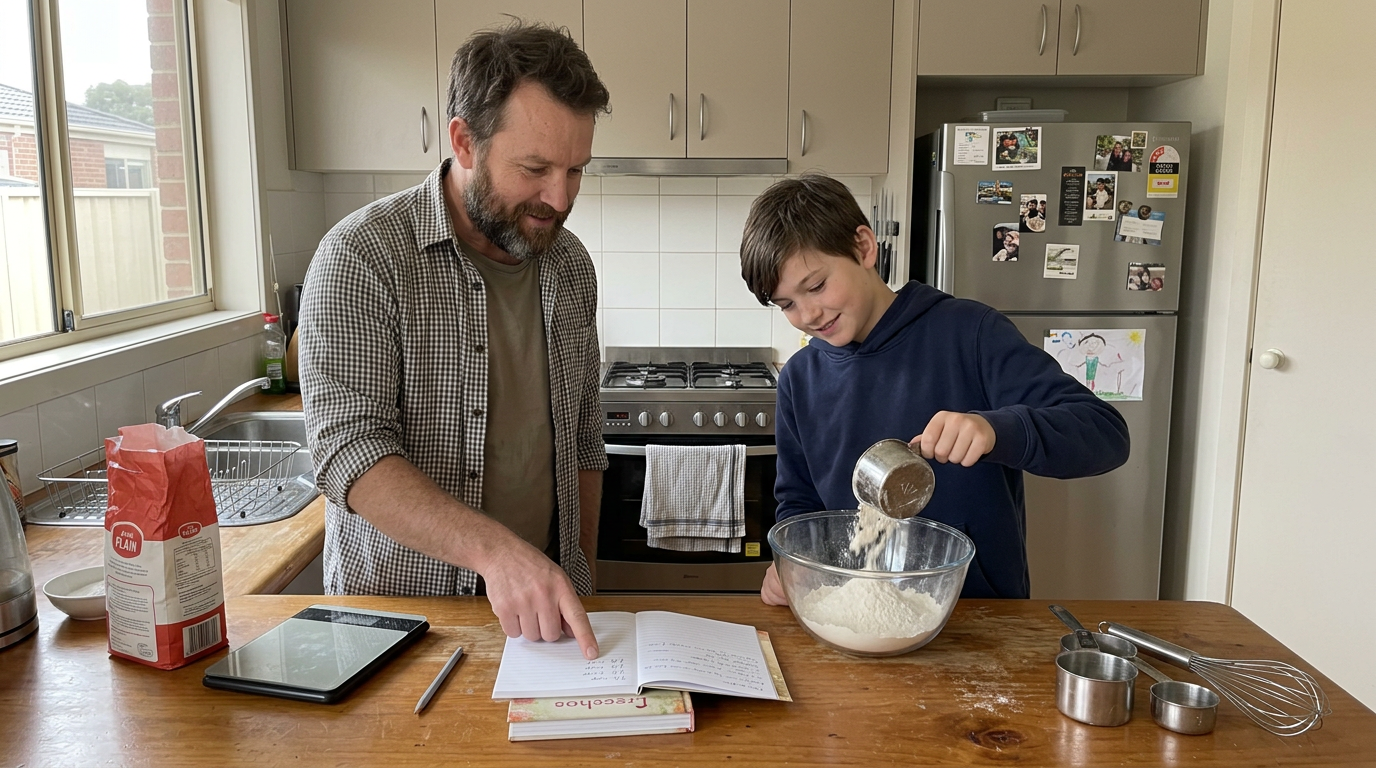
Yes — and the evidence is unusually strong. John Hattie's Visible Learning meta-analysis shows "deliberate vocabulary instruction" and "parent involvement in learning" both sit well above the 0.40 effect-size hinge that signals a year's worth of growth. Kitchen-table math combines both: the cup-and-spoon counting builds math fluency; the running narration ("we need three-quarters of a cup, that's three out of four equal parts…") builds vocabulary. An elementary-aged child halving a recipe is doing genuine fraction work; a 7th grader measuring ingredients to convert a recipe from grams to ounces is doing genuine ratio work; an 11th grader calculating macro splits for a meal-prep budget is doing genuine algebraic reasoning.
The trick is to let your child do the math, not just watch you do it. Hand them the measuring cup. Ask the question out loud ("if the recipe serves 4 and we're feeding 6, how much flour do we need?"), then wait — even when the silence feels long. Their brain is doing the work the moment you stop talking.
What everyday activities teach kids the most?
The six activities below give the highest return per minute spent, across elementary, middle school, and high school students. They use materials already in your home, work alongside school rather than replacing it, and build the same underlying skills (vocabulary, reasoning, curiosity, persistence) that school assessments measure. Each takes 15–30 minutes; none requires you to be an expert in the subject.
1. Reading aloud together — 15 minutes before bed
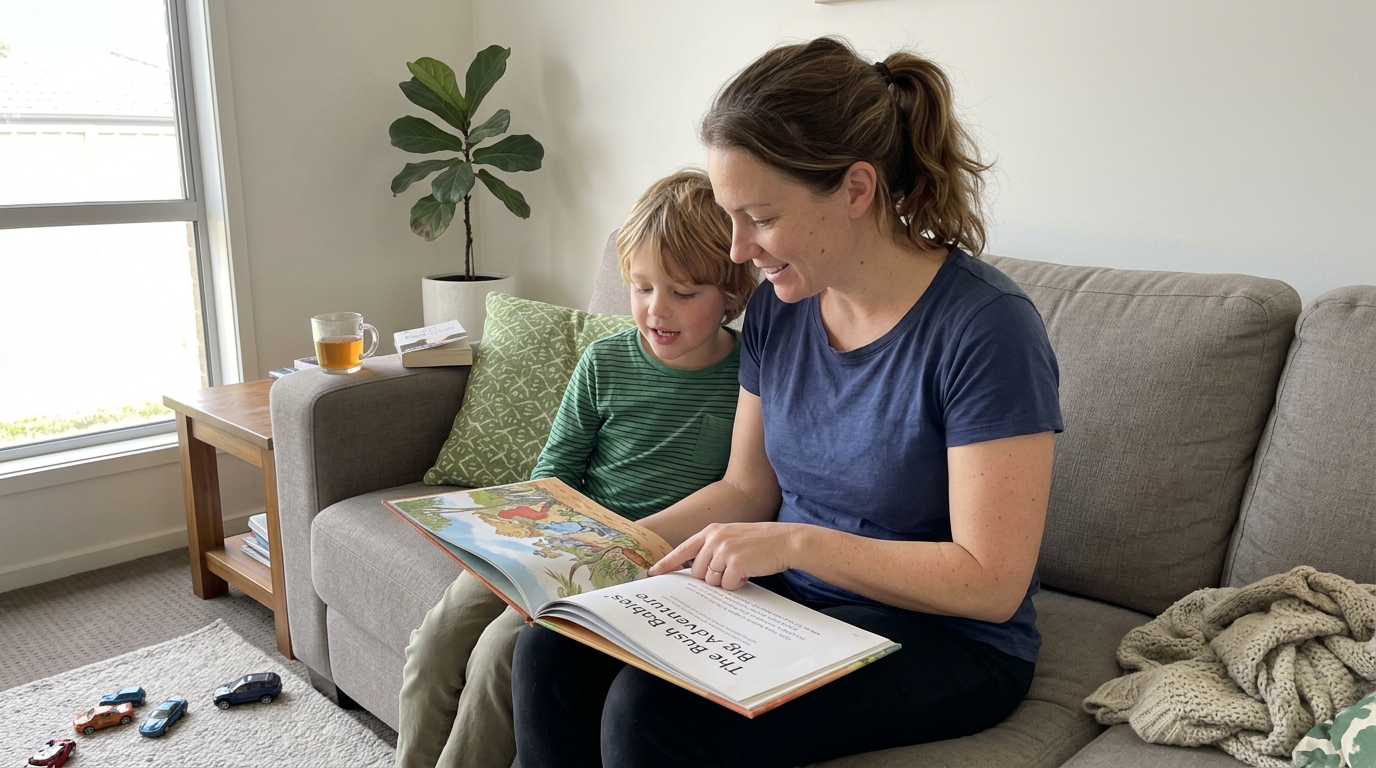
The single highest-leverage activity for elementary-aged children, and still useful well into 8th grade. Pick a book one notch above their independent reading level — you read, they listen, you both stop to talk about hard words. The American Academy of Pediatrics' Literacy Promotion policy recommends daily shared reading from infancy onward; the effect on vocabulary and comprehension is large and durable. For older children, swap the picture book for a chapter of a young-adult novel, a long-form magazine article, or even a news feature you discuss together. The shared activity matters more than the genre.
2. Kitchen-table math — 20 minutes while cooking dinner
Recipes are pre-built math problems. Halving, doubling, converting cups to grams, scaling for a different number of people, working out cost-per-serve — all live, all useful, all with a real outcome (the dinner). Elementary-aged kids practice fractions and counting; 6th–10th graders practice ratio, percentage, and unit conversion; high schoolers practice budgeting and quantitative reasoning. Hand over the measuring cups and the recipe; you stand beside them. Don't grade. Don't correct mid-stream. Let the recipe correct them — if the muffins flop, that's tomorrow's lesson on the importance of measurement.
3. Backyard or kitchen-window science — 30 minutes on Saturday morning
Pick one observable phenomenon in your home and watch it change over time. A herb seedling on the windowsill (growth, light, water). Ice cubes melting at different rates on different surfaces (heat transfer, surface area). A balloon over a bottle of warm water (gas expansion). Your child's job is to write down what they observe, predict what'll happen next, and check the prediction. That's the scientific method, in 30 minutes a week, with a saucer and a windowsill. Building observation and prediction habits early pays off all the way through to senior-year science.
4. Conversation-time history and current events — 10 minutes at dinner
The dinner table is the most underused classroom in the house. Pick one news story, one historical anniversary, or one family memory each evening and ask your child what they think happened, why, and what could happen next. The skill being trained is causal reasoning — the same skill assessed in essay-writing, source analysis, and AP US history. Don't lecture. Ask, listen, ask again. If they say something obviously wrong, ask "what makes you think that?" instead of correcting. The follow-up question is where the learning is.
5. Art with a thinking purpose — 30 minutes on Sunday
Drawing, painting, photography, or a craft project — but with a brief that forces a decision. "Draw the front of our house, but only with five colors." "Photograph three things in the kitchen that have the same shape." "Sketch your bedroom from memory, then go check what you got wrong." The brief is the lesson. The constraint forces planning, prioritization, and self-evaluation — the same metacognitive skills that strong students develop in any subject. The output doesn't need to be beautiful; the thinking does.
6. Sport as strategy practice — 20 minutes any afternoon
Backyard baseball, shooting hoops, table tennis, swimming laps — anything physical with a goal. After 15 minutes of play, sit on the back step for two minutes and ask three questions: "what worked, what didn't, what'll you try next time?" That's not coaching; that's deliberate practice. The same reflection loop drives improvement in every subject. A 9th grader who learns to debrief their tennis game also learns to debrief their math test. The transfer is real, even if it feels indirect.
How do I make at-home learning feel less like school?
Three rules. First, no worksheets. The instant a piece of paper with boxes appears, your child reads "this is school again" and the energy drops. The activities above use real objects, real outcomes, and real conversation; that's what makes them feel different. Second, let them choose the topic when possible. If they want to bake muffins instead of soup, that's the same math. If they want to read a graphic novel instead of the chapter book, that's the same vocabulary. Autonomy is a confidence multiplier — see our self-directed learning guide for the full case. Third, stop on a high. End the session before they're tired, while it still feels good. Tomorrow they'll come back willingly because today ended well.
The classroom analogue is "I do, we do, you do" — the teacher demonstrates, then the class practices together, then the student practices alone. Home learning is mostly "we do." You're not the teacher; you're the co-pilot. Joining matters more than instructing. Sustained attention is built by joining, not by directing.
How do I balance teaching at home with my full-time job?
You don't need a teaching block. You need to layer 15-minute pockets onto things you already do. Reading aloud is bedtime — already in the calendar. Kitchen-table math is dinner prep — already in the calendar. Conversation-time history is the dinner table — already in the calendar. Backyard science is Saturday morning — already in the calendar. The total at-home learning load is closer to two hours a week, distributed across pockets you don't control anyway. That's the realistic ask, not "set aside an hour each evening."
Two practical levers if even that feels like a lot. Trade off, don't add. Replace 20 minutes of screen time after dinner with the kitchen-table math; you're not adding to the day, you're swapping one thing for another. Build a positive learning environment first, so the activity has somewhere obvious to land — see our setup guide for the small physical changes that make the activity feel inviting instead of obligatory.
When should I get a tutor instead of teaching my child myself?
The six activities above are designed for supplementing school — not for closing a real academic gap. There are five clear signals that home teaching has hit its limit and a tutor would do more in 60 minutes than you can do in a week. One: your child is two or more grade levels behind in a specific subject. Two: homework is causing tears or fights more nights than not. Three: the topic has moved past where you confidently understand it (9th-grade algebra, AP chemistry, essay structure). Four: they have a high-stakes assessment in 8–12 weeks (state test, SAT, AP exam) and the trajectory isn't matching the goal. Five: the parent-child dynamic itself has become the bottleneck — they'll learn from a stranger but not from you.
If two or more apply, a tutor isn't a luxury — it's a faster, less-stressful path. Tutero's 1-to-1 online tutoring starts at US$45 per hour, with the same flat rate from kindergarten to 12th grade (no senior premium). Lessons happen on your child's schedule with a tutor matched to their grade level and subject. The right time to start is usually earlier than parents think — once any one of the five signals above appears. Motivation is also a leading indicator — when it dips, the gap is forming.
So what's the bottom line on teaching your kids at home?
You're already teaching your child every day — the question is whether you do it deliberately. Pick two of the six activities above and try them this week. Read aloud Tuesday night. Cook dinner together Wednesday. Notice what your child says when they're not being assessed. The activity that produces the "can we do that again tomorrow?" response is the one to keep; drop the others without guilt and try two more next week. Six weeks in, you'll have found your home's two or three signature activities — and your child will have learned more from those 90 minutes a week than from any amount of supervised homework.
If, six weeks in, the curve isn't moving — or one of the five tutor signals above appears — that's information, not failure. Ready to bring in a tutor for the gap that home teaching can't close? Find a Tutero tutor for your child — US$45/hour, online, matched to their grade level, available evenings and weekends.
You don't need a homeschool curriculum, a teaching certification, or a Pinterest-perfect study room to teach your child at home. You need 20 minutes a day, six everyday activities you already do, and a small shift in how you frame them. Reading the bedtime story is teaching. Cooking dinner together is teaching. Walking around the backyard noticing things is teaching. The trick is knowing which everyday moments are the highest-leverage ones — and how to do them deliberately enough that they actually move your child forward.
This guide is for parents supplementing what school already does — not for full-time homeschoolers replacing the curriculum. The six methods below cover reading, math, science, history, art, and life skills. Each takes 15–30 minutes, fits around a working parent's schedule, and works for elementary, middle school, and high school students with small adjustments.
Quick answer: What are the best ways to teach your kids at home?
The six everyday activities with the strongest evidence behind them are: reading aloud together, kitchen-table math (fractions, ratios, money via cooking), backyard or kitchen-window science, conversation-time history and current events, art with a thinking purpose, and sport as strategy practice. None require special materials. All require only that you join your child for 15–30 minutes and ask follow-up questions instead of lecturing. The Education Endowment Foundation's Working with Parents to Support Children's Learning review found low-effort, high-frequency parent involvement (small daily moments) consistently outperforms high-effort, low-frequency involvement (occasional big "teaching sessions").
Twenty deliberate minutes a day, six days a week, beats two hours on a Sunday. The frequency is the lever, not the duration.
How do I teach my child at home without homeschooling them?
Supplementing school is different from replacing it. School handles curriculum coverage, peer learning, structured assessment, and the social side. Your job at home is the application layer — taking what school introduced and giving your child a real-world chance to use it. That's why the six methods below all use ordinary household activities (cooking, reading, gardening, sport, conversation) as the vehicle. Your child gets repetition, vocabulary, and confidence; you get connection time. Neither of you has to pretend the living room is a classroom.
The clearest signal you're on the right track: your child stops noticing they're learning. The second they ask "can we do that again tomorrow?", the activity has earned its place. If they're rolling their eyes within five minutes, the activity is too school-shaped — strip out the worksheet feel and try again.
Are kitchen-table math activities effective for teaching kids?
Yes — and the evidence is unusually strong. John Hattie's Visible Learning meta-analysis shows "deliberate vocabulary instruction" and "parent involvement in learning" both sit well above the 0.40 effect-size hinge that signals a year's worth of growth. Kitchen-table math combines both: the cup-and-spoon counting builds math fluency; the running narration ("we need three-quarters of a cup, that's three out of four equal parts…") builds vocabulary. An elementary-aged child halving a recipe is doing genuine fraction work; a 7th grader measuring ingredients to convert a recipe from grams to ounces is doing genuine ratio work; an 11th grader calculating macro splits for a meal-prep budget is doing genuine algebraic reasoning.
The trick is to let your child do the math, not just watch you do it. Hand them the measuring cup. Ask the question out loud ("if the recipe serves 4 and we're feeding 6, how much flour do we need?"), then wait — even when the silence feels long. Their brain is doing the work the moment you stop talking.
What everyday activities teach kids the most?
The six activities below give the highest return per minute spent, across elementary, middle school, and high school students. They use materials already in your home, work alongside school rather than replacing it, and build the same underlying skills (vocabulary, reasoning, curiosity, persistence) that school assessments measure. Each takes 15–30 minutes; none requires you to be an expert in the subject.
1. Reading aloud together — 15 minutes before bed
The single highest-leverage activity for elementary-aged children, and still useful well into 8th grade. Pick a book one notch above their independent reading level — you read, they listen, you both stop to talk about hard words. The American Academy of Pediatrics' Literacy Promotion policy recommends daily shared reading from infancy onward; the effect on vocabulary and comprehension is large and durable. For older children, swap the picture book for a chapter of a young-adult novel, a long-form magazine article, or even a news feature you discuss together. The shared activity matters more than the genre.
2. Kitchen-table math — 20 minutes while cooking dinner
Recipes are pre-built math problems. Halving, doubling, converting cups to grams, scaling for a different number of people, working out cost-per-serve — all live, all useful, all with a real outcome (the dinner). Elementary-aged kids practice fractions and counting; 6th–10th graders practice ratio, percentage, and unit conversion; high schoolers practice budgeting and quantitative reasoning. Hand over the measuring cups and the recipe; you stand beside them. Don't grade. Don't correct mid-stream. Let the recipe correct them — if the muffins flop, that's tomorrow's lesson on the importance of measurement.
3. Backyard or kitchen-window science — 30 minutes on Saturday morning
Pick one observable phenomenon in your home and watch it change over time. A herb seedling on the windowsill (growth, light, water). Ice cubes melting at different rates on different surfaces (heat transfer, surface area). A balloon over a bottle of warm water (gas expansion). Your child's job is to write down what they observe, predict what'll happen next, and check the prediction. That's the scientific method, in 30 minutes a week, with a saucer and a windowsill. Building observation and prediction habits early pays off all the way through to senior-year science.
4. Conversation-time history and current events — 10 minutes at dinner
The dinner table is the most underused classroom in the house. Pick one news story, one historical anniversary, or one family memory each evening and ask your child what they think happened, why, and what could happen next. The skill being trained is causal reasoning — the same skill assessed in essay-writing, source analysis, and AP US history. Don't lecture. Ask, listen, ask again. If they say something obviously wrong, ask "what makes you think that?" instead of correcting. The follow-up question is where the learning is.
5. Art with a thinking purpose — 30 minutes on Sunday
Drawing, painting, photography, or a craft project — but with a brief that forces a decision. "Draw the front of our house, but only with five colors." "Photograph three things in the kitchen that have the same shape." "Sketch your bedroom from memory, then go check what you got wrong." The brief is the lesson. The constraint forces planning, prioritization, and self-evaluation — the same metacognitive skills that strong students develop in any subject. The output doesn't need to be beautiful; the thinking does.
6. Sport as strategy practice — 20 minutes any afternoon
Backyard baseball, shooting hoops, table tennis, swimming laps — anything physical with a goal. After 15 minutes of play, sit on the back step for two minutes and ask three questions: "what worked, what didn't, what'll you try next time?" That's not coaching; that's deliberate practice. The same reflection loop drives improvement in every subject. A 9th grader who learns to debrief their tennis game also learns to debrief their math test. The transfer is real, even if it feels indirect.
How do I make at-home learning feel less like school?
Three rules. First, no worksheets. The instant a piece of paper with boxes appears, your child reads "this is school again" and the energy drops. The activities above use real objects, real outcomes, and real conversation; that's what makes them feel different. Second, let them choose the topic when possible. If they want to bake muffins instead of soup, that's the same math. If they want to read a graphic novel instead of the chapter book, that's the same vocabulary. Autonomy is a confidence multiplier — see our self-directed learning guide for the full case. Third, stop on a high. End the session before they're tired, while it still feels good. Tomorrow they'll come back willingly because today ended well.
The classroom analogue is "I do, we do, you do" — the teacher demonstrates, then the class practices together, then the student practices alone. Home learning is mostly "we do." You're not the teacher; you're the co-pilot. Joining matters more than instructing. Sustained attention is built by joining, not by directing.
How do I balance teaching at home with my full-time job?
You don't need a teaching block. You need to layer 15-minute pockets onto things you already do. Reading aloud is bedtime — already in the calendar. Kitchen-table math is dinner prep — already in the calendar. Conversation-time history is the dinner table — already in the calendar. Backyard science is Saturday morning — already in the calendar. The total at-home learning load is closer to two hours a week, distributed across pockets you don't control anyway. That's the realistic ask, not "set aside an hour each evening."
Two practical levers if even that feels like a lot. Trade off, don't add. Replace 20 minutes of screen time after dinner with the kitchen-table math; you're not adding to the day, you're swapping one thing for another. Build a positive learning environment first, so the activity has somewhere obvious to land — see our setup guide for the small physical changes that make the activity feel inviting instead of obligatory.
When should I get a tutor instead of teaching my child myself?
The six activities above are designed for supplementing school — not for closing a real academic gap. There are five clear signals that home teaching has hit its limit and a tutor would do more in 60 minutes than you can do in a week. One: your child is two or more grade levels behind in a specific subject. Two: homework is causing tears or fights more nights than not. Three: the topic has moved past where you confidently understand it (9th-grade algebra, AP chemistry, essay structure). Four: they have a high-stakes assessment in 8–12 weeks (state test, SAT, AP exam) and the trajectory isn't matching the goal. Five: the parent-child dynamic itself has become the bottleneck — they'll learn from a stranger but not from you.
If two or more apply, a tutor isn't a luxury — it's a faster, less-stressful path. Tutero's 1-to-1 online tutoring starts at US$45 per hour, with the same flat rate from kindergarten to 12th grade (no senior premium). Lessons happen on your child's schedule with a tutor matched to their grade level and subject. The right time to start is usually earlier than parents think — once any one of the five signals above appears. Motivation is also a leading indicator — when it dips, the gap is forming.
So what's the bottom line on teaching your kids at home?
You're already teaching your child every day — the question is whether you do it deliberately. Pick two of the six activities above and try them this week. Read aloud Tuesday night. Cook dinner together Wednesday. Notice what your child says when they're not being assessed. The activity that produces the "can we do that again tomorrow?" response is the one to keep; drop the others without guilt and try two more next week. Six weeks in, you'll have found your home's two or three signature activities — and your child will have learned more from those 90 minutes a week than from any amount of supervised homework.
If, six weeks in, the curve isn't moving — or one of the five tutor signals above appears — that's information, not failure. Ready to bring in a tutor for the gap that home teaching can't close? Find a Tutero tutor for your child — US$45/hour, online, matched to their grade level, available evenings and weekends.

You don't need a homeschool curriculum, a teaching certification, or a Pinterest-perfect study room to teach your child at home. You need 20 minutes a day, six everyday activities you already do, and a small shift in how you frame them. Reading the bedtime story is teaching. Cooking dinner together is teaching. Walking around the backyard noticing things is teaching. The trick is knowing which everyday moments are the highest-leverage ones — and how to do them deliberately enough that they actually move your child forward.
This guide is for parents supplementing what school already does — not for full-time homeschoolers replacing the curriculum. The six methods below cover reading, math, science, history, art, and life skills. Each takes 15–30 minutes, fits around a working parent's schedule, and works for elementary, middle school, and high school students with small adjustments.
Quick answer: What are the best ways to teach your kids at home?
The six everyday activities with the strongest evidence behind them are: reading aloud together, kitchen-table math (fractions, ratios, money via cooking), backyard or kitchen-window science, conversation-time history and current events, art with a thinking purpose, and sport as strategy practice. None require special materials. All require only that you join your child for 15–30 minutes and ask follow-up questions instead of lecturing. The Education Endowment Foundation's Working with Parents to Support Children's Learning review found low-effort, high-frequency parent involvement (small daily moments) consistently outperforms high-effort, low-frequency involvement (occasional big "teaching sessions").
Twenty deliberate minutes a day, six days a week, beats two hours on a Sunday. The frequency is the lever, not the duration.
How do I teach my child at home without homeschooling them?
Supplementing school is different from replacing it. School handles curriculum coverage, peer learning, structured assessment, and the social side. Your job at home is the application layer — taking what school introduced and giving your child a real-world chance to use it. That's why the six methods below all use ordinary household activities (cooking, reading, gardening, sport, conversation) as the vehicle. Your child gets repetition, vocabulary, and confidence; you get connection time. Neither of you has to pretend the living room is a classroom.
The clearest signal you're on the right track: your child stops noticing they're learning. The second they ask "can we do that again tomorrow?", the activity has earned its place. If they're rolling their eyes within five minutes, the activity is too school-shaped — strip out the worksheet feel and try again.
Are kitchen-table math activities effective for teaching kids?
Yes — and the evidence is unusually strong. John Hattie's Visible Learning meta-analysis shows "deliberate vocabulary instruction" and "parent involvement in learning" both sit well above the 0.40 effect-size hinge that signals a year's worth of growth. Kitchen-table math combines both: the cup-and-spoon counting builds math fluency; the running narration ("we need three-quarters of a cup, that's three out of four equal parts…") builds vocabulary. An elementary-aged child halving a recipe is doing genuine fraction work; a 7th grader measuring ingredients to convert a recipe from grams to ounces is doing genuine ratio work; an 11th grader calculating macro splits for a meal-prep budget is doing genuine algebraic reasoning.
The trick is to let your child do the math, not just watch you do it. Hand them the measuring cup. Ask the question out loud ("if the recipe serves 4 and we're feeding 6, how much flour do we need?"), then wait — even when the silence feels long. Their brain is doing the work the moment you stop talking.
What everyday activities teach kids the most?
The six activities below give the highest return per minute spent, across elementary, middle school, and high school students. They use materials already in your home, work alongside school rather than replacing it, and build the same underlying skills (vocabulary, reasoning, curiosity, persistence) that school assessments measure. Each takes 15–30 minutes; none requires you to be an expert in the subject.
1. Reading aloud together — 15 minutes before bed
The single highest-leverage activity for elementary-aged children, and still useful well into 8th grade. Pick a book one notch above their independent reading level — you read, they listen, you both stop to talk about hard words. The American Academy of Pediatrics' Literacy Promotion policy recommends daily shared reading from infancy onward; the effect on vocabulary and comprehension is large and durable. For older children, swap the picture book for a chapter of a young-adult novel, a long-form magazine article, or even a news feature you discuss together. The shared activity matters more than the genre.
2. Kitchen-table math — 20 minutes while cooking dinner
Recipes are pre-built math problems. Halving, doubling, converting cups to grams, scaling for a different number of people, working out cost-per-serve — all live, all useful, all with a real outcome (the dinner). Elementary-aged kids practice fractions and counting; 6th–10th graders practice ratio, percentage, and unit conversion; high schoolers practice budgeting and quantitative reasoning. Hand over the measuring cups and the recipe; you stand beside them. Don't grade. Don't correct mid-stream. Let the recipe correct them — if the muffins flop, that's tomorrow's lesson on the importance of measurement.
3. Backyard or kitchen-window science — 30 minutes on Saturday morning
Pick one observable phenomenon in your home and watch it change over time. A herb seedling on the windowsill (growth, light, water). Ice cubes melting at different rates on different surfaces (heat transfer, surface area). A balloon over a bottle of warm water (gas expansion). Your child's job is to write down what they observe, predict what'll happen next, and check the prediction. That's the scientific method, in 30 minutes a week, with a saucer and a windowsill. Building observation and prediction habits early pays off all the way through to senior-year science.
4. Conversation-time history and current events — 10 minutes at dinner
The dinner table is the most underused classroom in the house. Pick one news story, one historical anniversary, or one family memory each evening and ask your child what they think happened, why, and what could happen next. The skill being trained is causal reasoning — the same skill assessed in essay-writing, source analysis, and AP US history. Don't lecture. Ask, listen, ask again. If they say something obviously wrong, ask "what makes you think that?" instead of correcting. The follow-up question is where the learning is.
5. Art with a thinking purpose — 30 minutes on Sunday
Drawing, painting, photography, or a craft project — but with a brief that forces a decision. "Draw the front of our house, but only with five colors." "Photograph three things in the kitchen that have the same shape." "Sketch your bedroom from memory, then go check what you got wrong." The brief is the lesson. The constraint forces planning, prioritization, and self-evaluation — the same metacognitive skills that strong students develop in any subject. The output doesn't need to be beautiful; the thinking does.
6. Sport as strategy practice — 20 minutes any afternoon
Backyard baseball, shooting hoops, table tennis, swimming laps — anything physical with a goal. After 15 minutes of play, sit on the back step for two minutes and ask three questions: "what worked, what didn't, what'll you try next time?" That's not coaching; that's deliberate practice. The same reflection loop drives improvement in every subject. A 9th grader who learns to debrief their tennis game also learns to debrief their math test. The transfer is real, even if it feels indirect.
How do I make at-home learning feel less like school?
Three rules. First, no worksheets. The instant a piece of paper with boxes appears, your child reads "this is school again" and the energy drops. The activities above use real objects, real outcomes, and real conversation; that's what makes them feel different. Second, let them choose the topic when possible. If they want to bake muffins instead of soup, that's the same math. If they want to read a graphic novel instead of the chapter book, that's the same vocabulary. Autonomy is a confidence multiplier — see our self-directed learning guide for the full case. Third, stop on a high. End the session before they're tired, while it still feels good. Tomorrow they'll come back willingly because today ended well.
The classroom analogue is "I do, we do, you do" — the teacher demonstrates, then the class practices together, then the student practices alone. Home learning is mostly "we do." You're not the teacher; you're the co-pilot. Joining matters more than instructing. Sustained attention is built by joining, not by directing.
How do I balance teaching at home with my full-time job?
You don't need a teaching block. You need to layer 15-minute pockets onto things you already do. Reading aloud is bedtime — already in the calendar. Kitchen-table math is dinner prep — already in the calendar. Conversation-time history is the dinner table — already in the calendar. Backyard science is Saturday morning — already in the calendar. The total at-home learning load is closer to two hours a week, distributed across pockets you don't control anyway. That's the realistic ask, not "set aside an hour each evening."
Two practical levers if even that feels like a lot. Trade off, don't add. Replace 20 minutes of screen time after dinner with the kitchen-table math; you're not adding to the day, you're swapping one thing for another. Build a positive learning environment first, so the activity has somewhere obvious to land — see our setup guide for the small physical changes that make the activity feel inviting instead of obligatory.
When should I get a tutor instead of teaching my child myself?
The six activities above are designed for supplementing school — not for closing a real academic gap. There are five clear signals that home teaching has hit its limit and a tutor would do more in 60 minutes than you can do in a week. One: your child is two or more grade levels behind in a specific subject. Two: homework is causing tears or fights more nights than not. Three: the topic has moved past where you confidently understand it (9th-grade algebra, AP chemistry, essay structure). Four: they have a high-stakes assessment in 8–12 weeks (state test, SAT, AP exam) and the trajectory isn't matching the goal. Five: the parent-child dynamic itself has become the bottleneck — they'll learn from a stranger but not from you.
If two or more apply, a tutor isn't a luxury — it's a faster, less-stressful path. Tutero's 1-to-1 online tutoring starts at US$45 per hour, with the same flat rate from kindergarten to 12th grade (no senior premium). Lessons happen on your child's schedule with a tutor matched to their grade level and subject. The right time to start is usually earlier than parents think — once any one of the five signals above appears. Motivation is also a leading indicator — when it dips, the gap is forming.
So what's the bottom line on teaching your kids at home?
You're already teaching your child every day — the question is whether you do it deliberately. Pick two of the six activities above and try them this week. Read aloud Tuesday night. Cook dinner together Wednesday. Notice what your child says when they're not being assessed. The activity that produces the "can we do that again tomorrow?" response is the one to keep; drop the others without guilt and try two more next week. Six weeks in, you'll have found your home's two or three signature activities — and your child will have learned more from those 90 minutes a week than from any amount of supervised homework.
If, six weeks in, the curve isn't moving — or one of the five tutor signals above appears — that's information, not failure. Ready to bring in a tutor for the gap that home teaching can't close? Find a Tutero tutor for your child — US$45/hour, online, matched to their grade level, available evenings and weekends.
.svg)
.svg)
Hoping to improve confidence & grades?

.png)