


Choosing a JC subject combination is the first big decision your child makes that shapes the next few years, from A-Level results to university applications. Most families come to it with too little information and too much worry. The five questions in this article are the ones to walk through together, in order, before the JC's subject registration closes.
It feels heavy because nobody in the family has practised it before. Your job as the parent is to turn it into a process, not a panic.
Quick answer
How do I help my child choose a JC subject combination? Sit down together for an hour and work through five questions in order: which subjects your child loves, what their teachers recommend, which career directions to keep open, which university prerequisites to meet, and whether each H2 subject can reach a realistic A-Level grade. Start with what your child loves. Use prerequisites as the filter, not the starting point.
What every JC combination includes: Students take four content-based subjects, usually three at H2 and one at H1, or four at H2. At least one must be a contrasting subject, so a science student takes one subject from the Humanities and the Arts, and an arts student takes one from Mathematics and the Sciences. On top of these, every student takes General Paper and Project Work, and H1 Mother Tongue unless they are exempted through Higher Mother Tongue.
| Level | What it means | Example |
|---|---|---|
| H1 | A lighter course that counts as one unit. Often used for the contrasting subject. | H1 Economics for a science student |
| H2 | The full A-Level course, counting as two units. Most students take three. | H2 Maths, H2 Chemistry, H2 History |
| H3 | An extra, more demanding course for highly able students, taken with the same subject at H2. | H3 Chemistry alongside H2 Chemistry |
MOE has also changed how these subjects count. Project Work is now graded pass or fail, and the fourth content-based subject only counts for university admission if it improves your child's score (MOE, 2023). For most students, three strong H2 subjects plus one H1 is a sound default.
What subjects does my child actually love and do well in?
Start with what your child loves and is good at, because A-Level performance builds on engagement. A student who enjoys a subject does the extra practice without being asked. Have the conversation with the school report book open: which subjects do they finish homework for first, which teacher do they speak warmly about, and which subject made them say "that was actually interesting" this year? Three subjects will rise quickly. Those are the floor.
The signal to look for: not "what grade did they get", but "what did they do with the work". A student who spends an extra weekend on a History essay because they want to read more is in the right subject. A student who gets a B3 in Pure Chemistry but rolls their eyes about it may not be.
When not to use it: if your child says they love everything equally, that often means "I don't want to disappoint you". Try the reverse: which two subjects would they drop tomorrow if they could?
What do my child's teachers think they should take?
Talking to your child's secondary school teachers is the most useful 30 minutes in the whole process. They have watched your child work through upper secondary and have a sharper read on subject fit than you do. Email each subject teacher one specific question: "Based on what you have seen, would you recommend my child take this subject at H2 in JC, and what is the one thing they would need to keep doing well?" Most will reply honestly. The pattern of who recommends and who hedges is the data.
What to ask the teacher:
- What does my child do really well in this subject?
- Where do they struggle, and is that about the subject or about study skills?
- If they took this at H2, what would be a realistic A-Level grade?
When not to use it: do not hand over the decision entirely. Teachers see your child for a few hours a week in one setting. You see them at the kitchen table the rest of the time. Their view is one input, alongside a tutor's read if your child already has 1-to-1 tuition.
Which career directions should this combination keep open?
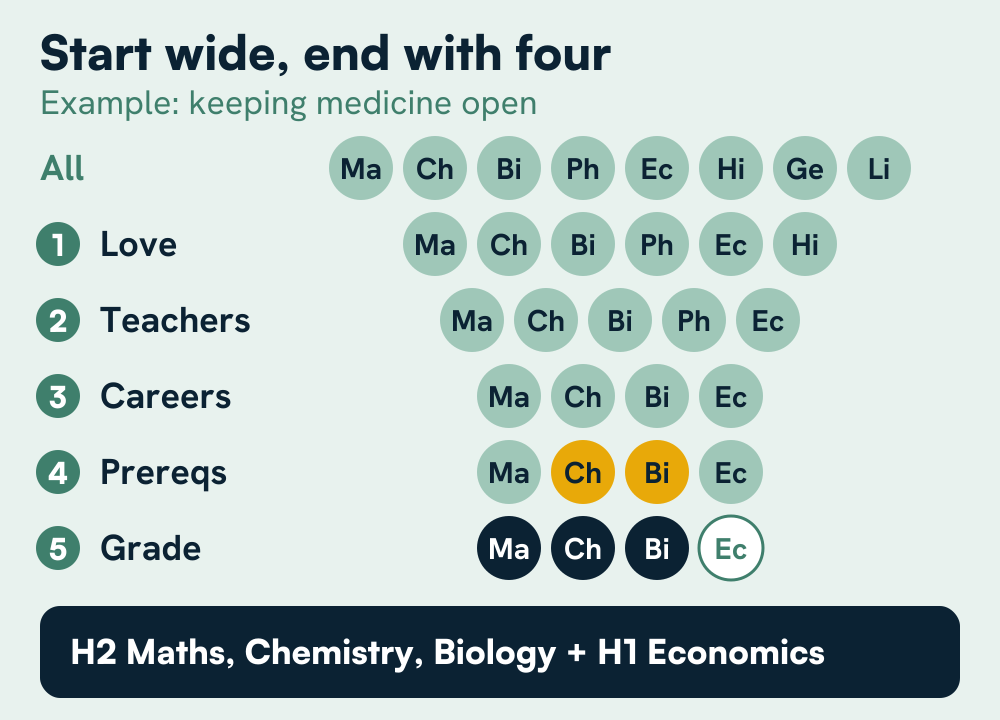
Picking subjects with an eye on careers means keeping doors open, not shutting them at 16. Most students finishing Sec 4 have no idea what they want to do at 25, and that is normal. The goal is a combination that does not close off obvious pathways. If medicine is a maybe, keep H2 Chemistry and H2 Biology or Physics. If engineering is a maybe, keep H2 Maths and one H2 science. If your child says "absolutely no H2 Maths", make sure they understand that most engineering courses ask for it before they sign. If they are still weighing poly or JC, settle that first.
The three-direction question: ask your child to name three jobs they could imagine enjoying, even loosely. Look up the subject prerequisites for each pathway, find the overlap and treat the overlap as the must-keep subjects. The rest of the combination can go to the subjects they love. Our guide to helping your child with career choices has more ways to start that conversation.
When not to use it: if your child has a clear, well-researched career goal at 16 (rare but real), align the combination closely with it. If they are guessing, keep doors open instead.
What university prerequisites does the combination need to meet?
Checking university prerequisites is the technical step most families do too early. Once you have the loved subjects, the teacher-recommended subjects and the rough career directions, open the subject prerequisite pages for the three to five university courses your child is most likely to apply for. NUS, NTU and SMU each publish these on their admissions sites. Trust those pages, not what an older cousin was told.
Two examples from NTU:
- Medicine: the Lee Kong Chian School of Medicine asks for a pass in H2 Chemistry and a pass in H2 Biology or H2 Physics.
- Engineering: most NTU engineering courses, including Mechanical, Civil and Electrical and Electronic Engineering, ask for a pass in H2 Mathematics and a pass in H2 Biology, Chemistry, Computing or Physics.
The four-question prerequisite check:
- Is a specific H2 subject required, such as H2 Maths or H2 Chemistry?
- Is a minimum grade required in that subject?
- Is there a recommended but not required list, and does my child want to compete without it?
- Is there a related course with different prerequisites if one is missed?
When not to use it: do not pick a subject only because it is a prerequisite if your child dislikes it and is close to failing. A weak H2 grade counts against the whole application, so compare it with a related course that does not need that subject. If your child is in an IP school heading for the IB Diploma instead of A-Levels, the same check applies to Higher Level subjects, and IB tuition can help with a shaky one. We also offer psychology tuition and French tuition.
How do Sec 3 subject combinations work under Full Subject-Based Banding?
Under Full Subject-Based Banding, students take subjects at three levels, G1, G2 and G3, and from 2026 upper secondary students can take electives such as Additional Mathematics at a more or less demanding level. Form classes are mixed, and MOE says schools consider each student's interest and learning progress when deciding subject levels. Each secondary school offers its own set of Sec 3 combinations, so ask your child's school which combinations it runs and how places are decided. From 2027, O-Level and N-Level papers are combined into the Singapore-Cambridge Secondary Education Certificate (SEC), with papers at each subject level.
Why Sec 3 choices matter for JC: some JCs assume knowledge of O-Level Additional Mathematics for H2 Maths (Raffles Institution lists it as assumed knowledge). Others set indicative grades for H2 sciences based on the matching secondary science; Eunoia Junior College lists B3 in the respective subject, or A1 in Combined Science. Dropping Additional Maths or a pure science at Sec 3 can narrow the JC combinations open later. If a Sec 3 or Sec 4 subject is wobbling, SEC and O-Level tuition is worth considering before results decide for you.
How do we run the final subject-combination conversation together?
Run the final conversation by getting the answers to the first four questions onto one page, sitting down with your child for an hour at the kitchen table and walking through the combination out loud. Do not just hand them the form. Your job is the questions, not the answers. The biggest mistake is steering towards the subjects you wish you had taken, or the ones that look impressive from outside.
The script that works:
- "Walk me through why you picked each of these four subjects." Let them justify each one out loud.
- "Which one are you least sure about?" This brings out the wobble before they sign.
- "If you had to drop one tomorrow, which would it be?" This confirms the wobble.
- "What is the worst that happens if this does not work out?" This names the fear, which is usually smaller than they thought.
When not to use it: if you are still deadlocked at the end of the hour, wait 48 hours, then book a 30-minute meeting with a career guidance counsellor at the school or JC. Do not decide late at night under deadline pressure.
When should we get extra help with a subject combination?
If your child is borderline in a prerequisite subject, for example scraping a pass in Additional Maths but needing H2 Maths for an engineering course, bring in a tutor before JC1 starts, not after the first common test. A few weeks of 1-to-1 work in the break before JC1 can rebuild the foundations that make H2 work manageable. H2 Maths tuition and chemistry tuition are the two we are asked about most for this, and our guide to the right time to start tuition covers timing in more detail. Tutero tuition is from S$65 an hour, or from S$75 an hour with a qualified teacher, the same rate from P1 to JC, with no contracts.
What should you do next?
Choosing a JC subject combination is a one-hour conversation, not a one-night decision. Start with what your child loves and is good at, add what their teachers see, sketch the career directions to keep open, then use university prerequisites as a filter, not the starting point. Sit down together for the final pass, ask the four questions out loud and let your child sign the form themselves. If a prerequisite subject is wobbly, get A-Level tuition or 1-to-1 tuition in place during the break, not after the first common test.
Choosing a JC subject combination is the first big decision your child makes that shapes the next few years, from A-Level results to university applications. Most families come to it with too little information and too much worry. The five questions in this article are the ones to walk through together, in order, before the JC's subject registration closes.
It feels heavy because nobody in the family has practised it before. Your job as the parent is to turn it into a process, not a panic.
Quick answer
How do I help my child choose a JC subject combination? Sit down together for an hour and work through five questions in order: which subjects your child loves, what their teachers recommend, which career directions to keep open, which university prerequisites to meet, and whether each H2 subject can reach a realistic A-Level grade. Start with what your child loves. Use prerequisites as the filter, not the starting point.
What every JC combination includes: Students take four content-based subjects, usually three at H2 and one at H1, or four at H2. At least one must be a contrasting subject, so a science student takes one subject from the Humanities and the Arts, and an arts student takes one from Mathematics and the Sciences. On top of these, every student takes General Paper and Project Work, and H1 Mother Tongue unless they are exempted through Higher Mother Tongue.
| Level | What it means | Example |
|---|---|---|
| H1 | A lighter course that counts as one unit. Often used for the contrasting subject. | H1 Economics for a science student |
| H2 | The full A-Level course, counting as two units. Most students take three. | H2 Maths, H2 Chemistry, H2 History |
| H3 | An extra, more demanding course for highly able students, taken with the same subject at H2. | H3 Chemistry alongside H2 Chemistry |
MOE has also changed how these subjects count. Project Work is now graded pass or fail, and the fourth content-based subject only counts for university admission if it improves your child's score (MOE, 2023). For most students, three strong H2 subjects plus one H1 is a sound default.
What subjects does my child actually love and do well in?
Start with what your child loves and is good at, because A-Level performance builds on engagement. A student who enjoys a subject does the extra practice without being asked. Have the conversation with the school report book open: which subjects do they finish homework for first, which teacher do they speak warmly about, and which subject made them say "that was actually interesting" this year? Three subjects will rise quickly. Those are the floor.
The signal to look for: not "what grade did they get", but "what did they do with the work". A student who spends an extra weekend on a History essay because they want to read more is in the right subject. A student who gets a B3 in Pure Chemistry but rolls their eyes about it may not be.
When not to use it: if your child says they love everything equally, that often means "I don't want to disappoint you". Try the reverse: which two subjects would they drop tomorrow if they could?
What do my child's teachers think they should take?
Talking to your child's secondary school teachers is the most useful 30 minutes in the whole process. They have watched your child work through upper secondary and have a sharper read on subject fit than you do. Email each subject teacher one specific question: "Based on what you have seen, would you recommend my child take this subject at H2 in JC, and what is the one thing they would need to keep doing well?" Most will reply honestly. The pattern of who recommends and who hedges is the data.
What to ask the teacher:
- What does my child do really well in this subject?
- Where do they struggle, and is that about the subject or about study skills?
- If they took this at H2, what would be a realistic A-Level grade?
When not to use it: do not hand over the decision entirely. Teachers see your child for a few hours a week in one setting. You see them at the kitchen table the rest of the time. Their view is one input, alongside a tutor's read if your child already has 1-to-1 tuition.
Which career directions should this combination keep open?
Picking subjects with an eye on careers means keeping doors open, not shutting them at 16. Most students finishing Sec 4 have no idea what they want to do at 25, and that is normal. The goal is a combination that does not close off obvious pathways. If medicine is a maybe, keep H2 Chemistry and H2 Biology or Physics. If engineering is a maybe, keep H2 Maths and one H2 science. If your child says "absolutely no H2 Maths", make sure they understand that most engineering courses ask for it before they sign. If they are still weighing poly or JC, settle that first.
The three-direction question: ask your child to name three jobs they could imagine enjoying, even loosely. Look up the subject prerequisites for each pathway, find the overlap and treat the overlap as the must-keep subjects. The rest of the combination can go to the subjects they love. Our guide to helping your child with career choices has more ways to start that conversation.
When not to use it: if your child has a clear, well-researched career goal at 16 (rare but real), align the combination closely with it. If they are guessing, keep doors open instead.
What university prerequisites does the combination need to meet?
Checking university prerequisites is the technical step most families do too early. Once you have the loved subjects, the teacher-recommended subjects and the rough career directions, open the subject prerequisite pages for the three to five university courses your child is most likely to apply for. NUS, NTU and SMU each publish these on their admissions sites. Trust those pages, not what an older cousin was told.
Two examples from NTU:
- Medicine: the Lee Kong Chian School of Medicine asks for a pass in H2 Chemistry and a pass in H2 Biology or H2 Physics.
- Engineering: most NTU engineering courses, including Mechanical, Civil and Electrical and Electronic Engineering, ask for a pass in H2 Mathematics and a pass in H2 Biology, Chemistry, Computing or Physics.
The four-question prerequisite check:
- Is a specific H2 subject required, such as H2 Maths or H2 Chemistry?
- Is a minimum grade required in that subject?
- Is there a recommended but not required list, and does my child want to compete without it?
- Is there a related course with different prerequisites if one is missed?
When not to use it: do not pick a subject only because it is a prerequisite if your child dislikes it and is close to failing. A weak H2 grade counts against the whole application, so compare it with a related course that does not need that subject. If your child is in an IP school heading for the IB Diploma instead of A-Levels, the same check applies to Higher Level subjects, and IB tuition can help with a shaky one. We also offer psychology tuition and French tuition.
How do Sec 3 subject combinations work under Full Subject-Based Banding?
Under Full Subject-Based Banding, students take subjects at three levels, G1, G2 and G3, and from 2026 upper secondary students can take electives such as Additional Mathematics at a more or less demanding level. Form classes are mixed, and MOE says schools consider each student's interest and learning progress when deciding subject levels. Each secondary school offers its own set of Sec 3 combinations, so ask your child's school which combinations it runs and how places are decided. From 2027, O-Level and N-Level papers are combined into the Singapore-Cambridge Secondary Education Certificate (SEC), with papers at each subject level.
Why Sec 3 choices matter for JC: some JCs assume knowledge of O-Level Additional Mathematics for H2 Maths (Raffles Institution lists it as assumed knowledge). Others set indicative grades for H2 sciences based on the matching secondary science; Eunoia Junior College lists B3 in the respective subject, or A1 in Combined Science. Dropping Additional Maths or a pure science at Sec 3 can narrow the JC combinations open later. If a Sec 3 or Sec 4 subject is wobbling, SEC and O-Level tuition is worth considering before results decide for you.
How do we run the final subject-combination conversation together?
Run the final conversation by getting the answers to the first four questions onto one page, sitting down with your child for an hour at the kitchen table and walking through the combination out loud. Do not just hand them the form. Your job is the questions, not the answers. The biggest mistake is steering towards the subjects you wish you had taken, or the ones that look impressive from outside.
The script that works:
- "Walk me through why you picked each of these four subjects." Let them justify each one out loud.
- "Which one are you least sure about?" This brings out the wobble before they sign.
- "If you had to drop one tomorrow, which would it be?" This confirms the wobble.
- "What is the worst that happens if this does not work out?" This names the fear, which is usually smaller than they thought.
When not to use it: if you are still deadlocked at the end of the hour, wait 48 hours, then book a 30-minute meeting with a career guidance counsellor at the school or JC. Do not decide late at night under deadline pressure.
When should we get extra help with a subject combination?
If your child is borderline in a prerequisite subject, for example scraping a pass in Additional Maths but needing H2 Maths for an engineering course, bring in a tutor before JC1 starts, not after the first common test. A few weeks of 1-to-1 work in the break before JC1 can rebuild the foundations that make H2 work manageable. H2 Maths tuition and chemistry tuition are the two we are asked about most for this, and our guide to the right time to start tuition covers timing in more detail. Tutero tuition is from S$65 an hour, or from S$75 an hour with a qualified teacher, the same rate from P1 to JC, with no contracts.
What should you do next?
Choosing a JC subject combination is a one-hour conversation, not a one-night decision. Start with what your child loves and is good at, add what their teachers see, sketch the career directions to keep open, then use university prerequisites as a filter, not the starting point. Sit down together for the final pass, ask the four questions out loud and let your child sign the form themselves. If a prerequisite subject is wobbly, get A-Level tuition or 1-to-1 tuition in place during the break, not after the first common test.


Most JC students take three H2 subjects and one H1 subject, and some take four H2 subjects. All four are content-based subjects, and at least one must be a contrasting subject from the other discipline group. General Paper and Project Work are taken on top of these four. Some JCs set a minimum O-Level score before allowing four H2 subjects.
H2 is the full A-Level course and counts as two units, while H1 is a lighter course that counts as one unit. H3 is an extra, more demanding course for highly able students, taken alongside the same subject at H2. A student cannot take the same subject at both H1 and H2.
Each JC sets its own rules on switching subjects, so speak to the college as soon as doubts appear. The later the switch, the more content your child has to catch up on in the new subject. Plan as if you will commit, and keep a short block of tuition in reserve in case a switch is needed.
NTU's Lee Kong Chian School of Medicine asks for a pass in H2 Chemistry and a pass in H2 Biology or H2 Physics. NUS Medicine publishes its own prerequisites on its admissions pages, so check them for your child's intake before JC subject registration. Keeping H2 Chemistry with H2 Biology or Physics keeps the NTU route open.
Each secondary school sets its own Sec 3 subject combinations and decides how places are given out. Under Full Subject-Based Banding, MOE says schools consider each student's interest and learning progress when deciding subject levels. Ask your child's school which combinations it offers, how places are decided and when choices are due.
It can. Some JCs assume O-Level Additional Mathematics knowledge for H2 Maths, and some set indicative grades for H2 sciences based on the matching secondary science. Dropping Additional Maths or a pure science at Sec 3 can therefore narrow the JC combinations open later. Check the subject pages of the JCs your child is considering before Sec 3 choices are due.
Hoping to improve confidence & grades?


