.svg)


Key findings
Texas Education Freedom Accounts (TEFA) let parents spend state money on tutoring, but where a family lives changes how many tutors they can choose from. We analyzed the Texas Comptroller’s list of 2,160 approved TEFA vendors alongside the state’s own participation data. Here is what we found.
- 564 tutoring vendors are approved for TEFA. That is 409 listed as “Tutor” and 155 as “Teaching Service”, about one in four of all approved vendors. With 116,574 participating students on October 1, 2026, that works out to about 207 TEFA students for every tutoring vendor.
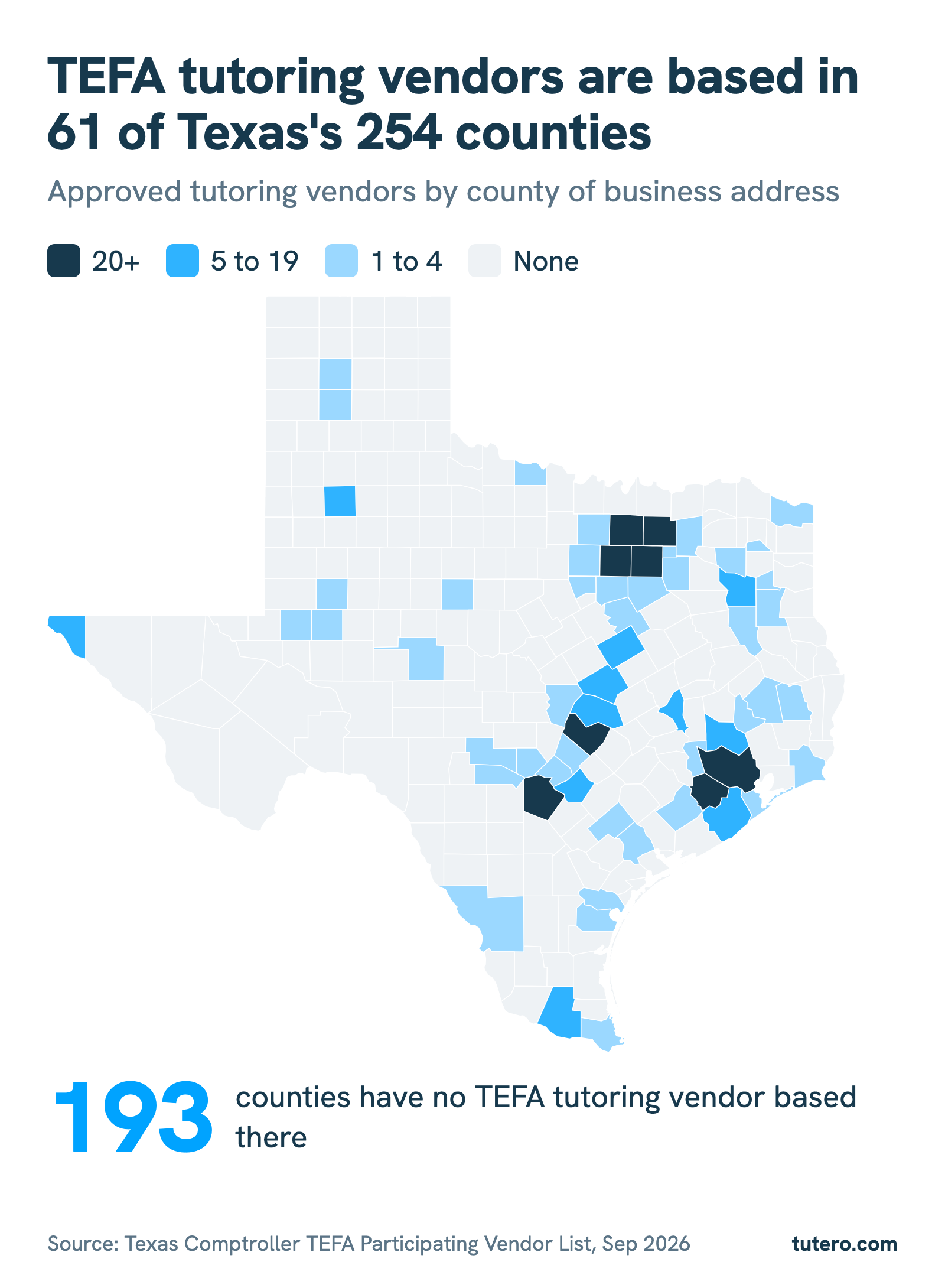
- Tutoring vendors are based in only 61 of Texas’s 254 counties. 193 counties have no TEFA tutoring vendor based there, even though TEFA students live in 895 school districts.
- Supply is uneven by region. The Austin region has 83 TEFA students per tutoring vendor. The Wichita Falls region has 711, San Angelo 576, Beaumont 538 and Corpus Christi 481.
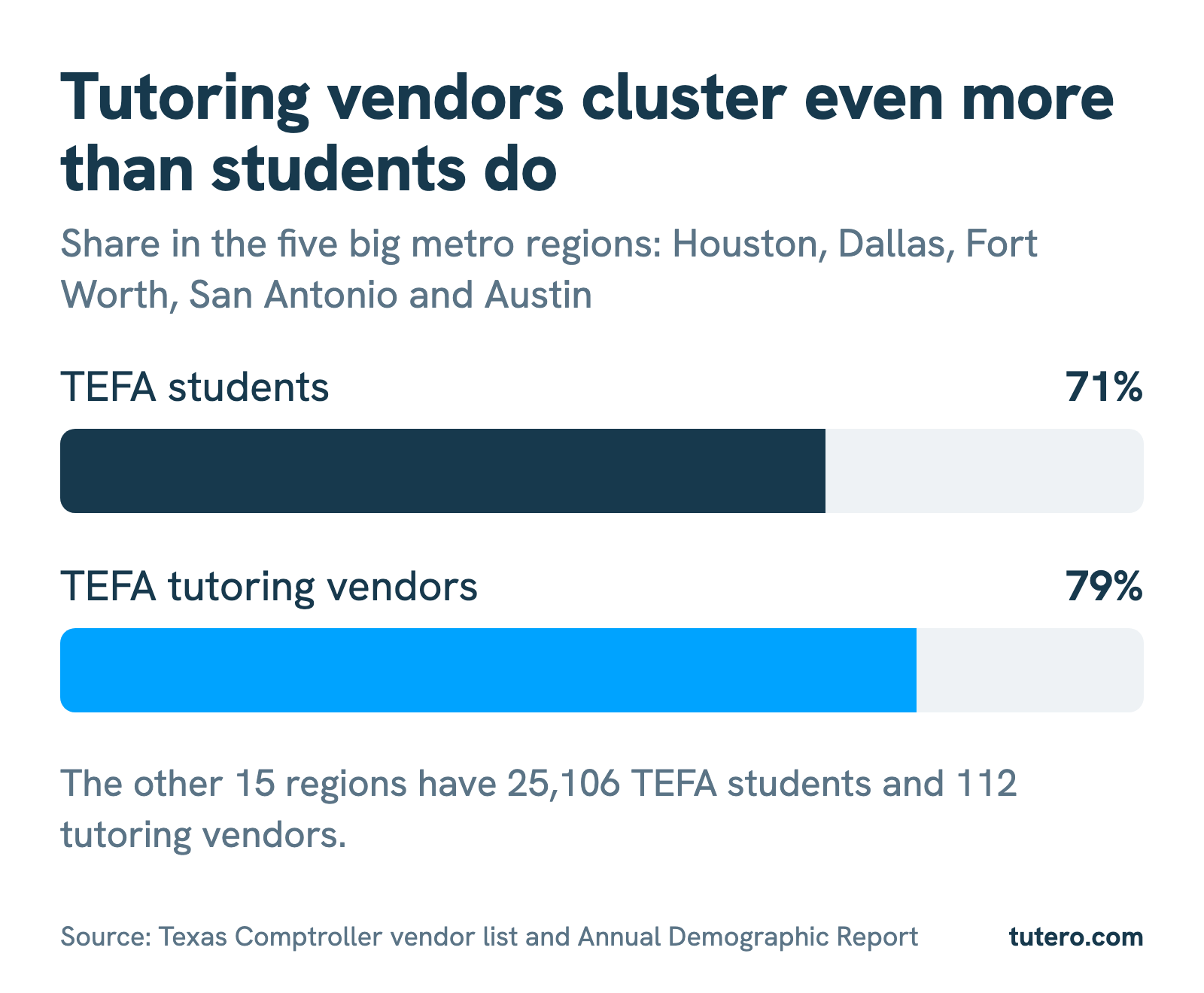
- Tutoring vendors cluster in the big metros even more than students do. The Houston, Dallas, Fort Worth, San Antonio and Austin regions hold 71% of TEFA students and 79% of TEFA tutoring vendors.
- Online lessons fill much of the gap. 74% of tutoring vendors say they teach online, either only online (15%) or online and in person (58%).
- Marketplace spending is small next to tuition so far. By August 2026, $36 million had been spent in the TEFA marketplace, where tutoring is bought, compared with $127 million paid in private school tuition, according to the Comptroller. How much of the $36 million went to tutoring is not published.
How many tutors are approved for TEFA?
The Comptroller publishes every approved vendor in its TEFA Participating Vendor List. The version we analyzed lists 2,160 vendors, with the most recent added on September 21, 2026. Each vendor picks a business type when it applies:
| Vendor type | Vendors | Share |
|---|---|---|
| Educational products | 495 | 23% |
| Therapist | 464 | 21% |
| Tutor | 409 | 19% |
| Other | 386 | 18% |
| Private school acting as a vendor | 192 | 9% |
| Teaching service | 155 | 7% |
| Pre-K provider, public school, college and unlisted | 59 | 3% |
Together, tutors and teaching services make up 564 vendors, or 26% of the list. A “Tutor” is usually one person or a small practice. A “Teaching Service” is a company that employs tutors or teachers. Tutero is listed as a Teaching Service.
A vendor is not the same as a tutor. One vendor can be a single tutor with a handful of students or a company with hundreds of teachers. So these numbers measure how much choice a family has and whether anyone is based nearby. They do not measure how many lessons Texas can deliver.
Most tutoring vendors joined early. 101 were approved in December 2025, when the Comptroller first invited existing vendors, and 127 joined in March 2026, during the family application window. Approvals slowed after that: 59 in July, 26 in August and 1 in September. 28 tutoring vendors are based outside Texas.
Where are TEFA tutors based?
We matched each vendor’s business ZIP code to its county, and each county to one of Texas’s 20 regional education service centers. The Comptroller reports TEFA participation by these same regions.
Tutoring vendors are concentrated in the big metro areas. Harris County alone has 87 tutoring vendors. Dallas, Tarrant, Bexar, Collin, Travis and Denton counties each have more than 30. Outside those areas, numbers drop fast. Many cities with large TEFA enrollment have one or two tutoring vendors based in the whole county:
| District (TEFA students, Oct 1, 2026) | County | Tutoring vendors based in county |
|---|---|---|
| Killeen ISD (1,370) | Bell | 8 |
| Corpus Christi ISD (1,076) | Nueces | 2 |
| Tyler ISD (861) | Smith | 5 |
| Victoria ISD (767) | Victoria | 1 |
| United ISD, Laredo (733) | Webb | 3 |
| Brownsville ISD (661) | Cameron | 4 |
| Beaumont ISD (526) | Jefferson | 1 |
| Midland ISD (467) | Midland | 1 |
District counts are from the Comptroller’s October 1, 2026 participants by district report and cover only that district. Other TEFA students live in nearby districts in the same county.
How many TEFA students are there per tutoring vendor?
The Comptroller’s Annual Demographic Report counts funded TEFA students in each region as of July 29, 2026, when 85,344 students were funded. Dividing those students by the tutoring vendors based in each region shows a wide spread.
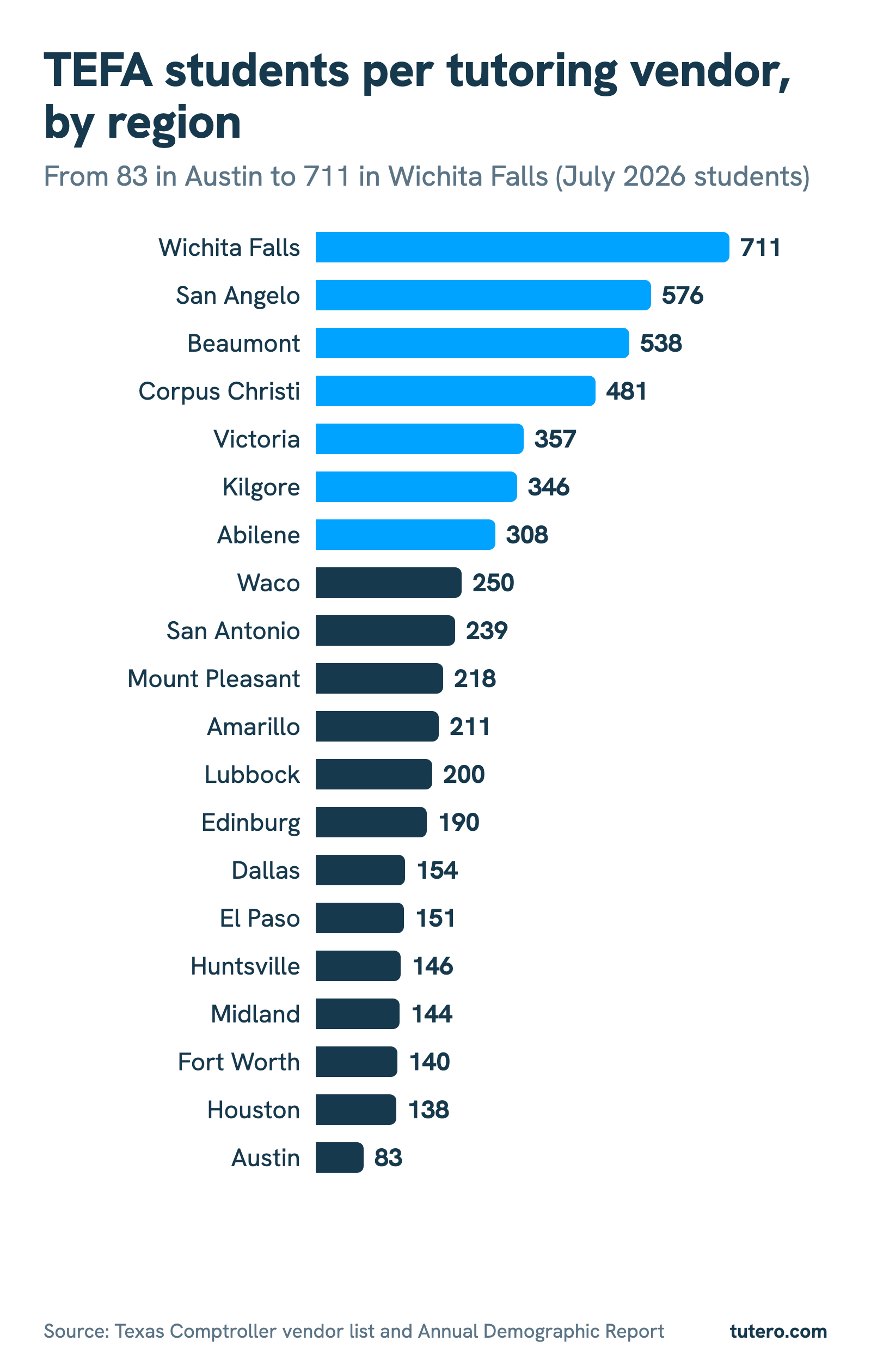
Seven regions have more than 300 TEFA students per tutoring vendor: Wichita Falls, San Angelo, Beaumont, Corpus Christi, Victoria, Kilgore (East Texas) and Abilene. Among the big metros, the San Antonio region stands out. It has 10,495 TEFA students, the fourth most in the state, but 44 tutoring vendors, which is 239 students per vendor. That is almost three times the Austin region’s 83.
Student numbers have grown since July, to 116,574 on October 1, so the real ratios today are higher everywhere. The Comptroller has not yet published October counts by region.
Online tutoring closes much of the gap
Each vendor also says how it delivers its services. Of the 564 tutoring vendors, 328 teach both online and in person, 149 teach only in person and 87 teach only online.
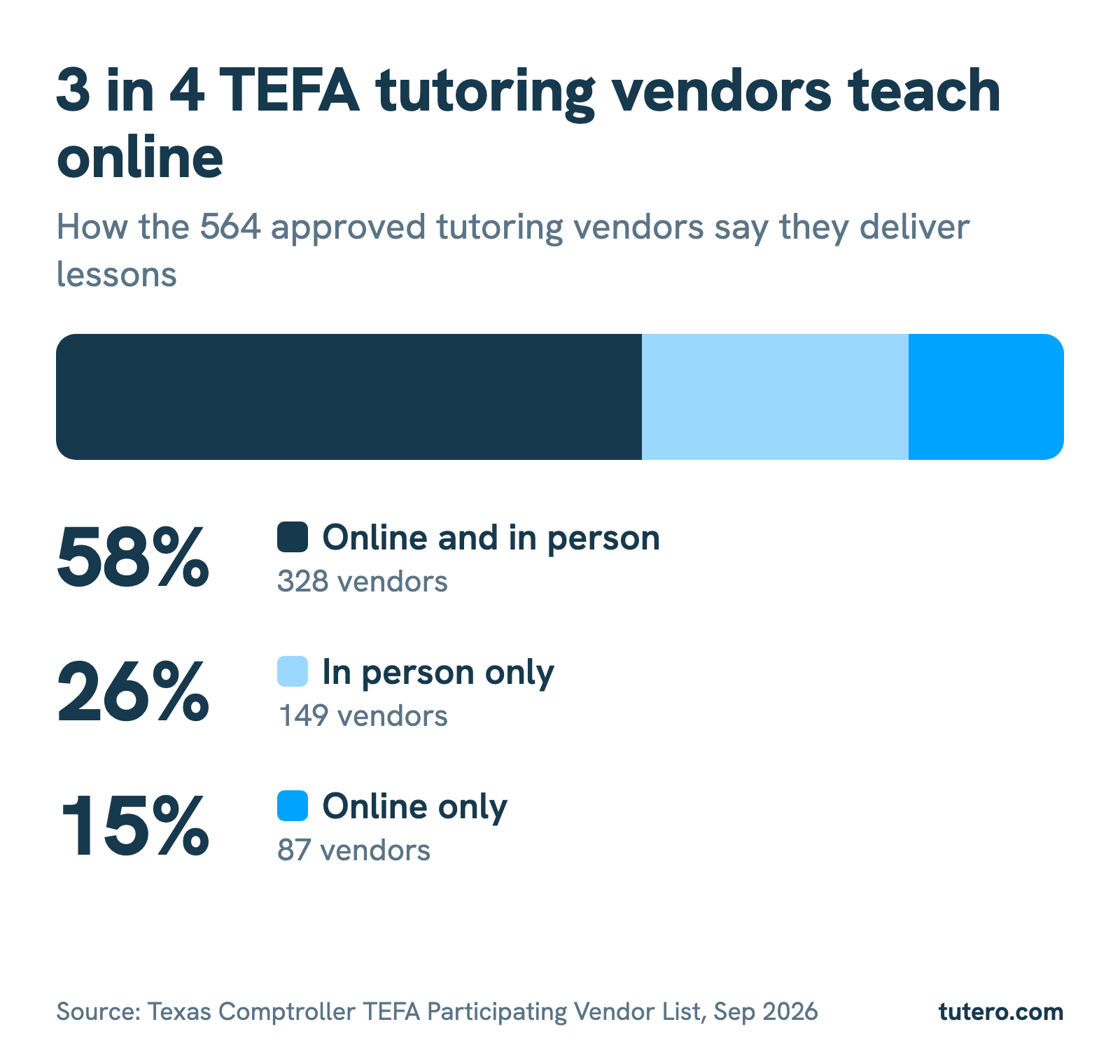
That means 415 tutoring vendors, or 74%, can teach a child anywhere in Texas. For a family in Victoria or Wichita Falls, the real choice is not between one local tutor and none. It is between a short list of local options and several hundred online ones. In-person tutoring, which some children need, is the part that stays scarce outside the metros.
How are families using their TEFA money?
Most TEFA money so far has gone to private school tuition. The Comptroller’s budget request for 2028-29, filed in August 2026, reports more than $270 million transferred to accounts, more than $127 million paid in tuition to private schools and $36 million spent in the marketplace, where tutoring, curriculum, therapies and devices are bought. Marketplace spending is not broken down by category, so how much has gone to tutoring is not public.
Who the program serves shapes what kind of tutoring families need:
- Young students. 61% of funded students in July were in pre-K to 6th grade, and only 18% were in high school.
- Students with disabilities. Almost 25% of funded students in July had a qualifying disability, according to the Annual Demographic Report.
- Homeschool families. More than 42,000 participating students were in homeschool or other non-private-school settings by September 2026. Their accounts hold $2,000 a year, so tutoring is one of the main things they can buy.
Families also search for the program, not for tutoring. In August 2026, searches in Texas for “odyssey tefa” and “tefa odyssey”, the platform where families spend their accounts, reached about 30,000. Searches for “tefa tutoring” were too few for Google to report. Parents look for tutors inside the marketplace, so how the marketplace sorts and displays tutoring vendors matters a great deal.
What TEFA families ask tutors for
Tutero is an approved TEFA vendor. Between July 1 and September 25, 2026, 82 Texas families filled in our TEFA tutoring enquiry form. It is a small sample, drawn from families who saw our ads, so treat it as a signal rather than a survey of all TEFA families. Their answers line up with the state data:
- Elementary first. 55% asked about elementary school, 30% middle school and 13% high school.
- Reading leads math. 44% wanted help with English and 37% with math.
- Confidence over grades. Asked for their main goal, 55% chose confidence, 28% grades and 17% happiness.
- Disability is common. Of the 22 families who told us their TEFA funding type, 15 said their child has an IEP or a disability.
- Many are still waiting. Of 60 families who answered, 42% already had a TEFA account and 37% did not yet but were interested.
What this means for parents
- If you live outside a big metro, look at online tutors too. Three in four TEFA tutoring vendors teach online. Our guide to how to pay for tutoring with TEFA walks through booking one.
- Check credentials and fit. Every TEFA tutor must meet the Comptroller’s Educator Credential Policy and pass a TEFA fingerprint background check. Being approved is not an endorsement, so ask about experience with your child’s age and needs.
- Know your budget. Homeschool accounts hold $2,000 a year and private school accounts $10,474 in 2026-27. The calculator in our TEFA eligibility and amounts guide estimates your child’s amount and priority tier.
What would help families
Three changes would make TEFA tutoring easier to find, especially outside the metros:
- Publish marketplace spending by category. Families, schools and lawmakers cannot see how much TEFA money goes to tutoring, therapies or curriculum.
- Let families filter the marketplace by delivery method and county. The vendor list already records both.
- Report participation by region more often. The July regional counts are now months old, and the program has grown by about 31,000 funded students since then.
Methodology
- Vendors. We downloaded the Comptroller’s Participating Vendor List on October 7, 2026 (2,160 vendors; latest addition September 21, 2026). “Tutoring vendors” are those with the business type “Tutor” or “Teaching Service”. Delivery method is as reported by each vendor.
- Location. We matched each vendor’s ZIP code to a county using the US Census Bureau’s 2020 ZIP code (ZCTA) to county file, assigning ZIP codes that cross county lines to the county with the most land area. We grouped counties into the 20 education service center regions. 12 Texas vendors could not be matched, and vendors based outside Texas are excluded from regional counts. A vendor’s address is where it is registered, not everywhere it works.
- Students. Regional student counts are funded participants by education service center from the TEFA Annual Demographic Report (as of July 29, 2026). The statewide total of 116,574 is from the Comptroller’s October 1, 2026 fact sheet. District counts are from the October 1, 2026 participants by district report.
- Spending. Spending figures are from the Comptroller’s Legislative Appropriations Request for fiscal years 2028-29 (August 2026). Search figures are Google Ads monthly search volumes for Texas, pulled October 7, 2026.
- Limits. Vendor counts measure choice and local presence, not tutoring capacity. Student counts by region are from July and are lower than today’s.
- Disclosure. Tutero is an approved TEFA vendor that tutors online, so we benefit when families choose online tutoring. We have reported the state’s numbers as published and shared our method so anyone can check them.
Using this data
Journalists, researchers and schools are welcome to use these findings and charts with a link to this page. For the regional data file, a county-level breakdown or an interview, email Joey Moshinsky, co-founder of Tutero, at joey@tutero.com.
About this report
Written by Tutero’s Texas team. Tutero is an approved TEFA vendor. Every program figure comes from the Texas Comptroller’s published TEFA documents. We will update this report when the Comptroller publishes new vendor or participation data.
Related guides: TEFA eligibility and account amounts, the TEFA marketplace in Odyssey and TEFA FAQ. See how TEFA tutoring works with Tutero.
Your next step
Find a TEFA tutor wherever you live in Texas
Expert teachers, 1-on-1 and online, paid from your TEFA account with $0 out of pocket.
Or estimate your amount: TEFA calculator →
Key findings
Texas Education Freedom Accounts (TEFA) let parents spend state money on tutoring, but where a family lives changes how many tutors they can choose from. We analyzed the Texas Comptroller’s list of 2,160 approved TEFA vendors alongside the state’s own participation data. Here is what we found.
- 564 tutoring vendors are approved for TEFA. That is 409 listed as “Tutor” and 155 as “Teaching Service”, about one in four of all approved vendors. With 116,574 participating students on October 1, 2026, that works out to about 207 TEFA students for every tutoring vendor.
- Tutoring vendors are based in only 61 of Texas’s 254 counties. 193 counties have no TEFA tutoring vendor based there, even though TEFA students live in 895 school districts.
- Supply is uneven by region. The Austin region has 83 TEFA students per tutoring vendor. The Wichita Falls region has 711, San Angelo 576, Beaumont 538 and Corpus Christi 481.
- Tutoring vendors cluster in the big metros even more than students do. The Houston, Dallas, Fort Worth, San Antonio and Austin regions hold 71% of TEFA students and 79% of TEFA tutoring vendors.
- Online lessons fill much of the gap. 74% of tutoring vendors say they teach online, either only online (15%) or online and in person (58%).
- Marketplace spending is small next to tuition so far. By August 2026, $36 million had been spent in the TEFA marketplace, where tutoring is bought, compared with $127 million paid in private school tuition, according to the Comptroller. How much of the $36 million went to tutoring is not published.
How many tutors are approved for TEFA?
The Comptroller publishes every approved vendor in its TEFA Participating Vendor List. The version we analyzed lists 2,160 vendors, with the most recent added on September 21, 2026. Each vendor picks a business type when it applies:
| Vendor type | Vendors | Share |
|---|---|---|
| Educational products | 495 | 23% |
| Therapist | 464 | 21% |
| Tutor | 409 | 19% |
| Other | 386 | 18% |
| Private school acting as a vendor | 192 | 9% |
| Teaching service | 155 | 7% |
| Pre-K provider, public school, college and unlisted | 59 | 3% |
Together, tutors and teaching services make up 564 vendors, or 26% of the list. A “Tutor” is usually one person or a small practice. A “Teaching Service” is a company that employs tutors or teachers. Tutero is listed as a Teaching Service.
A vendor is not the same as a tutor. One vendor can be a single tutor with a handful of students or a company with hundreds of teachers. So these numbers measure how much choice a family has and whether anyone is based nearby. They do not measure how many lessons Texas can deliver.
Most tutoring vendors joined early. 101 were approved in December 2025, when the Comptroller first invited existing vendors, and 127 joined in March 2026, during the family application window. Approvals slowed after that: 59 in July, 26 in August and 1 in September. 28 tutoring vendors are based outside Texas.
Where are TEFA tutors based?
We matched each vendor’s business ZIP code to its county, and each county to one of Texas’s 20 regional education service centers. The Comptroller reports TEFA participation by these same regions.
Tutoring vendors are concentrated in the big metro areas. Harris County alone has 87 tutoring vendors. Dallas, Tarrant, Bexar, Collin, Travis and Denton counties each have more than 30. Outside those areas, numbers drop fast. Many cities with large TEFA enrollment have one or two tutoring vendors based in the whole county:
| District (TEFA students, Oct 1, 2026) | County | Tutoring vendors based in county |
|---|---|---|
| Killeen ISD (1,370) | Bell | 8 |
| Corpus Christi ISD (1,076) | Nueces | 2 |
| Tyler ISD (861) | Smith | 5 |
| Victoria ISD (767) | Victoria | 1 |
| United ISD, Laredo (733) | Webb | 3 |
| Brownsville ISD (661) | Cameron | 4 |
| Beaumont ISD (526) | Jefferson | 1 |
| Midland ISD (467) | Midland | 1 |
District counts are from the Comptroller’s October 1, 2026 participants by district report and cover only that district. Other TEFA students live in nearby districts in the same county.
How many TEFA students are there per tutoring vendor?
The Comptroller’s Annual Demographic Report counts funded TEFA students in each region as of July 29, 2026, when 85,344 students were funded. Dividing those students by the tutoring vendors based in each region shows a wide spread.
Seven regions have more than 300 TEFA students per tutoring vendor: Wichita Falls, San Angelo, Beaumont, Corpus Christi, Victoria, Kilgore (East Texas) and Abilene. Among the big metros, the San Antonio region stands out. It has 10,495 TEFA students, the fourth most in the state, but 44 tutoring vendors, which is 239 students per vendor. That is almost three times the Austin region’s 83.
Student numbers have grown since July, to 116,574 on October 1, so the real ratios today are higher everywhere. The Comptroller has not yet published October counts by region.
Online tutoring closes much of the gap
Each vendor also says how it delivers its services. Of the 564 tutoring vendors, 328 teach both online and in person, 149 teach only in person and 87 teach only online.
That means 415 tutoring vendors, or 74%, can teach a child anywhere in Texas. For a family in Victoria or Wichita Falls, the real choice is not between one local tutor and none. It is between a short list of local options and several hundred online ones. In-person tutoring, which some children need, is the part that stays scarce outside the metros.
How are families using their TEFA money?
Most TEFA money so far has gone to private school tuition. The Comptroller’s budget request for 2028-29, filed in August 2026, reports more than $270 million transferred to accounts, more than $127 million paid in tuition to private schools and $36 million spent in the marketplace, where tutoring, curriculum, therapies and devices are bought. Marketplace spending is not broken down by category, so how much has gone to tutoring is not public.
Who the program serves shapes what kind of tutoring families need:
- Young students. 61% of funded students in July were in pre-K to 6th grade, and only 18% were in high school.
- Students with disabilities. Almost 25% of funded students in July had a qualifying disability, according to the Annual Demographic Report.
- Homeschool families. More than 42,000 participating students were in homeschool or other non-private-school settings by September 2026. Their accounts hold $2,000 a year, so tutoring is one of the main things they can buy.
Families also search for the program, not for tutoring. In August 2026, searches in Texas for “odyssey tefa” and “tefa odyssey”, the platform where families spend their accounts, reached about 30,000. Searches for “tefa tutoring” were too few for Google to report. Parents look for tutors inside the marketplace, so how the marketplace sorts and displays tutoring vendors matters a great deal.
What TEFA families ask tutors for
Tutero is an approved TEFA vendor. Between July 1 and September 25, 2026, 82 Texas families filled in our TEFA tutoring enquiry form. It is a small sample, drawn from families who saw our ads, so treat it as a signal rather than a survey of all TEFA families. Their answers line up with the state data:
- Elementary first. 55% asked about elementary school, 30% middle school and 13% high school.
- Reading leads math. 44% wanted help with English and 37% with math.
- Confidence over grades. Asked for their main goal, 55% chose confidence, 28% grades and 17% happiness.
- Disability is common. Of the 22 families who told us their TEFA funding type, 15 said their child has an IEP or a disability.
- Many are still waiting. Of 60 families who answered, 42% already had a TEFA account and 37% did not yet but were interested.
What this means for parents
- If you live outside a big metro, look at online tutors too. Three in four TEFA tutoring vendors teach online. Our guide to how to pay for tutoring with TEFA walks through booking one.
- Check credentials and fit. Every TEFA tutor must meet the Comptroller’s Educator Credential Policy and pass a TEFA fingerprint background check. Being approved is not an endorsement, so ask about experience with your child’s age and needs.
- Know your budget. Homeschool accounts hold $2,000 a year and private school accounts $10,474 in 2026-27. The calculator in our TEFA eligibility and amounts guide estimates your child’s amount and priority tier.
What would help families
Three changes would make TEFA tutoring easier to find, especially outside the metros:
- Publish marketplace spending by category. Families, schools and lawmakers cannot see how much TEFA money goes to tutoring, therapies or curriculum.
- Let families filter the marketplace by delivery method and county. The vendor list already records both.
- Report participation by region more often. The July regional counts are now months old, and the program has grown by about 31,000 funded students since then.
Methodology
- Vendors. We downloaded the Comptroller’s Participating Vendor List on October 7, 2026 (2,160 vendors; latest addition September 21, 2026). “Tutoring vendors” are those with the business type “Tutor” or “Teaching Service”. Delivery method is as reported by each vendor.
- Location. We matched each vendor’s ZIP code to a county using the US Census Bureau’s 2020 ZIP code (ZCTA) to county file, assigning ZIP codes that cross county lines to the county with the most land area. We grouped counties into the 20 education service center regions. 12 Texas vendors could not be matched, and vendors based outside Texas are excluded from regional counts. A vendor’s address is where it is registered, not everywhere it works.
- Students. Regional student counts are funded participants by education service center from the TEFA Annual Demographic Report (as of July 29, 2026). The statewide total of 116,574 is from the Comptroller’s October 1, 2026 fact sheet. District counts are from the October 1, 2026 participants by district report.
- Spending. Spending figures are from the Comptroller’s Legislative Appropriations Request for fiscal years 2028-29 (August 2026). Search figures are Google Ads monthly search volumes for Texas, pulled October 7, 2026.
- Limits. Vendor counts measure choice and local presence, not tutoring capacity. Student counts by region are from July and are lower than today’s.
- Disclosure. Tutero is an approved TEFA vendor that tutors online, so we benefit when families choose online tutoring. We have reported the state’s numbers as published and shared our method so anyone can check them.
Using this data
Journalists, researchers and schools are welcome to use these findings and charts with a link to this page. For the regional data file, a county-level breakdown or an interview, email Joey Moshinsky, co-founder of Tutero, at joey@tutero.com.
About this report
Written by Tutero’s Texas team. Tutero is an approved TEFA vendor. Every program figure comes from the Texas Comptroller’s published TEFA documents. We will update this report when the Comptroller publishes new vendor or participation data.
Related guides: TEFA eligibility and account amounts, the TEFA marketplace in Odyssey and TEFA FAQ. See how TEFA tutoring works with Tutero.
Your next step
Find a TEFA tutor wherever you live in Texas
Expert teachers, 1-on-1 and online, paid from your TEFA account with $0 out of pocket.
Or estimate your amount: TEFA calculator →

Key findings
Texas Education Freedom Accounts (TEFA) let parents spend state money on tutoring, but where a family lives changes how many tutors they can choose from. We analyzed the Texas Comptroller’s list of 2,160 approved TEFA vendors alongside the state’s own participation data. Here is what we found.
- 564 tutoring vendors are approved for TEFA. That is 409 listed as “Tutor” and 155 as “Teaching Service”, about one in four of all approved vendors. With 116,574 participating students on October 1, 2026, that works out to about 207 TEFA students for every tutoring vendor.
- Tutoring vendors are based in only 61 of Texas’s 254 counties. 193 counties have no TEFA tutoring vendor based there, even though TEFA students live in 895 school districts.
- Supply is uneven by region. The Austin region has 83 TEFA students per tutoring vendor. The Wichita Falls region has 711, San Angelo 576, Beaumont 538 and Corpus Christi 481.
- Tutoring vendors cluster in the big metros even more than students do. The Houston, Dallas, Fort Worth, San Antonio and Austin regions hold 71% of TEFA students and 79% of TEFA tutoring vendors.
- Online lessons fill much of the gap. 74% of tutoring vendors say they teach online, either only online (15%) or online and in person (58%).
- Marketplace spending is small next to tuition so far. By August 2026, $36 million had been spent in the TEFA marketplace, where tutoring is bought, compared with $127 million paid in private school tuition, according to the Comptroller. How much of the $36 million went to tutoring is not published.
How many tutors are approved for TEFA?
The Comptroller publishes every approved vendor in its TEFA Participating Vendor List. The version we analyzed lists 2,160 vendors, with the most recent added on September 21, 2026. Each vendor picks a business type when it applies:
| Vendor type | Vendors | Share |
|---|---|---|
| Educational products | 495 | 23% |
| Therapist | 464 | 21% |
| Tutor | 409 | 19% |
| Other | 386 | 18% |
| Private school acting as a vendor | 192 | 9% |
| Teaching service | 155 | 7% |
| Pre-K provider, public school, college and unlisted | 59 | 3% |
Together, tutors and teaching services make up 564 vendors, or 26% of the list. A “Tutor” is usually one person or a small practice. A “Teaching Service” is a company that employs tutors or teachers. Tutero is listed as a Teaching Service.
A vendor is not the same as a tutor. One vendor can be a single tutor with a handful of students or a company with hundreds of teachers. So these numbers measure how much choice a family has and whether anyone is based nearby. They do not measure how many lessons Texas can deliver.
Most tutoring vendors joined early. 101 were approved in December 2025, when the Comptroller first invited existing vendors, and 127 joined in March 2026, during the family application window. Approvals slowed after that: 59 in July, 26 in August and 1 in September. 28 tutoring vendors are based outside Texas.
Where are TEFA tutors based?
We matched each vendor’s business ZIP code to its county, and each county to one of Texas’s 20 regional education service centers. The Comptroller reports TEFA participation by these same regions.
Tutoring vendors are concentrated in the big metro areas. Harris County alone has 87 tutoring vendors. Dallas, Tarrant, Bexar, Collin, Travis and Denton counties each have more than 30. Outside those areas, numbers drop fast. Many cities with large TEFA enrollment have one or two tutoring vendors based in the whole county:
| District (TEFA students, Oct 1, 2026) | County | Tutoring vendors based in county |
|---|---|---|
| Killeen ISD (1,370) | Bell | 8 |
| Corpus Christi ISD (1,076) | Nueces | 2 |
| Tyler ISD (861) | Smith | 5 |
| Victoria ISD (767) | Victoria | 1 |
| United ISD, Laredo (733) | Webb | 3 |
| Brownsville ISD (661) | Cameron | 4 |
| Beaumont ISD (526) | Jefferson | 1 |
| Midland ISD (467) | Midland | 1 |
District counts are from the Comptroller’s October 1, 2026 participants by district report and cover only that district. Other TEFA students live in nearby districts in the same county.
How many TEFA students are there per tutoring vendor?
The Comptroller’s Annual Demographic Report counts funded TEFA students in each region as of July 29, 2026, when 85,344 students were funded. Dividing those students by the tutoring vendors based in each region shows a wide spread.
Seven regions have more than 300 TEFA students per tutoring vendor: Wichita Falls, San Angelo, Beaumont, Corpus Christi, Victoria, Kilgore (East Texas) and Abilene. Among the big metros, the San Antonio region stands out. It has 10,495 TEFA students, the fourth most in the state, but 44 tutoring vendors, which is 239 students per vendor. That is almost three times the Austin region’s 83.
Student numbers have grown since July, to 116,574 on October 1, so the real ratios today are higher everywhere. The Comptroller has not yet published October counts by region.
Online tutoring closes much of the gap
Each vendor also says how it delivers its services. Of the 564 tutoring vendors, 328 teach both online and in person, 149 teach only in person and 87 teach only online.
That means 415 tutoring vendors, or 74%, can teach a child anywhere in Texas. For a family in Victoria or Wichita Falls, the real choice is not between one local tutor and none. It is between a short list of local options and several hundred online ones. In-person tutoring, which some children need, is the part that stays scarce outside the metros.
How are families using their TEFA money?
Most TEFA money so far has gone to private school tuition. The Comptroller’s budget request for 2028-29, filed in August 2026, reports more than $270 million transferred to accounts, more than $127 million paid in tuition to private schools and $36 million spent in the marketplace, where tutoring, curriculum, therapies and devices are bought. Marketplace spending is not broken down by category, so how much has gone to tutoring is not public.
Who the program serves shapes what kind of tutoring families need:
- Young students. 61% of funded students in July were in pre-K to 6th grade, and only 18% were in high school.
- Students with disabilities. Almost 25% of funded students in July had a qualifying disability, according to the Annual Demographic Report.
- Homeschool families. More than 42,000 participating students were in homeschool or other non-private-school settings by September 2026. Their accounts hold $2,000 a year, so tutoring is one of the main things they can buy.
Families also search for the program, not for tutoring. In August 2026, searches in Texas for “odyssey tefa” and “tefa odyssey”, the platform where families spend their accounts, reached about 30,000. Searches for “tefa tutoring” were too few for Google to report. Parents look for tutors inside the marketplace, so how the marketplace sorts and displays tutoring vendors matters a great deal.
What TEFA families ask tutors for
Tutero is an approved TEFA vendor. Between July 1 and September 25, 2026, 82 Texas families filled in our TEFA tutoring enquiry form. It is a small sample, drawn from families who saw our ads, so treat it as a signal rather than a survey of all TEFA families. Their answers line up with the state data:
- Elementary first. 55% asked about elementary school, 30% middle school and 13% high school.
- Reading leads math. 44% wanted help with English and 37% with math.
- Confidence over grades. Asked for their main goal, 55% chose confidence, 28% grades and 17% happiness.
- Disability is common. Of the 22 families who told us their TEFA funding type, 15 said their child has an IEP or a disability.
- Many are still waiting. Of 60 families who answered, 42% already had a TEFA account and 37% did not yet but were interested.
What this means for parents
- If you live outside a big metro, look at online tutors too. Three in four TEFA tutoring vendors teach online. Our guide to how to pay for tutoring with TEFA walks through booking one.
- Check credentials and fit. Every TEFA tutor must meet the Comptroller’s Educator Credential Policy and pass a TEFA fingerprint background check. Being approved is not an endorsement, so ask about experience with your child’s age and needs.
- Know your budget. Homeschool accounts hold $2,000 a year and private school accounts $10,474 in 2026-27. The calculator in our TEFA eligibility and amounts guide estimates your child’s amount and priority tier.
What would help families
Three changes would make TEFA tutoring easier to find, especially outside the metros:
- Publish marketplace spending by category. Families, schools and lawmakers cannot see how much TEFA money goes to tutoring, therapies or curriculum.
- Let families filter the marketplace by delivery method and county. The vendor list already records both.
- Report participation by region more often. The July regional counts are now months old, and the program has grown by about 31,000 funded students since then.
Methodology
- Vendors. We downloaded the Comptroller’s Participating Vendor List on October 7, 2026 (2,160 vendors; latest addition September 21, 2026). “Tutoring vendors” are those with the business type “Tutor” or “Teaching Service”. Delivery method is as reported by each vendor.
- Location. We matched each vendor’s ZIP code to a county using the US Census Bureau’s 2020 ZIP code (ZCTA) to county file, assigning ZIP codes that cross county lines to the county with the most land area. We grouped counties into the 20 education service center regions. 12 Texas vendors could not be matched, and vendors based outside Texas are excluded from regional counts. A vendor’s address is where it is registered, not everywhere it works.
- Students. Regional student counts are funded participants by education service center from the TEFA Annual Demographic Report (as of July 29, 2026). The statewide total of 116,574 is from the Comptroller’s October 1, 2026 fact sheet. District counts are from the October 1, 2026 participants by district report.
- Spending. Spending figures are from the Comptroller’s Legislative Appropriations Request for fiscal years 2028-29 (August 2026). Search figures are Google Ads monthly search volumes for Texas, pulled October 7, 2026.
- Limits. Vendor counts measure choice and local presence, not tutoring capacity. Student counts by region are from July and are lower than today’s.
- Disclosure. Tutero is an approved TEFA vendor that tutors online, so we benefit when families choose online tutoring. We have reported the state’s numbers as published and shared our method so anyone can check them.
Using this data
Journalists, researchers and schools are welcome to use these findings and charts with a link to this page. For the regional data file, a county-level breakdown or an interview, email Joey Moshinsky, co-founder of Tutero, at joey@tutero.com.
About this report
Written by Tutero’s Texas team. Tutero is an approved TEFA vendor. Every program figure comes from the Texas Comptroller’s published TEFA documents. We will update this report when the Comptroller publishes new vendor or participation data.
Related guides: TEFA eligibility and account amounts, the TEFA marketplace in Odyssey and TEFA FAQ. See how TEFA tutoring works with Tutero.
Your next step
Find a TEFA tutor wherever you live in Texas
Expert teachers, 1-on-1 and online, paid from your TEFA account with $0 out of pocket.
Or estimate your amount: TEFA calculator →
.svg)
.svg)
As of the Comptroller’s Participating Vendor List with additions through September 21, 2026, 564 tutoring vendors are approved: 409 listed as Tutor and 155 as Teaching Service. A vendor can be one tutor or a company with many tutors.
Approved tutors are listed in the TEFA marketplace in your child’s Odyssey account under the Tutoring category. The Comptroller also publishes the full Participating Vendor List on educationfreedom.texas.gov.
Tutoring vendors are based in 61 of Texas’s 254 counties, mostly around Houston, Dallas-Fort Worth, Austin and San Antonio. 74% of tutoring vendors teach online, so families anywhere in Texas can choose an online tutor.
Yes. Fees for a private tutor or teaching service are an approved TEFA expense, online or in person, as long as the vendor is approved and you book through the Odyssey marketplace.
The Comptroller has not published spending by category. By August 2026, $36 million had been spent in the TEFA marketplace, which includes tutoring, curriculum, therapies and devices, compared with $127 million in private school tuition.
Yes. Please link to this page as the source. For the regional data file or an interview, email joey@tutero.com.
Hoping to improve confidence & grades?

.png)