.svg)

Roughly 28% of US middle-school math classrooms are taught by teachers without a math-specialist background, according to RAND's 2024 out-of-field teaching report and US Department of Education Schools and Staffing Survey data. Out-of-field math teaching is normal, it is not your fault, and it does not mean your students are doomed — but it does mean the next term needs a deliberate plan rather than a hope-for-the-best one.
This guide is the practical scaffold an out-of-field math teacher actually needs: what to study yourself first, where to find trusted explainers, how to build a grade-by-grade content map, when to teach concept before procedure, and when to escalate to a math-specialist colleague. Throughout, we cite the primary sources teachers ask us about — NCTM, the National Math Panel, RAND's 2024 out-of-field teaching report, the Education Endowment Foundation, and Hattie's Visible Learning effect sizes on teacher confidence.
Quick answer: prioritize concept mastery before procedure for the next two weeks of content, build a tight reference list of three trusted explainers per topic (a textbook, a video, and a worked-example bank), shadow a math-specialist colleague for one period every two weeks, and use an AI co-teacher to pressure-test your own understanding before each lesson. The Tutero AI Co-Teacher was built for exactly this — your math-specialist co-pilot when one is not in the room.
What does “out-of-field teaching” actually mean?
Out-of-field teaching is when a teacher is assigned classes in a subject they did not specialize in during their initial teacher education. The US Department of Education defines it as teaching a subject for which the teacher has not completed at least a major sequence of tertiary study, plus the matching curriculum and pedagogy units. In US middle and high schools, mathematics is the most common out-of-field assignment, followed by science and English language arts. The RAND 2024 out-of-field teaching report found 28% of US middle-school math teachers held a teaching credential in a non-math subject, with rural and high-poverty schools disproportionately affected. The pattern is similar across most OECD countries. Out-of-field teaching is a school staffing decision, not a verdict on you.
How do I prepare for a math class I am not qualified to teach?
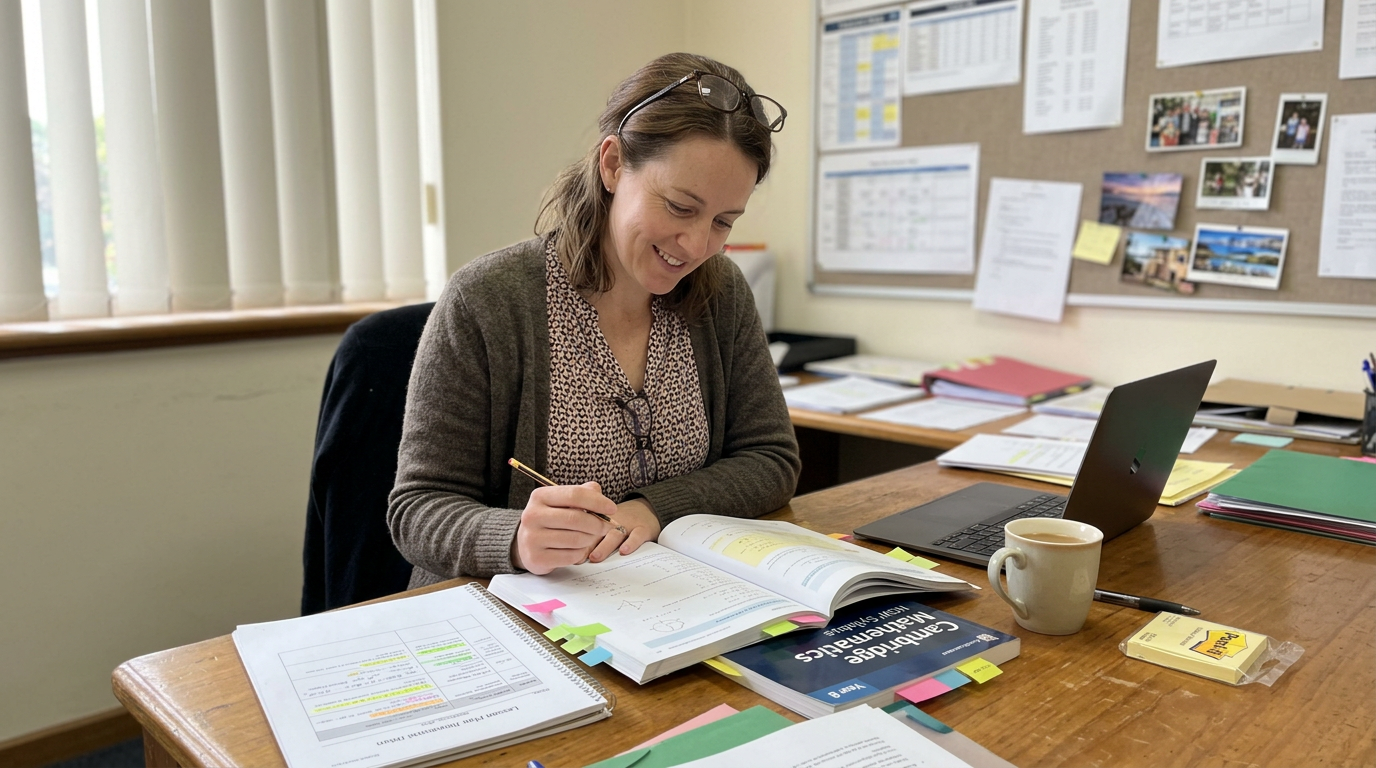
Treat the next two weeks of curriculum as your own learning project. For each lesson, follow a four-step prep loop: read the relevant page of the textbook teacher edition; watch one trusted video explainer for the same concept (Eddie Woo on YouTube for visual senior content, 3Blue1Brown for visual intuition, Khan Academy for procedural worked examples); work through six to eight student-level problems yourself in a notebook before you write a lesson plan; pressure-test your understanding by explaining the concept aloud to an AI co-teacher and asking it to find the gaps. The Education Endowment Foundation's mathematics evidence reviews repeatedly find that teacher subject confidence is one of the strongest predictors of student gains — Hattie places teacher self-efficacy at an effect size of d = 0.92, well above the 0.4 hinge point.
What should I study myself first?
Start with the concepts that come up earliest and most often: place value and number sense for grades 6–7, fractions and decimal arithmetic for grades 6–8, linear equations and graphing for grade 8, and quadratics plus introductory probability for grade 9. Illustrative Mathematics, Open Up Resources, and the National Council of Teachers of Mathematics (NCTM) Essential Understandings series are free, written for teachers, and walk through both the math and the common student misconceptions — bookmark them as your first reference.
What resources help out-of-field math teachers?
Out-of-field teachers do not need more resources, they need fewer trusted ones. Build a tight reference stack of three explainers per topic: one textbook (your school's adopted grades 6–9 textbook plus its teacher edition), one video channel for visual intuition (Eddie Woo's Wootube covers most of the senior syllabus for free; 3Blue1Brown is the gold standard for the why behind the procedure), and one worked-example bank (Khan Academy or the NCTM Essential Understandings). Add the NCTM professional learning library for pedagogy, and the NBPTS Five Core Propositions for what accomplished math teaching actually looks like in a real classroom. Skip the bottomless Pinterest boards — they are a productivity trap when you are out-of-field.
Which US sources should I trust?
Four primary sources cover almost everything an American out-of-field math teacher needs:
- NCTM — the National Council of Teachers of Mathematics, with state affiliates running PD specifically for non-specialist teachers and the Principles to Actions teaching framework.
- National Math Panel and What Works Clearinghouse — US Department of Education syntheses of what the evidence base actually supports for math instruction.
- Illustrative Mathematics and Open Up Resources — free open-licensed math content modules used by hundreds of US districts.
- Common Core State Standards (or your state standards) — the math content standards and learning progressions for grades 6–9 are the source of truth for what your students must know by the end of the year.
Should I teach concept before procedure?
Yes, and this is the single highest-leverage shift an out-of-field teacher can make. Specialist math teachers often default to procedure-first because they intuit the concept and can scaffold it on the fly. Non-specialists who copy that pattern leave students without the conceptual hook, so the procedure feels arbitrary and is forgotten within two weeks. The Education Endowment Foundation's Improving Mathematics in Key Stages 2 and 3 guidance puts conceptual understanding ahead of procedural fluency in its order of recommendations, with effect sizes consistently above d = 0.5 for concept-first teaching across replication studies. Practically: spend the first ten minutes of every new topic on a concrete example, a manipulative, or a visual model before you write the first algebraic step on the board.
How do I build a grade-by-grade content map?
A content map is a one-page document, per year level, listing the six to ten major topic strands with three columns: what students should already know, what they need to know by year-end, and what comes next. Build it once, refer to it every week. Source the inputs from the Common Core State Standards (or your state's math standards) for grades 6–9, alongside the NCTM learning progressions, then sanity-check the sequence against your school's adopted scope-and-sequence document. The point of the map is not coverage anxiety; it is to stop you over-teaching topics you find easy and rushing topics you find hard. Most out-of-field teachers do both unconsciously in their first year.
When should I escalate to a math-specialist colleague?
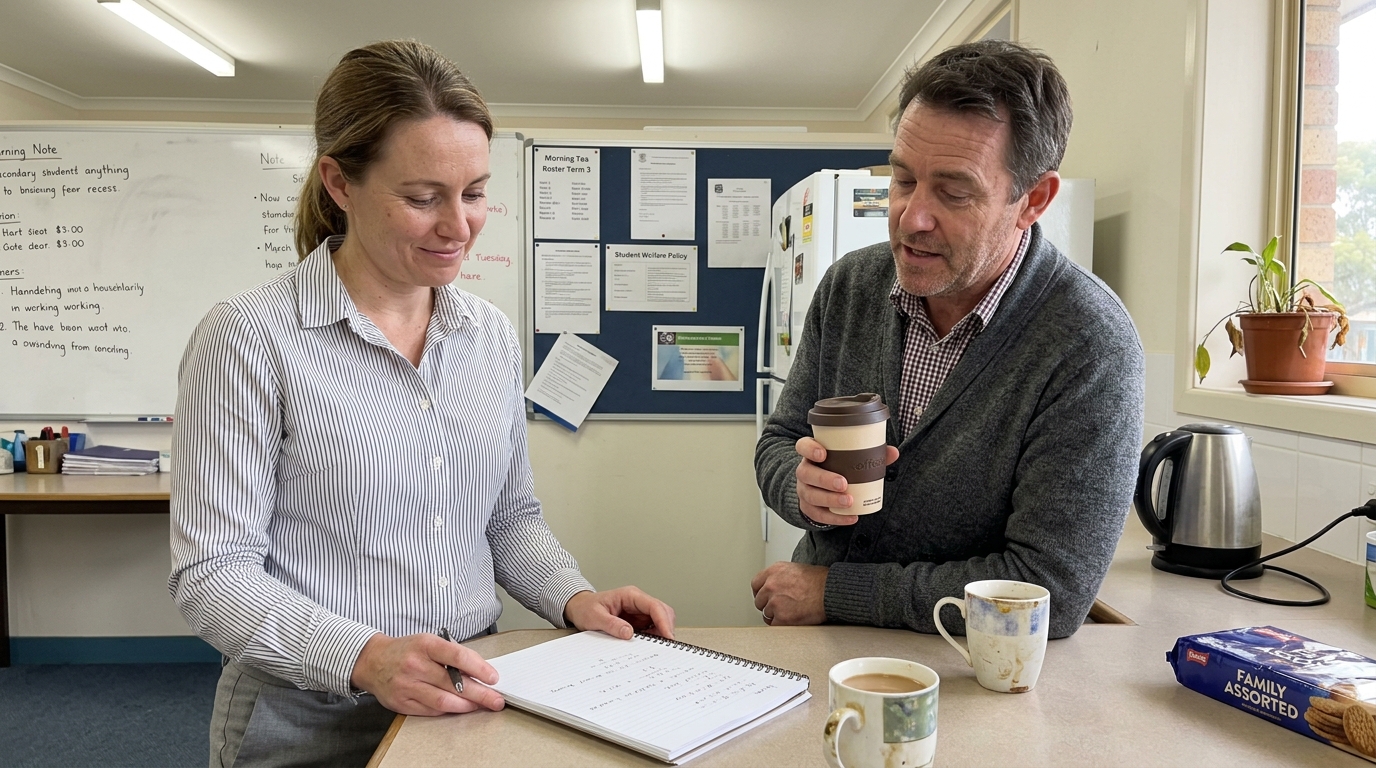
Escalate early and often. The pattern that fails out-of-field teachers is privately struggling for a week, googling at 11pm, then teaching a half-formed lesson on autopilot. The pattern that works is a five-minute conversation with a math-specialist colleague at morning break on Monday, before the lesson is taught on Wednesday. Specifically, escalate when: a textbook explanation does not click after one careful read; you are about to teach a topic for the first time; a student asks a why question and your answer feels like a procedure not a reason; you are introducing a new representation (number line, area model, function graph) and you are not sure which to lead with. Bring a notebook with the specific concept written down so the conversation is concrete, not abstract.
Can AI help me teach math if I am not a math specialist?
Yes — and used well, an AI co-teacher closes the largest gap an out-of-field teacher faces, which is the absence of a math-specialist colleague at the moment of preparation. Three uses are particularly high-leverage. First, pressure-test your own understanding of a concept by explaining it aloud to the AI and asking it to identify gaps or misconceptions in your explanation. Second, generate three to five worked examples at progressively harder difficulty levels for the lesson you are about to teach. Third, anticipate the why questions a grade 7 student is most likely to ask about a topic, with model answers you can rehearse. The Tutero AI Co-Teacher was built specifically for this use case — it is your math-specialist co-pilot when one is not in the room. Try the AI Co-Teacher before your next lesson plan.
How long does it take to upskill in math teaching?
Plan for a two-year arc, with a confident first term as the realistic short-term goal. The NCTM professional learning framework and the National Math Panel both suggest 70–100 hours of dedicated subject and pedagogy study to teach a year level confidently — roughly two hours a week across an academic year. National Board Certification (NBPTS) in mathematics, which signals deep subject expertise, typically takes three to five years from initial registration. The realistic target for your first term is to be one chapter ahead of your students at all times, with a clear content map and a math-specialist colleague you can phone. Confidence compounds quickly once the prep loop is consistent.
How can an elementary teacher teach 6th-grade math confidently?
Elementary teachers redeployed to middle-school math usually have a stronger pedagogy base than secondary specialists give them credit for, but a thinner conceptual base in algebra, proportional reasoning, and probability. The fastest fix is to spend the summer break working through the grade 6 textbook front to back yourself, treating it as a student would, then watch the matching Eddie Woo or Khan Academy explainer for any topic that took longer than fifteen minutes to internalize. Lean on your primary-school strengths in formative assessment, scaffolding, and behavior management — they transfer cleanly. The math content gap closes in a term if the prep loop is honest.
Should out-of-field teachers admit it to their students?
A measured yes. There is no need to announce it on day one, but when a student asks a question you cannot answer, saying "good question — let me think about that and come back to you tomorrow" models the most important thing a math classroom can model: that not knowing yet is the normal first step of learning. Hattie's effect-size data on teacher credibility (d = 0.9) shows students do not lose trust in teachers who admit a gap; they lose trust in teachers who fake an answer. Have the answer ready by the next lesson, and the credibility account stays healthy.
What does a sustainable weekly prep routine look like?
Two hours of preparation per week, ringfenced. One hour goes to the upcoming week of lessons — read the textbook chapter, watch one explainer, work through eight student-level problems. The second hour goes to building the term ahead — five minutes of content-map review, fifteen minutes of pedagogy reading from NCTM or What Works Clearinghouse, twenty minutes with the AI co-teacher pressure-testing a topic, twenty minutes with a math-specialist colleague over coffee. Two hours sounds like little, but it is more than most out-of-field teachers actually do, and it is enough to compound into confident teaching by the end of term.
The bottom line for out-of-field math teachers
Out-of-field math teaching is a workforce reality, not a personal failing. Teach concept before procedure, build a tight reference stack rather than a sprawling one, escalate to a math-specialist colleague early and often, and use an AI co-teacher to fill the gap when no specialist is in the room. The combination of a two-hour weekly prep routine, a one-page content map per year level, and the Tutero AI Co-Teacher as your on-demand math-specialist co-pilot is what a confident first term actually looks like. Start with the AI Co-Teacher before your next lesson.
Related reading for out-of-field math teachers
- A practical guide to teaching maths in Australia
- Formative assessment strategies for the math classroom
- Creating math exit tickets with AI
- Math intervention strategies to help struggling students
- 3 AI tools every math teacher needs
- 6 ways math teachers are using AI
- How to use AI to enhance learning in K–12 education
Out-of-field math teaching is a school staffing decision, not a verdict on you.
Out-of-field math teaching is a school staffing decision, not a verdict on you.
Roughly 28% of US middle-school math classrooms are taught by teachers without a math-specialist background, according to RAND's 2024 out-of-field teaching report and US Department of Education Schools and Staffing Survey data. Out-of-field math teaching is normal, it is not your fault, and it does not mean your students are doomed — but it does mean the next term needs a deliberate plan rather than a hope-for-the-best one.
This guide is the practical scaffold an out-of-field math teacher actually needs: what to study yourself first, where to find trusted explainers, how to build a grade-by-grade content map, when to teach concept before procedure, and when to escalate to a math-specialist colleague. Throughout, we cite the primary sources teachers ask us about — NCTM, the National Math Panel, RAND's 2024 out-of-field teaching report, the Education Endowment Foundation, and Hattie's Visible Learning effect sizes on teacher confidence.
Quick answer: prioritize concept mastery before procedure for the next two weeks of content, build a tight reference list of three trusted explainers per topic (a textbook, a video, and a worked-example bank), shadow a math-specialist colleague for one period every two weeks, and use an AI co-teacher to pressure-test your own understanding before each lesson. The Tutero AI Co-Teacher was built for exactly this — your math-specialist co-pilot when one is not in the room.
What does “out-of-field teaching” actually mean?
Out-of-field teaching is when a teacher is assigned classes in a subject they did not specialize in during their initial teacher education. The US Department of Education defines it as teaching a subject for which the teacher has not completed at least a major sequence of tertiary study, plus the matching curriculum and pedagogy units. In US middle and high schools, mathematics is the most common out-of-field assignment, followed by science and English language arts. The RAND 2024 out-of-field teaching report found 28% of US middle-school math teachers held a teaching credential in a non-math subject, with rural and high-poverty schools disproportionately affected. The pattern is similar across most OECD countries. Out-of-field teaching is a school staffing decision, not a verdict on you.
How do I prepare for a math class I am not qualified to teach?
Treat the next two weeks of curriculum as your own learning project. For each lesson, follow a four-step prep loop: read the relevant page of the textbook teacher edition; watch one trusted video explainer for the same concept (Eddie Woo on YouTube for visual senior content, 3Blue1Brown for visual intuition, Khan Academy for procedural worked examples); work through six to eight student-level problems yourself in a notebook before you write a lesson plan; pressure-test your understanding by explaining the concept aloud to an AI co-teacher and asking it to find the gaps. The Education Endowment Foundation's mathematics evidence reviews repeatedly find that teacher subject confidence is one of the strongest predictors of student gains — Hattie places teacher self-efficacy at an effect size of d = 0.92, well above the 0.4 hinge point.
What should I study myself first?
Start with the concepts that come up earliest and most often: place value and number sense for grades 6–7, fractions and decimal arithmetic for grades 6–8, linear equations and graphing for grade 8, and quadratics plus introductory probability for grade 9. Illustrative Mathematics, Open Up Resources, and the National Council of Teachers of Mathematics (NCTM) Essential Understandings series are free, written for teachers, and walk through both the math and the common student misconceptions — bookmark them as your first reference.
What resources help out-of-field math teachers?
Out-of-field teachers do not need more resources, they need fewer trusted ones. Build a tight reference stack of three explainers per topic: one textbook (your school's adopted grades 6–9 textbook plus its teacher edition), one video channel for visual intuition (Eddie Woo's Wootube covers most of the senior syllabus for free; 3Blue1Brown is the gold standard for the why behind the procedure), and one worked-example bank (Khan Academy or the NCTM Essential Understandings). Add the NCTM professional learning library for pedagogy, and the NBPTS Five Core Propositions for what accomplished math teaching actually looks like in a real classroom. Skip the bottomless Pinterest boards — they are a productivity trap when you are out-of-field.
Which US sources should I trust?
Four primary sources cover almost everything an American out-of-field math teacher needs:
- NCTM — the National Council of Teachers of Mathematics, with state affiliates running PD specifically for non-specialist teachers and the Principles to Actions teaching framework.
- National Math Panel and What Works Clearinghouse — US Department of Education syntheses of what the evidence base actually supports for math instruction.
- Illustrative Mathematics and Open Up Resources — free open-licensed math content modules used by hundreds of US districts.
- Common Core State Standards (or your state standards) — the math content standards and learning progressions for grades 6–9 are the source of truth for what your students must know by the end of the year.
Should I teach concept before procedure?
Yes, and this is the single highest-leverage shift an out-of-field teacher can make. Specialist math teachers often default to procedure-first because they intuit the concept and can scaffold it on the fly. Non-specialists who copy that pattern leave students without the conceptual hook, so the procedure feels arbitrary and is forgotten within two weeks. The Education Endowment Foundation's Improving Mathematics in Key Stages 2 and 3 guidance puts conceptual understanding ahead of procedural fluency in its order of recommendations, with effect sizes consistently above d = 0.5 for concept-first teaching across replication studies. Practically: spend the first ten minutes of every new topic on a concrete example, a manipulative, or a visual model before you write the first algebraic step on the board.
How do I build a grade-by-grade content map?
A content map is a one-page document, per year level, listing the six to ten major topic strands with three columns: what students should already know, what they need to know by year-end, and what comes next. Build it once, refer to it every week. Source the inputs from the Common Core State Standards (or your state's math standards) for grades 6–9, alongside the NCTM learning progressions, then sanity-check the sequence against your school's adopted scope-and-sequence document. The point of the map is not coverage anxiety; it is to stop you over-teaching topics you find easy and rushing topics you find hard. Most out-of-field teachers do both unconsciously in their first year.
When should I escalate to a math-specialist colleague?
Escalate early and often. The pattern that fails out-of-field teachers is privately struggling for a week, googling at 11pm, then teaching a half-formed lesson on autopilot. The pattern that works is a five-minute conversation with a math-specialist colleague at morning break on Monday, before the lesson is taught on Wednesday. Specifically, escalate when: a textbook explanation does not click after one careful read; you are about to teach a topic for the first time; a student asks a why question and your answer feels like a procedure not a reason; you are introducing a new representation (number line, area model, function graph) and you are not sure which to lead with. Bring a notebook with the specific concept written down so the conversation is concrete, not abstract.
Can AI help me teach math if I am not a math specialist?
Yes — and used well, an AI co-teacher closes the largest gap an out-of-field teacher faces, which is the absence of a math-specialist colleague at the moment of preparation. Three uses are particularly high-leverage. First, pressure-test your own understanding of a concept by explaining it aloud to the AI and asking it to identify gaps or misconceptions in your explanation. Second, generate three to five worked examples at progressively harder difficulty levels for the lesson you are about to teach. Third, anticipate the why questions a grade 7 student is most likely to ask about a topic, with model answers you can rehearse. The Tutero AI Co-Teacher was built specifically for this use case — it is your math-specialist co-pilot when one is not in the room. Try the AI Co-Teacher before your next lesson plan.
How long does it take to upskill in math teaching?
Plan for a two-year arc, with a confident first term as the realistic short-term goal. The NCTM professional learning framework and the National Math Panel both suggest 70–100 hours of dedicated subject and pedagogy study to teach a year level confidently — roughly two hours a week across an academic year. National Board Certification (NBPTS) in mathematics, which signals deep subject expertise, typically takes three to five years from initial registration. The realistic target for your first term is to be one chapter ahead of your students at all times, with a clear content map and a math-specialist colleague you can phone. Confidence compounds quickly once the prep loop is consistent.
How can an elementary teacher teach 6th-grade math confidently?
Elementary teachers redeployed to middle-school math usually have a stronger pedagogy base than secondary specialists give them credit for, but a thinner conceptual base in algebra, proportional reasoning, and probability. The fastest fix is to spend the summer break working through the grade 6 textbook front to back yourself, treating it as a student would, then watch the matching Eddie Woo or Khan Academy explainer for any topic that took longer than fifteen minutes to internalize. Lean on your primary-school strengths in formative assessment, scaffolding, and behavior management — they transfer cleanly. The math content gap closes in a term if the prep loop is honest.
Should out-of-field teachers admit it to their students?
A measured yes. There is no need to announce it on day one, but when a student asks a question you cannot answer, saying "good question — let me think about that and come back to you tomorrow" models the most important thing a math classroom can model: that not knowing yet is the normal first step of learning. Hattie's effect-size data on teacher credibility (d = 0.9) shows students do not lose trust in teachers who admit a gap; they lose trust in teachers who fake an answer. Have the answer ready by the next lesson, and the credibility account stays healthy.
What does a sustainable weekly prep routine look like?
Two hours of preparation per week, ringfenced. One hour goes to the upcoming week of lessons — read the textbook chapter, watch one explainer, work through eight student-level problems. The second hour goes to building the term ahead — five minutes of content-map review, fifteen minutes of pedagogy reading from NCTM or What Works Clearinghouse, twenty minutes with the AI co-teacher pressure-testing a topic, twenty minutes with a math-specialist colleague over coffee. Two hours sounds like little, but it is more than most out-of-field teachers actually do, and it is enough to compound into confident teaching by the end of term.
The bottom line for out-of-field math teachers
Out-of-field math teaching is a workforce reality, not a personal failing. Teach concept before procedure, build a tight reference stack rather than a sprawling one, escalate to a math-specialist colleague early and often, and use an AI co-teacher to fill the gap when no specialist is in the room. The combination of a two-hour weekly prep routine, a one-page content map per year level, and the Tutero AI Co-Teacher as your on-demand math-specialist co-pilot is what a confident first term actually looks like. Start with the AI Co-Teacher before your next lesson.
Related reading for out-of-field math teachers
- A practical guide to teaching maths in Australia
- Formative assessment strategies for the math classroom
- Creating math exit tickets with AI
- Math intervention strategies to help struggling students
- 3 AI tools every math teacher needs
- 6 ways math teachers are using AI
- How to use AI to enhance learning in K–12 education
FAQ
.svg)
.svg)
Online maths tutoring at Tutero is catering to students of all year levels. We offer programs tailored to the unique learning curves of each age group.
We also have expert NAPLAN and ATAR subject tutors, ensuring students are well-equipped for these pivotal assessments.
We recommend at least two to three session per week for consistent progress. However, this can vary based on your child's needs and goals.
Our platform uses advanced security protocols to ensure the safety and privacy of all our online sessions.
Parents are welcome to observe sessions. We believe in a collaborative approach to education.
We provide regular progress reports and assessments to track your child’s academic development.
Yes, we prioritise the student-tutor relationship and can arrange a change if the need arises.
Yes, we offer a range of resources and materials, including interactive exercises and practice worksheets.
Out-of-field math teaching is a school staffing decision, not a verdict on you.
Out-of-field math teaching is a school staffing decision, not a verdict on you.

Out-of-field math teaching is a school staffing decision, not a verdict on you.
An AI co-teacher closes the largest gap an out-of-field teacher faces — the absence of a math-specialist colleague at the moment of preparation.
Roughly 28% of US middle-school math classrooms are taught by teachers without a math-specialist background, according to RAND's 2024 out-of-field teaching report and US Department of Education Schools and Staffing Survey data. Out-of-field math teaching is normal, it is not your fault, and it does not mean your students are doomed — but it does mean the next term needs a deliberate plan rather than a hope-for-the-best one.
This guide is the practical scaffold an out-of-field math teacher actually needs: what to study yourself first, where to find trusted explainers, how to build a grade-by-grade content map, when to teach concept before procedure, and when to escalate to a math-specialist colleague. Throughout, we cite the primary sources teachers ask us about — NCTM, the National Math Panel, RAND's 2024 out-of-field teaching report, the Education Endowment Foundation, and Hattie's Visible Learning effect sizes on teacher confidence.
Quick answer: prioritize concept mastery before procedure for the next two weeks of content, build a tight reference list of three trusted explainers per topic (a textbook, a video, and a worked-example bank), shadow a math-specialist colleague for one period every two weeks, and use an AI co-teacher to pressure-test your own understanding before each lesson. The Tutero AI Co-Teacher was built for exactly this — your math-specialist co-pilot when one is not in the room.
What does “out-of-field teaching” actually mean?
Out-of-field teaching is when a teacher is assigned classes in a subject they did not specialize in during their initial teacher education. The US Department of Education defines it as teaching a subject for which the teacher has not completed at least a major sequence of tertiary study, plus the matching curriculum and pedagogy units. In US middle and high schools, mathematics is the most common out-of-field assignment, followed by science and English language arts. The RAND 2024 out-of-field teaching report found 28% of US middle-school math teachers held a teaching credential in a non-math subject, with rural and high-poverty schools disproportionately affected. The pattern is similar across most OECD countries. Out-of-field teaching is a school staffing decision, not a verdict on you.
How do I prepare for a math class I am not qualified to teach?
Treat the next two weeks of curriculum as your own learning project. For each lesson, follow a four-step prep loop: read the relevant page of the textbook teacher edition; watch one trusted video explainer for the same concept (Eddie Woo on YouTube for visual senior content, 3Blue1Brown for visual intuition, Khan Academy for procedural worked examples); work through six to eight student-level problems yourself in a notebook before you write a lesson plan; pressure-test your understanding by explaining the concept aloud to an AI co-teacher and asking it to find the gaps. The Education Endowment Foundation's mathematics evidence reviews repeatedly find that teacher subject confidence is one of the strongest predictors of student gains — Hattie places teacher self-efficacy at an effect size of d = 0.92, well above the 0.4 hinge point.
What should I study myself first?
Start with the concepts that come up earliest and most often: place value and number sense for grades 6–7, fractions and decimal arithmetic for grades 6–8, linear equations and graphing for grade 8, and quadratics plus introductory probability for grade 9. Illustrative Mathematics, Open Up Resources, and the National Council of Teachers of Mathematics (NCTM) Essential Understandings series are free, written for teachers, and walk through both the math and the common student misconceptions — bookmark them as your first reference.
What resources help out-of-field math teachers?
Out-of-field teachers do not need more resources, they need fewer trusted ones. Build a tight reference stack of three explainers per topic: one textbook (your school's adopted grades 6–9 textbook plus its teacher edition), one video channel for visual intuition (Eddie Woo's Wootube covers most of the senior syllabus for free; 3Blue1Brown is the gold standard for the why behind the procedure), and one worked-example bank (Khan Academy or the NCTM Essential Understandings). Add the NCTM professional learning library for pedagogy, and the NBPTS Five Core Propositions for what accomplished math teaching actually looks like in a real classroom. Skip the bottomless Pinterest boards — they are a productivity trap when you are out-of-field.
Which US sources should I trust?
Four primary sources cover almost everything an American out-of-field math teacher needs:
- NCTM — the National Council of Teachers of Mathematics, with state affiliates running PD specifically for non-specialist teachers and the Principles to Actions teaching framework.
- National Math Panel and What Works Clearinghouse — US Department of Education syntheses of what the evidence base actually supports for math instruction.
- Illustrative Mathematics and Open Up Resources — free open-licensed math content modules used by hundreds of US districts.
- Common Core State Standards (or your state standards) — the math content standards and learning progressions for grades 6–9 are the source of truth for what your students must know by the end of the year.
Should I teach concept before procedure?
Yes, and this is the single highest-leverage shift an out-of-field teacher can make. Specialist math teachers often default to procedure-first because they intuit the concept and can scaffold it on the fly. Non-specialists who copy that pattern leave students without the conceptual hook, so the procedure feels arbitrary and is forgotten within two weeks. The Education Endowment Foundation's Improving Mathematics in Key Stages 2 and 3 guidance puts conceptual understanding ahead of procedural fluency in its order of recommendations, with effect sizes consistently above d = 0.5 for concept-first teaching across replication studies. Practically: spend the first ten minutes of every new topic on a concrete example, a manipulative, or a visual model before you write the first algebraic step on the board.
How do I build a grade-by-grade content map?
A content map is a one-page document, per year level, listing the six to ten major topic strands with three columns: what students should already know, what they need to know by year-end, and what comes next. Build it once, refer to it every week. Source the inputs from the Common Core State Standards (or your state's math standards) for grades 6–9, alongside the NCTM learning progressions, then sanity-check the sequence against your school's adopted scope-and-sequence document. The point of the map is not coverage anxiety; it is to stop you over-teaching topics you find easy and rushing topics you find hard. Most out-of-field teachers do both unconsciously in their first year.
When should I escalate to a math-specialist colleague?
Escalate early and often. The pattern that fails out-of-field teachers is privately struggling for a week, googling at 11pm, then teaching a half-formed lesson on autopilot. The pattern that works is a five-minute conversation with a math-specialist colleague at morning break on Monday, before the lesson is taught on Wednesday. Specifically, escalate when: a textbook explanation does not click after one careful read; you are about to teach a topic for the first time; a student asks a why question and your answer feels like a procedure not a reason; you are introducing a new representation (number line, area model, function graph) and you are not sure which to lead with. Bring a notebook with the specific concept written down so the conversation is concrete, not abstract.
Can AI help me teach math if I am not a math specialist?
Yes — and used well, an AI co-teacher closes the largest gap an out-of-field teacher faces, which is the absence of a math-specialist colleague at the moment of preparation. Three uses are particularly high-leverage. First, pressure-test your own understanding of a concept by explaining it aloud to the AI and asking it to identify gaps or misconceptions in your explanation. Second, generate three to five worked examples at progressively harder difficulty levels for the lesson you are about to teach. Third, anticipate the why questions a grade 7 student is most likely to ask about a topic, with model answers you can rehearse. The Tutero AI Co-Teacher was built specifically for this use case — it is your math-specialist co-pilot when one is not in the room. Try the AI Co-Teacher before your next lesson plan.
How long does it take to upskill in math teaching?
Plan for a two-year arc, with a confident first term as the realistic short-term goal. The NCTM professional learning framework and the National Math Panel both suggest 70–100 hours of dedicated subject and pedagogy study to teach a year level confidently — roughly two hours a week across an academic year. National Board Certification (NBPTS) in mathematics, which signals deep subject expertise, typically takes three to five years from initial registration. The realistic target for your first term is to be one chapter ahead of your students at all times, with a clear content map and a math-specialist colleague you can phone. Confidence compounds quickly once the prep loop is consistent.
How can an elementary teacher teach 6th-grade math confidently?
Elementary teachers redeployed to middle-school math usually have a stronger pedagogy base than secondary specialists give them credit for, but a thinner conceptual base in algebra, proportional reasoning, and probability. The fastest fix is to spend the summer break working through the grade 6 textbook front to back yourself, treating it as a student would, then watch the matching Eddie Woo or Khan Academy explainer for any topic that took longer than fifteen minutes to internalize. Lean on your primary-school strengths in formative assessment, scaffolding, and behavior management — they transfer cleanly. The math content gap closes in a term if the prep loop is honest.
Should out-of-field teachers admit it to their students?
A measured yes. There is no need to announce it on day one, but when a student asks a question you cannot answer, saying "good question — let me think about that and come back to you tomorrow" models the most important thing a math classroom can model: that not knowing yet is the normal first step of learning. Hattie's effect-size data on teacher credibility (d = 0.9) shows students do not lose trust in teachers who admit a gap; they lose trust in teachers who fake an answer. Have the answer ready by the next lesson, and the credibility account stays healthy.
What does a sustainable weekly prep routine look like?
Two hours of preparation per week, ringfenced. One hour goes to the upcoming week of lessons — read the textbook chapter, watch one explainer, work through eight student-level problems. The second hour goes to building the term ahead — five minutes of content-map review, fifteen minutes of pedagogy reading from NCTM or What Works Clearinghouse, twenty minutes with the AI co-teacher pressure-testing a topic, twenty minutes with a math-specialist colleague over coffee. Two hours sounds like little, but it is more than most out-of-field teachers actually do, and it is enough to compound into confident teaching by the end of term.
The bottom line for out-of-field math teachers
Out-of-field math teaching is a workforce reality, not a personal failing. Teach concept before procedure, build a tight reference stack rather than a sprawling one, escalate to a math-specialist colleague early and often, and use an AI co-teacher to fill the gap when no specialist is in the room. The combination of a two-hour weekly prep routine, a one-page content map per year level, and the Tutero AI Co-Teacher as your on-demand math-specialist co-pilot is what a confident first term actually looks like. Start with the AI Co-Teacher before your next lesson.
Related reading for out-of-field math teachers
- A practical guide to teaching maths in Australia
- Formative assessment strategies for the math classroom
- Creating math exit tickets with AI
- Math intervention strategies to help struggling students
- 3 AI tools every math teacher needs
- 6 ways math teachers are using AI
- How to use AI to enhance learning in K–12 education
Out-of-field math teaching is a school staffing decision, not a verdict on you.
An AI co-teacher closes the largest gap an out-of-field teacher faces — the absence of a math-specialist colleague at the moment of preparation.
Hoping to improve confidence & grades?

.png)