.svg)

Most kids don't struggle with math because they're not "good at math". They struggle because the concept stayed abstract. A "tens column" is invisible. A fraction is just a number on a worksheet. A right angle is a symbol on a page. Teaching aids give kids something to see, touch, and move — and the moment they can, the concept clicks.
This guide is for elementary teachers planning lessons and parents helping at home. We'll walk through the eight physical math manipulatives that genuinely earn their place in an elementary classroom or kitchen table, the four digital aids worth bookmarking in 2026, when to use which, and when to retire them. The research is clear: the right aid at the right stage is one of the highest-leverage moves in elementary math.
Quick answer: which math teaching aids should I actually buy?
For Kindergarten–2nd grade: ten frames, counters, base-ten blocks (MAB), and a hundred board. Under US$55 covers the lot.
For 3rd–6th grade: add Cuisenaire rods, fraction tiles, a geoboard, and two pairs of dice plus a deck of cards. Another US$40.
Digital aids worth bookmarking: Mathigon Polypad (free virtual manipulatives), Desmos (free graphing and number lines), Khan Academy Kids (free, Kindergarten–2nd grade), and an AI worksheet generator like Tutero for tailored practice. Together that's the entire toolkit an elementary teacher or parent needs from Kindergarten through 6th grade.

What are math teaching aids?
Math teaching aids — also called manipulatives — are physical or digital objects students touch and move to make abstract math concrete. They include base-ten blocks, Cuisenaire rods, fraction tiles, ten frames, geoboards, hundred boards, dice and cards on the physical side, plus virtual manipulatives like Mathigon Polypad and Desmos on the digital side. The point is to bridge the gap between a symbol on a page ("3 + 4", "½", "10s column") and what that symbol actually means.
Most aids cost between US$3 and US$20, last for years, and serve students from Kindergarten through 6th grade. They're standard equipment in US elementary classrooms and increasingly common in homes where parents are supporting math after school.
Why do math manipulatives actually work?
Manipulatives work because they let a student see a concept they can't yet picture in their head. Jerome Bruner's Concrete-Representational-Abstract (CRA) sequence — the foundation of Singapore Math and a core component of the Education Endowment Foundation's elementary math guidance — describes the progression every learner needs: handle the object, draw the picture, write the symbol. Skip the concrete stage and "10 + 23" is just a string of characters. Use a base-ten block first, and the same student sees one ten-rod and three units join with two ten-rods and three units, and the answer becomes obvious before the algorithm is even introduced.
John Hattie's meta-analyses place the use of manipulatives at an effect size of around 0.30 — a small-to-moderate positive effect on its own, but considerably larger when paired with explicit teacher questioning ("Why did you put that one there? Show me another way.") that pushes students from doing to explaining. The aid alone isn't magic; the aid plus a focused question is.
What are the best physical math manipulatives for kids?
Eight physical manipulatives cover the entire elementary math curriculum. None are expensive, all of them last, and most can be improvised at home if a parent doesn't want to buy a kit. Here's what each one teaches and when to reach for it.
Base-ten blocks (MAB)
The single most useful manipulative in elementary math. A standard set has unit cubes, "longs" (ten-rods of ten units), "flats" (hundreds), and a "thousands" cube. Base-ten blocks teach place value, addition, subtraction, multiplication, division, and decimals — every operation in elementary numeracy. A student who builds 247 with two flats, four longs, and seven units understands what "the 4 is in the tens column" actually means. Buy a class set or a small home pack of ten longs and a hundred units; expect to use it from 1st grade right through to 6th grade decimal work.
Cuisenaire rods
Ten colored rods of length 1 through 10. Cuisenaire rods — invented by Belgian teacher Georges Cuisenaire in the 1950s — teach number bonds, addition, subtraction, multiplication, fractions, ratios, and pre-algebra. The white rod is 1, the red is 2, the light green is 3, and so on up to the orange ten-rod. A student who can show "7 = 3 + 4" by laying a light green and a purple rod alongside a black seven-rod is one short step from "7 - 3 = 4". They're brilliant for visualizing fractions in upper elementary too: if the orange rod is "1", the white rod is one-tenth, and a half is the yellow rod. Roughly US$17 for a class set on US education suppliers.
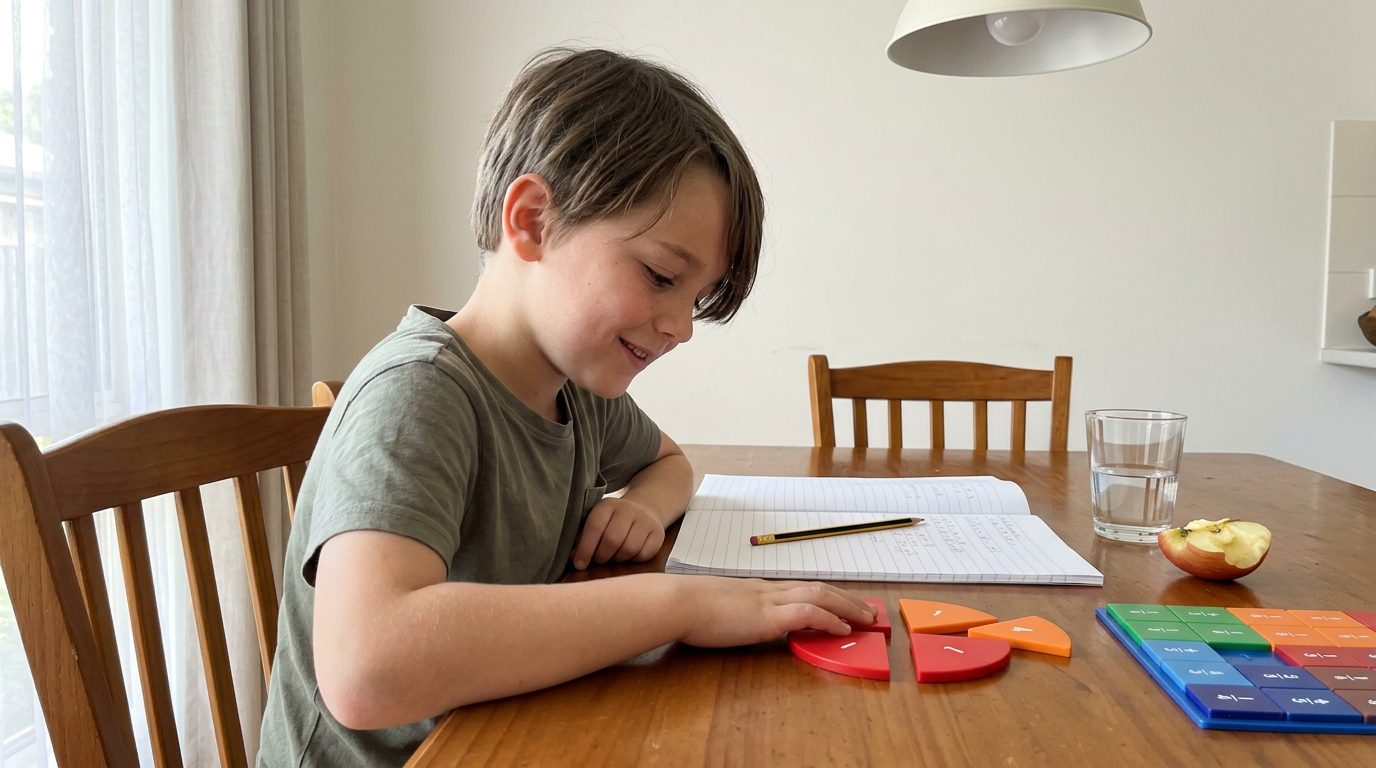
Fraction tiles
Color-coded plastic tiles that show the same length divided into halves, thirds, quarters, fifths, sixths, eighths, tenths, and twelfths. Fraction tiles are the fastest way to teach equivalence ("two quarters and one half are the same length"), comparison ("three eighths is smaller than one half"), and addition with unlike denominators. They're also the manipulative that prevents the most common 4th–5th grade error: assuming a bigger denominator means a bigger fraction. One look at the eighths beside the halves and the misconception evaporates.
Ten frames
A printed grid of ten boxes, two rows of five. Ten frames are the foundation of early number sense in Kindergarten–2nd grade. They teach subitizing (recognizing small quantities at a glance), number bonds to ten, and basic addition and subtraction. A student who fills a ten frame with seven counters and immediately knows "three more makes ten" is building the mental model that underpins every later mental-arithmetic strategy. Print free templates from a state department of education resource site, or buy laminated reusable cards for under US$7.
Hundred boards
A 10×10 grid of the numbers 1 to 100. Hundred boards teach counting, skip-counting, multiplication patterns, odd and even numbers, and number-sense relationships ("what's ten more than 47?"). Used alongside transparent counters, they're brilliant for showing the multiples of three or the prime numbers under 100. Most US elementary classrooms have one on the wall; a laminated student copy costs US$3 and gets used from Kindergarten right through to 4th grade.
Geoboards
A square pegboard with rubber bands. Geoboards teach 2D shapes, perimeter, area, symmetry, angles, and coordinate geometry. A student who can stretch a rubber band around four pegs and find the area inside is doing real geometry without a single formula. The 5×5 and 11×11 boards both have their place; US$7 each on US suppliers, plus a bag of rubber bands.
Dice and playing cards
The cheapest manipulative in this list and one of the best. A pair of six-sided dice teaches addition facts to twelve; a pair of ten-sided dice teaches two-digit place value and addition to 99. A deck of playing cards (with the picture cards removed) drives a hundred mental-arithmetic games — "Salute" for missing addends, "War" for comparing values, "Make Ten" for number bonds. Total cost: US$3. Used from Kindergarten right through to 6th grade fluency practice.
Counters and bead strings
Round plastic counters and threaded bead strings round out the early-years toolkit. Counters partner with ten frames, hundred boards, and addition mats; bead strings make subitizing and skip-counting kinaesthetic for kids who need to touch the count. A bag of 200 counters and a 100-bead string together cost under US$10 and earn their keep from Kindergarten through 2nd grade.
How do I use base-ten blocks effectively?
Base-ten blocks teach place value through a four-stage progression every elementary teacher and parent should know. Stage one: build a number. Say a number like 34, ask the student to lay out three longs and four units, then count it back. Stage two: trade. Show that ten units can be exchanged for one long, and one long can be broken into ten units — this is the core idea of regrouping. Stage three: add and subtract with regrouping. Build 27, add 16 by laying out one long and six units, watch what happens when seven units plus six units exceed ten ("we trade ten of them for a long"). Stage four: connect to the algorithm. Write the same calculation vertically and show how each column corresponds to units, longs, and flats.
The mistake most adults make is jumping straight to stage three or four. Spend a full lesson on stage one and another on stage two before you ever attempt regrouping with the blocks. The CRA sequence depends on the concrete being secure before the abstract is introduced — rushing the blocks just builds a shakier algorithm.
What are Cuisenaire rods used for?
Cuisenaire rods are used to teach number relationships through color and length, without naming the numbers themselves at first. A typical Kindergarten-level lesson asks "which two rods, laid end to end, are the same length as the yellow rod?" — the student discovers that white-and-purple, red-and-light green, or two whites and a light green all equal a yellow five-rod. That's number bonds to five, taught without a single numeral. Older elementary students use the same rods to model fractions (if orange is one whole, then white is one tenth and yellow is one half), to introduce ratios (light green to dark green is 3:6, which simplifies to 1:2), and to lay the groundwork for algebra (if red plus light green equals yellow, then yellow minus red equals light green).
The pedagogical advantage of Cuisenaire over base-ten blocks is that the rods aren't pre-named "ten" or "one" — students assign meaning, which forces them to think relationally rather than just count. For students who already know their number facts but don't see the structure underneath, Cuisenaire rods are the manipulative that opens up algebraic thinking earlier than most curricula expect.
What are the best digital math teaching aids in 2026?
Digital aids don't replace physical manipulatives — they extend them. Four are worth genuine teacher and parent time. Mathigon Polypad is a free, browser-based virtual manipulative library covering base-ten blocks, fraction bars, algebra tiles, number lines, balance beams, geoboards, and probability spinners; it's the closest digital equivalent of an elementary math tool drawer and works on any device. Desmos is a free graphing calculator and number-line tool that earns its place from upper elementary through senior secondary; the activities library has hundreds of free, classroom-ready lessons. Khan Academy Kids is free, ad-free, and covers Kindergarten–2nd grade numeracy through games and short videos. And Tutero is the AI teaching aid US teachers use to generate tailored practice worksheets, exit tickets, and small-group activities in seconds — instead of hand-typing a fluency sheet for 4th grade division, you describe the skill and Tutero produces the worksheet.
Used together, Mathigon for in-lesson modeling, Desmos for senior elementary graphing, Khan Academy Kids for early-years independent practice, and Tutero for differentiated worksheets covers the entire digital toolkit an elementary teacher needs. None of the four require credit-card upfront for the core features.
When should kids stop using physical math aids?
Physical math aids should be retired gradually, not removed all at once. The right time to step back is when a student can solve a problem mentally and then explain the strategy in their own words — at that point the manipulative has done its job and forcing it slows them down. For most students this happens around 3rd grade for addition and subtraction within 20, around 4th grade for multiplication facts up to 12×12, and around 5th grade for fraction equivalence. Place-value blocks earn an unusual extension: students often still benefit from them for decimal work in 5th–6th grade, even when they no longer need them for whole numbers.
The wrong reason to retire a manipulative is age. A 6th grade student who's still struggling with regrouping should still have access to the blocks. The CRA sequence isn't a race — it's a security check. Concrete first, representational second, abstract third, and the order is non-negotiable.
How do teaching aids help with math anxiety?
Math anxiety usually starts when a student can't picture what the symbols mean and the gap between "what the teacher just said" and "what I can do" widens silently for weeks. Teaching aids close that gap by giving the student something they can succeed at right now — building 23 with blocks, finding two thirds with fraction tiles, completing a ten frame. Each small visible win rebuilds the belief that math is figure-out-able rather than memorize-or-fail. Used in low-stakes ways at home (no marks, no stopwatch), manipulatives also separate "I can't do this math" from "I can't do this math quickly under pressure" — and the second is a much more solvable problem than the first.
For students who are already anxious, the best lesson sequence is invitation rather than instruction: lay the manipulative on the table, ask an open question ("can you show me what 24 looks like?"), and let the student lead. The aid replaces the worksheet's relentless red-pen feedback loop with something a student can adjust without anyone watching.
What's the difference between manipulatives and worksheets?
Worksheets test whether a concept has been understood; manipulatives are how the concept gets understood in the first place. A worksheet can ask "what is 27 + 16?" and a student might answer correctly through memorization without grasping the structure. A base-ten block activity makes the structure visible — ten units traded for one long is the entire idea of carrying, made physical. The worksheet still has a role: it builds fluency and exposes gaps. But it's the wrong tool for teaching a new concept, and it's the wrong tool for the student who already knows the concept and just needs to practice.
The pragmatic rule for elementary teachers and parents: introduce with the manipulative, build understanding with teacher-led questioning, then move to a representational drawing, then to the worksheet for fluency, then to mental math. Skip any of those four stages and you'll spend twice as long fixing the misconception later.
Where can I get personalized math support for my child or class?
The right teaching aid is only half the equation — a student also needs a knowledgeable adult asking the right question at the right time. For parents whose child needs more focused help than a kitchen-table session can give, Tutero's online elementary math tutoring pairs students with vetted US tutors who use the same CRA sequence and manipulatives described above, in 1:1 sessions that fit around school. For teachers, the Tutero AI teaching aid generates differentiated worksheets, exit tickets, warm-ups, and small-group activities aligned to the Common Core State Standards in seconds, freeing the time you'd otherwise spend on resource prep for the small-group manipulative work that actually moves the needle.
The right aid at the right stage is one of the highest-leverage moves in elementary math. The aid alone isn't magic; the aid plus a focused question is.
Related reading
- Math intervention strategies to help struggling students — when a student needs more than a manipulative can deliver in a regular lesson.
- Formative assessment strategies for the math classroom — the questioning techniques that make manipulatives work harder.
- Creating math exit tickets with AI — the digital companion to small-group manipulative lessons.
- Prepare a math worksheet in 30 seconds with AI — for the fluency stage that follows manipulative work.
- How to use AI to boost engagement in your math classroom — Tutero's full classroom playbook.
- The ultimate guide to AI in education — the wider context for digital teaching aids.
The bottom line
Eight physical manipulatives — base-ten blocks, Cuisenaire rods, fraction tiles, ten frames, hundred boards, geoboards, dice and cards, counters — plus four digital aids — Mathigon Polypad, Desmos, Khan Academy Kids, and Tutero — cover the entire elementary math curriculum from Kindergarten to 6th grade. The total physical kit costs under US$95 and lasts years. The digital tools are free or freemium for the features that matter. Use them at the concrete stage, ask focused questions, and let students explain the concept back before you move to the worksheet. That sequence — concrete, representational, abstract — is the difference between a class that gets math and a class that survives it.
The right aid at the right stage is one of the highest-leverage moves in elementary math.
The right aid at the right stage is one of the highest-leverage moves in elementary math.
Most kids don't struggle with math because they're not "good at math". They struggle because the concept stayed abstract. A "tens column" is invisible. A fraction is just a number on a worksheet. A right angle is a symbol on a page. Teaching aids give kids something to see, touch, and move — and the moment they can, the concept clicks.
This guide is for elementary teachers planning lessons and parents helping at home. We'll walk through the eight physical math manipulatives that genuinely earn their place in an elementary classroom or kitchen table, the four digital aids worth bookmarking in 2026, when to use which, and when to retire them. The research is clear: the right aid at the right stage is one of the highest-leverage moves in elementary math.
Quick answer: which math teaching aids should I actually buy?
For Kindergarten–2nd grade: ten frames, counters, base-ten blocks (MAB), and a hundred board. Under US$55 covers the lot.
For 3rd–6th grade: add Cuisenaire rods, fraction tiles, a geoboard, and two pairs of dice plus a deck of cards. Another US$40.
Digital aids worth bookmarking: Mathigon Polypad (free virtual manipulatives), Desmos (free graphing and number lines), Khan Academy Kids (free, Kindergarten–2nd grade), and an AI worksheet generator like Tutero for tailored practice. Together that's the entire toolkit an elementary teacher or parent needs from Kindergarten through 6th grade.
What are math teaching aids?
Math teaching aids — also called manipulatives — are physical or digital objects students touch and move to make abstract math concrete. They include base-ten blocks, Cuisenaire rods, fraction tiles, ten frames, geoboards, hundred boards, dice and cards on the physical side, plus virtual manipulatives like Mathigon Polypad and Desmos on the digital side. The point is to bridge the gap between a symbol on a page ("3 + 4", "½", "10s column") and what that symbol actually means.
Most aids cost between US$3 and US$20, last for years, and serve students from Kindergarten through 6th grade. They're standard equipment in US elementary classrooms and increasingly common in homes where parents are supporting math after school.
Why do math manipulatives actually work?
Manipulatives work because they let a student see a concept they can't yet picture in their head. Jerome Bruner's Concrete-Representational-Abstract (CRA) sequence — the foundation of Singapore Math and a core component of the Education Endowment Foundation's elementary math guidance — describes the progression every learner needs: handle the object, draw the picture, write the symbol. Skip the concrete stage and "10 + 23" is just a string of characters. Use a base-ten block first, and the same student sees one ten-rod and three units join with two ten-rods and three units, and the answer becomes obvious before the algorithm is even introduced.
John Hattie's meta-analyses place the use of manipulatives at an effect size of around 0.30 — a small-to-moderate positive effect on its own, but considerably larger when paired with explicit teacher questioning ("Why did you put that one there? Show me another way.") that pushes students from doing to explaining. The aid alone isn't magic; the aid plus a focused question is.
What are the best physical math manipulatives for kids?
Eight physical manipulatives cover the entire elementary math curriculum. None are expensive, all of them last, and most can be improvised at home if a parent doesn't want to buy a kit. Here's what each one teaches and when to reach for it.
Base-ten blocks (MAB)
The single most useful manipulative in elementary math. A standard set has unit cubes, "longs" (ten-rods of ten units), "flats" (hundreds), and a "thousands" cube. Base-ten blocks teach place value, addition, subtraction, multiplication, division, and decimals — every operation in elementary numeracy. A student who builds 247 with two flats, four longs, and seven units understands what "the 4 is in the tens column" actually means. Buy a class set or a small home pack of ten longs and a hundred units; expect to use it from 1st grade right through to 6th grade decimal work.
Cuisenaire rods
Ten colored rods of length 1 through 10. Cuisenaire rods — invented by Belgian teacher Georges Cuisenaire in the 1950s — teach number bonds, addition, subtraction, multiplication, fractions, ratios, and pre-algebra. The white rod is 1, the red is 2, the light green is 3, and so on up to the orange ten-rod. A student who can show "7 = 3 + 4" by laying a light green and a purple rod alongside a black seven-rod is one short step from "7 - 3 = 4". They're brilliant for visualizing fractions in upper elementary too: if the orange rod is "1", the white rod is one-tenth, and a half is the yellow rod. Roughly US$17 for a class set on US education suppliers.
Fraction tiles
Color-coded plastic tiles that show the same length divided into halves, thirds, quarters, fifths, sixths, eighths, tenths, and twelfths. Fraction tiles are the fastest way to teach equivalence ("two quarters and one half are the same length"), comparison ("three eighths is smaller than one half"), and addition with unlike denominators. They're also the manipulative that prevents the most common 4th–5th grade error: assuming a bigger denominator means a bigger fraction. One look at the eighths beside the halves and the misconception evaporates.
Ten frames
A printed grid of ten boxes, two rows of five. Ten frames are the foundation of early number sense in Kindergarten–2nd grade. They teach subitizing (recognizing small quantities at a glance), number bonds to ten, and basic addition and subtraction. A student who fills a ten frame with seven counters and immediately knows "three more makes ten" is building the mental model that underpins every later mental-arithmetic strategy. Print free templates from a state department of education resource site, or buy laminated reusable cards for under US$7.
Hundred boards
A 10×10 grid of the numbers 1 to 100. Hundred boards teach counting, skip-counting, multiplication patterns, odd and even numbers, and number-sense relationships ("what's ten more than 47?"). Used alongside transparent counters, they're brilliant for showing the multiples of three or the prime numbers under 100. Most US elementary classrooms have one on the wall; a laminated student copy costs US$3 and gets used from Kindergarten right through to 4th grade.
Geoboards
A square pegboard with rubber bands. Geoboards teach 2D shapes, perimeter, area, symmetry, angles, and coordinate geometry. A student who can stretch a rubber band around four pegs and find the area inside is doing real geometry without a single formula. The 5×5 and 11×11 boards both have their place; US$7 each on US suppliers, plus a bag of rubber bands.
Dice and playing cards
The cheapest manipulative in this list and one of the best. A pair of six-sided dice teaches addition facts to twelve; a pair of ten-sided dice teaches two-digit place value and addition to 99. A deck of playing cards (with the picture cards removed) drives a hundred mental-arithmetic games — "Salute" for missing addends, "War" for comparing values, "Make Ten" for number bonds. Total cost: US$3. Used from Kindergarten right through to 6th grade fluency practice.
Counters and bead strings
Round plastic counters and threaded bead strings round out the early-years toolkit. Counters partner with ten frames, hundred boards, and addition mats; bead strings make subitizing and skip-counting kinaesthetic for kids who need to touch the count. A bag of 200 counters and a 100-bead string together cost under US$10 and earn their keep from Kindergarten through 2nd grade.
How do I use base-ten blocks effectively?
Base-ten blocks teach place value through a four-stage progression every elementary teacher and parent should know. Stage one: build a number. Say a number like 34, ask the student to lay out three longs and four units, then count it back. Stage two: trade. Show that ten units can be exchanged for one long, and one long can be broken into ten units — this is the core idea of regrouping. Stage three: add and subtract with regrouping. Build 27, add 16 by laying out one long and six units, watch what happens when seven units plus six units exceed ten ("we trade ten of them for a long"). Stage four: connect to the algorithm. Write the same calculation vertically and show how each column corresponds to units, longs, and flats.
The mistake most adults make is jumping straight to stage three or four. Spend a full lesson on stage one and another on stage two before you ever attempt regrouping with the blocks. The CRA sequence depends on the concrete being secure before the abstract is introduced — rushing the blocks just builds a shakier algorithm.
What are Cuisenaire rods used for?
Cuisenaire rods are used to teach number relationships through color and length, without naming the numbers themselves at first. A typical Kindergarten-level lesson asks "which two rods, laid end to end, are the same length as the yellow rod?" — the student discovers that white-and-purple, red-and-light green, or two whites and a light green all equal a yellow five-rod. That's number bonds to five, taught without a single numeral. Older elementary students use the same rods to model fractions (if orange is one whole, then white is one tenth and yellow is one half), to introduce ratios (light green to dark green is 3:6, which simplifies to 1:2), and to lay the groundwork for algebra (if red plus light green equals yellow, then yellow minus red equals light green).
The pedagogical advantage of Cuisenaire over base-ten blocks is that the rods aren't pre-named "ten" or "one" — students assign meaning, which forces them to think relationally rather than just count. For students who already know their number facts but don't see the structure underneath, Cuisenaire rods are the manipulative that opens up algebraic thinking earlier than most curricula expect.
What are the best digital math teaching aids in 2026?
Digital aids don't replace physical manipulatives — they extend them. Four are worth genuine teacher and parent time. Mathigon Polypad is a free, browser-based virtual manipulative library covering base-ten blocks, fraction bars, algebra tiles, number lines, balance beams, geoboards, and probability spinners; it's the closest digital equivalent of an elementary math tool drawer and works on any device. Desmos is a free graphing calculator and number-line tool that earns its place from upper elementary through senior secondary; the activities library has hundreds of free, classroom-ready lessons. Khan Academy Kids is free, ad-free, and covers Kindergarten–2nd grade numeracy through games and short videos. And Tutero is the AI teaching aid US teachers use to generate tailored practice worksheets, exit tickets, and small-group activities in seconds — instead of hand-typing a fluency sheet for 4th grade division, you describe the skill and Tutero produces the worksheet.
Used together, Mathigon for in-lesson modeling, Desmos for senior elementary graphing, Khan Academy Kids for early-years independent practice, and Tutero for differentiated worksheets covers the entire digital toolkit an elementary teacher needs. None of the four require credit-card upfront for the core features.
When should kids stop using physical math aids?
Physical math aids should be retired gradually, not removed all at once. The right time to step back is when a student can solve a problem mentally and then explain the strategy in their own words — at that point the manipulative has done its job and forcing it slows them down. For most students this happens around 3rd grade for addition and subtraction within 20, around 4th grade for multiplication facts up to 12×12, and around 5th grade for fraction equivalence. Place-value blocks earn an unusual extension: students often still benefit from them for decimal work in 5th–6th grade, even when they no longer need them for whole numbers.
The wrong reason to retire a manipulative is age. A 6th grade student who's still struggling with regrouping should still have access to the blocks. The CRA sequence isn't a race — it's a security check. Concrete first, representational second, abstract third, and the order is non-negotiable.
How do teaching aids help with math anxiety?
Math anxiety usually starts when a student can't picture what the symbols mean and the gap between "what the teacher just said" and "what I can do" widens silently for weeks. Teaching aids close that gap by giving the student something they can succeed at right now — building 23 with blocks, finding two thirds with fraction tiles, completing a ten frame. Each small visible win rebuilds the belief that math is figure-out-able rather than memorize-or-fail. Used in low-stakes ways at home (no marks, no stopwatch), manipulatives also separate "I can't do this math" from "I can't do this math quickly under pressure" — and the second is a much more solvable problem than the first.
For students who are already anxious, the best lesson sequence is invitation rather than instruction: lay the manipulative on the table, ask an open question ("can you show me what 24 looks like?"), and let the student lead. The aid replaces the worksheet's relentless red-pen feedback loop with something a student can adjust without anyone watching.
What's the difference between manipulatives and worksheets?
Worksheets test whether a concept has been understood; manipulatives are how the concept gets understood in the first place. A worksheet can ask "what is 27 + 16?" and a student might answer correctly through memorization without grasping the structure. A base-ten block activity makes the structure visible — ten units traded for one long is the entire idea of carrying, made physical. The worksheet still has a role: it builds fluency and exposes gaps. But it's the wrong tool for teaching a new concept, and it's the wrong tool for the student who already knows the concept and just needs to practice.
The pragmatic rule for elementary teachers and parents: introduce with the manipulative, build understanding with teacher-led questioning, then move to a representational drawing, then to the worksheet for fluency, then to mental math. Skip any of those four stages and you'll spend twice as long fixing the misconception later.
Where can I get personalized math support for my child or class?
The right teaching aid is only half the equation — a student also needs a knowledgeable adult asking the right question at the right time. For parents whose child needs more focused help than a kitchen-table session can give, Tutero's online elementary math tutoring pairs students with vetted US tutors who use the same CRA sequence and manipulatives described above, in 1:1 sessions that fit around school. For teachers, the Tutero AI teaching aid generates differentiated worksheets, exit tickets, warm-ups, and small-group activities aligned to the Common Core State Standards in seconds, freeing the time you'd otherwise spend on resource prep for the small-group manipulative work that actually moves the needle.
The right aid at the right stage is one of the highest-leverage moves in elementary math. The aid alone isn't magic; the aid plus a focused question is.
Related reading
- Math intervention strategies to help struggling students — when a student needs more than a manipulative can deliver in a regular lesson.
- Formative assessment strategies for the math classroom — the questioning techniques that make manipulatives work harder.
- Creating math exit tickets with AI — the digital companion to small-group manipulative lessons.
- Prepare a math worksheet in 30 seconds with AI — for the fluency stage that follows manipulative work.
- How to use AI to boost engagement in your math classroom — Tutero's full classroom playbook.
- The ultimate guide to AI in education — the wider context for digital teaching aids.
The bottom line
Eight physical manipulatives — base-ten blocks, Cuisenaire rods, fraction tiles, ten frames, hundred boards, geoboards, dice and cards, counters — plus four digital aids — Mathigon Polypad, Desmos, Khan Academy Kids, and Tutero — cover the entire elementary math curriculum from Kindergarten to 6th grade. The total physical kit costs under US$95 and lasts years. The digital tools are free or freemium for the features that matter. Use them at the concrete stage, ask focused questions, and let students explain the concept back before you move to the worksheet. That sequence — concrete, representational, abstract — is the difference between a class that gets math and a class that survives it.
The right aid at the right stage is one of the highest-leverage moves in elementary math.
The right aid at the right stage is one of the highest-leverage moves in elementary math.

The right aid at the right stage is one of the highest-leverage moves in elementary math.
The aid alone isn't magic; the aid plus a focused question is.
Most kids don't struggle with math because they're not "good at math". They struggle because the concept stayed abstract. A "tens column" is invisible. A fraction is just a number on a worksheet. A right angle is a symbol on a page. Teaching aids give kids something to see, touch, and move — and the moment they can, the concept clicks.
This guide is for elementary teachers planning lessons and parents helping at home. We'll walk through the eight physical math manipulatives that genuinely earn their place in an elementary classroom or kitchen table, the four digital aids worth bookmarking in 2026, when to use which, and when to retire them. The research is clear: the right aid at the right stage is one of the highest-leverage moves in elementary math.
Quick answer: which math teaching aids should I actually buy?
For Kindergarten–2nd grade: ten frames, counters, base-ten blocks (MAB), and a hundred board. Under US$55 covers the lot.
For 3rd–6th grade: add Cuisenaire rods, fraction tiles, a geoboard, and two pairs of dice plus a deck of cards. Another US$40.
Digital aids worth bookmarking: Mathigon Polypad (free virtual manipulatives), Desmos (free graphing and number lines), Khan Academy Kids (free, Kindergarten–2nd grade), and an AI worksheet generator like Tutero for tailored practice. Together that's the entire toolkit an elementary teacher or parent needs from Kindergarten through 6th grade.
What are math teaching aids?
Math teaching aids — also called manipulatives — are physical or digital objects students touch and move to make abstract math concrete. They include base-ten blocks, Cuisenaire rods, fraction tiles, ten frames, geoboards, hundred boards, dice and cards on the physical side, plus virtual manipulatives like Mathigon Polypad and Desmos on the digital side. The point is to bridge the gap between a symbol on a page ("3 + 4", "½", "10s column") and what that symbol actually means.
Most aids cost between US$3 and US$20, last for years, and serve students from Kindergarten through 6th grade. They're standard equipment in US elementary classrooms and increasingly common in homes where parents are supporting math after school.
Why do math manipulatives actually work?
Manipulatives work because they let a student see a concept they can't yet picture in their head. Jerome Bruner's Concrete-Representational-Abstract (CRA) sequence — the foundation of Singapore Math and a core component of the Education Endowment Foundation's elementary math guidance — describes the progression every learner needs: handle the object, draw the picture, write the symbol. Skip the concrete stage and "10 + 23" is just a string of characters. Use a base-ten block first, and the same student sees one ten-rod and three units join with two ten-rods and three units, and the answer becomes obvious before the algorithm is even introduced.
John Hattie's meta-analyses place the use of manipulatives at an effect size of around 0.30 — a small-to-moderate positive effect on its own, but considerably larger when paired with explicit teacher questioning ("Why did you put that one there? Show me another way.") that pushes students from doing to explaining. The aid alone isn't magic; the aid plus a focused question is.
What are the best physical math manipulatives for kids?
Eight physical manipulatives cover the entire elementary math curriculum. None are expensive, all of them last, and most can be improvised at home if a parent doesn't want to buy a kit. Here's what each one teaches and when to reach for it.
Base-ten blocks (MAB)
The single most useful manipulative in elementary math. A standard set has unit cubes, "longs" (ten-rods of ten units), "flats" (hundreds), and a "thousands" cube. Base-ten blocks teach place value, addition, subtraction, multiplication, division, and decimals — every operation in elementary numeracy. A student who builds 247 with two flats, four longs, and seven units understands what "the 4 is in the tens column" actually means. Buy a class set or a small home pack of ten longs and a hundred units; expect to use it from 1st grade right through to 6th grade decimal work.
Cuisenaire rods
Ten colored rods of length 1 through 10. Cuisenaire rods — invented by Belgian teacher Georges Cuisenaire in the 1950s — teach number bonds, addition, subtraction, multiplication, fractions, ratios, and pre-algebra. The white rod is 1, the red is 2, the light green is 3, and so on up to the orange ten-rod. A student who can show "7 = 3 + 4" by laying a light green and a purple rod alongside a black seven-rod is one short step from "7 - 3 = 4". They're brilliant for visualizing fractions in upper elementary too: if the orange rod is "1", the white rod is one-tenth, and a half is the yellow rod. Roughly US$17 for a class set on US education suppliers.
Fraction tiles
Color-coded plastic tiles that show the same length divided into halves, thirds, quarters, fifths, sixths, eighths, tenths, and twelfths. Fraction tiles are the fastest way to teach equivalence ("two quarters and one half are the same length"), comparison ("three eighths is smaller than one half"), and addition with unlike denominators. They're also the manipulative that prevents the most common 4th–5th grade error: assuming a bigger denominator means a bigger fraction. One look at the eighths beside the halves and the misconception evaporates.
Ten frames
A printed grid of ten boxes, two rows of five. Ten frames are the foundation of early number sense in Kindergarten–2nd grade. They teach subitizing (recognizing small quantities at a glance), number bonds to ten, and basic addition and subtraction. A student who fills a ten frame with seven counters and immediately knows "three more makes ten" is building the mental model that underpins every later mental-arithmetic strategy. Print free templates from a state department of education resource site, or buy laminated reusable cards for under US$7.
Hundred boards
A 10×10 grid of the numbers 1 to 100. Hundred boards teach counting, skip-counting, multiplication patterns, odd and even numbers, and number-sense relationships ("what's ten more than 47?"). Used alongside transparent counters, they're brilliant for showing the multiples of three or the prime numbers under 100. Most US elementary classrooms have one on the wall; a laminated student copy costs US$3 and gets used from Kindergarten right through to 4th grade.
Geoboards
A square pegboard with rubber bands. Geoboards teach 2D shapes, perimeter, area, symmetry, angles, and coordinate geometry. A student who can stretch a rubber band around four pegs and find the area inside is doing real geometry without a single formula. The 5×5 and 11×11 boards both have their place; US$7 each on US suppliers, plus a bag of rubber bands.
Dice and playing cards
The cheapest manipulative in this list and one of the best. A pair of six-sided dice teaches addition facts to twelve; a pair of ten-sided dice teaches two-digit place value and addition to 99. A deck of playing cards (with the picture cards removed) drives a hundred mental-arithmetic games — "Salute" for missing addends, "War" for comparing values, "Make Ten" for number bonds. Total cost: US$3. Used from Kindergarten right through to 6th grade fluency practice.
Counters and bead strings
Round plastic counters and threaded bead strings round out the early-years toolkit. Counters partner with ten frames, hundred boards, and addition mats; bead strings make subitizing and skip-counting kinaesthetic for kids who need to touch the count. A bag of 200 counters and a 100-bead string together cost under US$10 and earn their keep from Kindergarten through 2nd grade.
How do I use base-ten blocks effectively?
Base-ten blocks teach place value through a four-stage progression every elementary teacher and parent should know. Stage one: build a number. Say a number like 34, ask the student to lay out three longs and four units, then count it back. Stage two: trade. Show that ten units can be exchanged for one long, and one long can be broken into ten units — this is the core idea of regrouping. Stage three: add and subtract with regrouping. Build 27, add 16 by laying out one long and six units, watch what happens when seven units plus six units exceed ten ("we trade ten of them for a long"). Stage four: connect to the algorithm. Write the same calculation vertically and show how each column corresponds to units, longs, and flats.
The mistake most adults make is jumping straight to stage three or four. Spend a full lesson on stage one and another on stage two before you ever attempt regrouping with the blocks. The CRA sequence depends on the concrete being secure before the abstract is introduced — rushing the blocks just builds a shakier algorithm.
What are Cuisenaire rods used for?
Cuisenaire rods are used to teach number relationships through color and length, without naming the numbers themselves at first. A typical Kindergarten-level lesson asks "which two rods, laid end to end, are the same length as the yellow rod?" — the student discovers that white-and-purple, red-and-light green, or two whites and a light green all equal a yellow five-rod. That's number bonds to five, taught without a single numeral. Older elementary students use the same rods to model fractions (if orange is one whole, then white is one tenth and yellow is one half), to introduce ratios (light green to dark green is 3:6, which simplifies to 1:2), and to lay the groundwork for algebra (if red plus light green equals yellow, then yellow minus red equals light green).
The pedagogical advantage of Cuisenaire over base-ten blocks is that the rods aren't pre-named "ten" or "one" — students assign meaning, which forces them to think relationally rather than just count. For students who already know their number facts but don't see the structure underneath, Cuisenaire rods are the manipulative that opens up algebraic thinking earlier than most curricula expect.
What are the best digital math teaching aids in 2026?
Digital aids don't replace physical manipulatives — they extend them. Four are worth genuine teacher and parent time. Mathigon Polypad is a free, browser-based virtual manipulative library covering base-ten blocks, fraction bars, algebra tiles, number lines, balance beams, geoboards, and probability spinners; it's the closest digital equivalent of an elementary math tool drawer and works on any device. Desmos is a free graphing calculator and number-line tool that earns its place from upper elementary through senior secondary; the activities library has hundreds of free, classroom-ready lessons. Khan Academy Kids is free, ad-free, and covers Kindergarten–2nd grade numeracy through games and short videos. And Tutero is the AI teaching aid US teachers use to generate tailored practice worksheets, exit tickets, and small-group activities in seconds — instead of hand-typing a fluency sheet for 4th grade division, you describe the skill and Tutero produces the worksheet.
Used together, Mathigon for in-lesson modeling, Desmos for senior elementary graphing, Khan Academy Kids for early-years independent practice, and Tutero for differentiated worksheets covers the entire digital toolkit an elementary teacher needs. None of the four require credit-card upfront for the core features.
When should kids stop using physical math aids?
Physical math aids should be retired gradually, not removed all at once. The right time to step back is when a student can solve a problem mentally and then explain the strategy in their own words — at that point the manipulative has done its job and forcing it slows them down. For most students this happens around 3rd grade for addition and subtraction within 20, around 4th grade for multiplication facts up to 12×12, and around 5th grade for fraction equivalence. Place-value blocks earn an unusual extension: students often still benefit from them for decimal work in 5th–6th grade, even when they no longer need them for whole numbers.
The wrong reason to retire a manipulative is age. A 6th grade student who's still struggling with regrouping should still have access to the blocks. The CRA sequence isn't a race — it's a security check. Concrete first, representational second, abstract third, and the order is non-negotiable.
How do teaching aids help with math anxiety?
Math anxiety usually starts when a student can't picture what the symbols mean and the gap between "what the teacher just said" and "what I can do" widens silently for weeks. Teaching aids close that gap by giving the student something they can succeed at right now — building 23 with blocks, finding two thirds with fraction tiles, completing a ten frame. Each small visible win rebuilds the belief that math is figure-out-able rather than memorize-or-fail. Used in low-stakes ways at home (no marks, no stopwatch), manipulatives also separate "I can't do this math" from "I can't do this math quickly under pressure" — and the second is a much more solvable problem than the first.
For students who are already anxious, the best lesson sequence is invitation rather than instruction: lay the manipulative on the table, ask an open question ("can you show me what 24 looks like?"), and let the student lead. The aid replaces the worksheet's relentless red-pen feedback loop with something a student can adjust without anyone watching.
What's the difference between manipulatives and worksheets?
Worksheets test whether a concept has been understood; manipulatives are how the concept gets understood in the first place. A worksheet can ask "what is 27 + 16?" and a student might answer correctly through memorization without grasping the structure. A base-ten block activity makes the structure visible — ten units traded for one long is the entire idea of carrying, made physical. The worksheet still has a role: it builds fluency and exposes gaps. But it's the wrong tool for teaching a new concept, and it's the wrong tool for the student who already knows the concept and just needs to practice.
The pragmatic rule for elementary teachers and parents: introduce with the manipulative, build understanding with teacher-led questioning, then move to a representational drawing, then to the worksheet for fluency, then to mental math. Skip any of those four stages and you'll spend twice as long fixing the misconception later.
Where can I get personalized math support for my child or class?
The right teaching aid is only half the equation — a student also needs a knowledgeable adult asking the right question at the right time. For parents whose child needs more focused help than a kitchen-table session can give, Tutero's online elementary math tutoring pairs students with vetted US tutors who use the same CRA sequence and manipulatives described above, in 1:1 sessions that fit around school. For teachers, the Tutero AI teaching aid generates differentiated worksheets, exit tickets, warm-ups, and small-group activities aligned to the Common Core State Standards in seconds, freeing the time you'd otherwise spend on resource prep for the small-group manipulative work that actually moves the needle.
The right aid at the right stage is one of the highest-leverage moves in elementary math. The aid alone isn't magic; the aid plus a focused question is.
Related reading
- Math intervention strategies to help struggling students — when a student needs more than a manipulative can deliver in a regular lesson.
- Formative assessment strategies for the math classroom — the questioning techniques that make manipulatives work harder.
- Creating math exit tickets with AI — the digital companion to small-group manipulative lessons.
- Prepare a math worksheet in 30 seconds with AI — for the fluency stage that follows manipulative work.
- How to use AI to boost engagement in your math classroom — Tutero's full classroom playbook.
- The ultimate guide to AI in education — the wider context for digital teaching aids.
The bottom line
Eight physical manipulatives — base-ten blocks, Cuisenaire rods, fraction tiles, ten frames, hundred boards, geoboards, dice and cards, counters — plus four digital aids — Mathigon Polypad, Desmos, Khan Academy Kids, and Tutero — cover the entire elementary math curriculum from Kindergarten to 6th grade. The total physical kit costs under US$95 and lasts years. The digital tools are free or freemium for the features that matter. Use them at the concrete stage, ask focused questions, and let students explain the concept back before you move to the worksheet. That sequence — concrete, representational, abstract — is the difference between a class that gets math and a class that survives it.
The right aid at the right stage is one of the highest-leverage moves in elementary math.
The aid alone isn't magic; the aid plus a focused question is.
.svg)
.svg)
The eight physical manipulatives every elementary teacher and parent should have are base-ten blocks, Cuisenaire rods, fraction tiles, ten frames, hundred boards, geoboards, dice and cards, and counters with bead strings. The four digital aids worth bookmarking in 2026 are Mathigon Polypad, Desmos, Khan Academy Kids, and Tutero. Together that's the entire toolkit an elementary teacher or parent needs from Kindergarten through 6th grade, for under US$95 in physical equipment.
Use the four-stage CRA progression. First, build numbers with longs and units. Second, practice trading ten units for one long and one long for ten units. Third, add and subtract with regrouping using the blocks. Fourth, write the calculation vertically and connect each column back to the blocks. Spend a full session on each stage; don't rush ahead. The blocks earn their keep when the student can explain why a trade works, not just do it.
For most students the two work best together, not as substitutes. Physical manipulatives are stronger for first introductions because the kinaesthetic experience of moving a block builds a memory the brain can retrieve later. Digital aids like Mathigon Polypad shine for whole-class modeling on a screen, for older elementary topics like fractions and graphing, and for independent practice between lessons. The honest answer: physical first, digital second, both better than worksheets alone.
When they can solve the problem mentally and explain the strategy in their own words, the manipulative has done its job. For most children that's around 3rd grade for addition and subtraction within 20, around 4th grade for multiplication facts, and around 5th grade for fraction equivalence. Place-value blocks often stay useful into 5th–6th grade for decimals. Don't retire a manipulative because of age — retire it because the concept is secure.
Yes, especially when used at home in low-stakes ways. Math anxiety builds when symbols don't connect to meaning and small failures stack up silently. A manipulative gives a child something they can succeed at immediately — building 23 with blocks, completing a ten frame, comparing fractions tiles. Each visible win rebuilds the belief that math is figure-out-able rather than memorize-or-fail. Combine the manipulative with open invitations ('show me what 24 looks like') instead of timed drills.
<a href="https://www.tutero.com/us/online-tutoring">Tutero's online elementary tutoring</a> pairs US elementary students with vetted tutors who use the Concrete-Representational-Abstract sequence — the same approach Singapore Math and the Education Endowment Foundation recommend. Sessions are 1:1, online, and tutors bring their own physical or virtual manipulatives. For teachers, <a href="https://www.tutero.ai">Tutero's AI teaching aid</a> generates differentiated worksheets, exit tickets and small-group activities so you can spend lesson time on the manipulative work that moves the needle.
Hoping to improve confidence & grades?

.png)